South Africa’s vehicle crime landscape shifts – here’s what the data reveals
Business vehicles remain more vulnerable to hijackings than personal cars, though the gap has narrowed over the past year.

Vehicle crime remains a concern in South Africa, but the proportion of Tracker customers affected by vehicle theft and hijacking has declined significantly over the past 30 years.
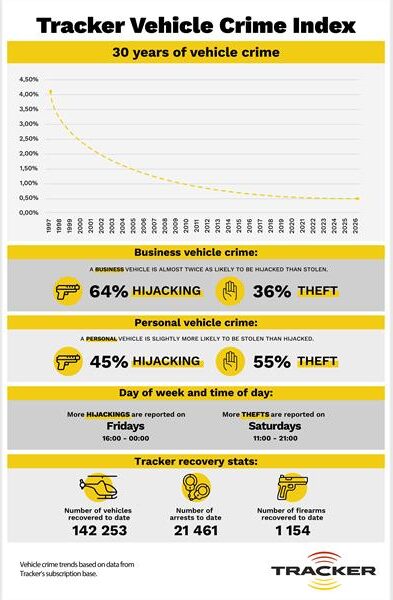
According to Tracker, its historical vehicle crime data shows that the proportion of customers affected by vehicle theft and hijacking dropped from about 4% in the late 1990s to 0.5% in recent years.
The figures come as the vehicle tracking and recovery company celebrates 30 years in the industry, reflecting significant changes in vehicle security technology, crime prevention and recovery strategies.
Several industry developments contributed to the decline, including the introduction of free vehicle tracker fitment in the late 1990s, which removed the initial cost barrier for motorists.
In the early 2000s, the expansion of stolen vehicle recovery networks also encouraged insurers to offer premium discounts to motorists whose vehicles were fitted with tracking systems.
Further developments followed with the introduction of connected vehicles and the increased use of telematics data in the mid-to-late 2000s. By the early 2010s, this information was being used to provide driver behaviour insights, usage-based insurance models and safety incentive programmes.
During the 2020s, vehicle connectivity and data increasingly became part of fleet management and additional telematics services.
Evolution of tracking technology
Tracker chief operating officer Duma Ngcobo said the company had played an active role in the development of South Africa’s vehicle tracking and recovery industry.
Established in response to the country’s rising vehicle crime crisis after apartheid, Tracker had expanded its role beyond recovering stolen vehicles to providing data-driven insights to motorists, businesses, insurers and fleet operators.
Business vehicles face higher hijacking risk
The company’s latest vehicle crime statistics, covering January to June 2026, show that business-owned vehicles remain more vulnerable to vehicle crime than privately owned vehicles.
Business vehicles are 17% more likely to be targeted than personal vehicles, although this represents a decrease from the 48% recorded a year ago.
Nationally, business vehicle crime is heavily skewed towards hijacking, with business vehicles almost twice as likely to be hijacked as stolen.
The trend is particularly pronounced in some provinces. In the Eastern Cape, business hijackings are almost five times more prevalent than thefts, while in Mpumalanga they are more than eight times as prevalent.
In contrast, theft accounts for a larger share of crime involving privately owned vehicles, representing 55% of incidents compared to 45% for hijackings.
Gauteng and KwaZulu-Natal largely influence this national trend, together accounting for 80% of all vehicle crime incidents.
However, Tracker’s figures also highlight regional differences. In the Eastern Cape, consumer hijackings are twice as prevalent as thefts, while hijackings exceed thefts by 42% in the Western Cape. Mpumalanga also recorded more hijackings than thefts involving personal vehicles.
Nationally, theft and hijacking incidents are now evenly split. This marks a shift from recent years, when hijackings became the dominant form of vehicle crime as vehicle use and mobility returned to normal after the Covid-19 lockdown period.
High-risk days and times
The statistics further reveal distinct patterns in when vehicle crimes occur.
Vehicle theft is most common on Saturdays between 11:00 and 21:00, with Fridays between 16:00 and 21:00 also identified as a high-risk period.
Hijackings peak on Fridays between 16:00 and 00:00.
Business hijackings follow a slightly different pattern, occurring most frequently on weekday afternoons and evenings between 16:00 and 21:00.
Focus on prevention and recovery
Ngcobo said the changing nature of vehicle crime highlighted the importance of motorists and businesses adapting their prevention strategies.
He added that vehicle crime could have consequences beyond the loss of a vehicle, particularly for businesses, where downtime, service disruptions and lost revenue could have a significant financial impact.
He emphasised the importance of prevention, driver safety and rapid vehicle recovery in maintaining business continuity.
As it looks towards the future, Tracker said it remained committed to using technology, data and innovation to protect people, vehicles and businesses across South Africa.
To date, the company has recovered 142 253 vehicles, assisted in 21 461 arrests and helped recover 1 154 firearms. It also reported an industry recovery rate of 96% for the last financial year.