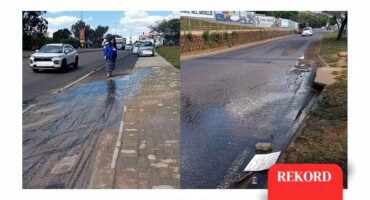
Metro accused of wasting water
With water restrictions and warnings of drought-like conditions, the Tshwane metro is being accused of not fixing water leaks in the city speedily enough.
While residents are urged to use water sparingly, Tshwane metro is being accused of dragging its feet with water leaks in the city.
Most of Gauteng’s water is supplied by the Vaal and Crocodile West river systems with the average dam levels currently at 84%.
The situation in Tshwane and the rest of the province, according to Rand Water and to the ministry of water affairs, currently posed a manageable short-term water security risk.
“No hydrological drought is experienced currently. A number of projects are however underway to address service delivery problems,” Water and Sanitation Minister Nomvula Mokonyane said at a weekend media briefing.
Tshwane introduced water restrictions in most towns due to the heat wave in October and as a result of weather conditions which could bring a drought.
However, the civil rights organisation AfriForum this week accused Tshwane metro of wasting water by not speedily fixing the myriad of water leaks across Pretoria and other towns in the metro.
“We are concerned about our members and this critical natural resource. There is currently an El Nino condition in South Africa and water restrictions were introduced in the capital city,” said Tarien Cooks, AfriForum coordinator for Gauteng North.
Cooks said the metro was not doing its job in saving water.
“According to the city’s water services regulations, water leaks must be fixed within 48 hours,” she said, adding the regulations were not being adhered to and therefore Tshwane was wasting thousands of litres of water daily.
“This while residents are being threatened with heavy fines if they ignored water restrictions.”
Cooks said AfriForum received daily complaints about water leaks and non-functional water meters, and although the majority of leaks were reported to the metro, in most cases it took up to ten days to repair a leak.
The organisation has now called on residents to contact Afriorum with details of water leaks on pretoria@afriforum.co.za to enable them to get a more complete picture of leaks.
The community was requested to send details of leaks, their names, a Tshwane reference number and the date on which the leak had been reported to the metro.
Meanwhile, Rand Water said it might be forced to introduce water restrictions in future, if there was no rainfall soon.
This despite the water utility saying it currently had enough water supplies for Gauteng residents.
Rand Water CEO Percy Sechemane, said the situation could get worse if people did not use water sparingly.
“But on the other side, we are saying the end users are actually key in terms of how they use water at this stage because from our side as Rand Water, we are still operating within our parameters, it’s just that the demand is actually much more than is usually is on a yearly basis,” he said at a media briefing.
The Free State and KwaZulu-Natal have already been declared disaster areas due to drought.
Mokonyane called on citizens to use water sparingly and responsibly because climate change has exacerbated the drought situation in the country.
Briefing media on Sunday, the minister called on local government and those responsible for managing water to lead communities in using water wisely.
She explained that 98% of the water in the country had already been supplied and it had to be re-used. South Africa had to draw some of the water from Lesotho.
“The drought currently affects 173 of the 1 628 water supply schemes nationally, serving approximately 2.7 million households or 18% of the national population,” she said.
Mokonyane said to address and mitigate the potential impact of drought there were immediate, medium and long-term measures being put in place.
“The department has committed R352.6 million to initial drought intervention projects and a further R96.620 million to interim tinkering and additional interventions,” said Mokonyane.
“Key interventions to be implemented in mitigation of potential drought impacts include water conservation and water demand management programmes, Phase 2 of Lesotho Highlands Water Project, the eradication of unlawful water use in the irrigation sector, desalination of mine water and reuse of return flows,” said the minister.
“Despite below average rainfall, the domestic water supply systems are still in good state. Main impacts are on irrigated agriculture, forestry and associated industries,” she said.
Also read:
Water flows freely as water crisis looms
Hottest year to date fast approaching
Tips on how to use water efficiently
Do you have more information about the story? Please send us an email to editorial@rekord.co.za or phone us on 072 435 7717.
For free breaking and community news, visit Rekord’s websites:
For more news and interesting articles, like Rekord on Facebook, follow us on Twitter or Instagram.
- We have exciting news! We’re offering a free alert to help you always be in the loop. Send an email with the word ‘Subscribe’ to breakingnews@rekord.co.za to receive your free daily breaking news update.