Tshwane metro disconnects 3 000 clients within two weeks
"We have deployed more than 100 teams across Tshwane to disconnect arrears debtors, with our focus on individual accounts of R50 000 or more."
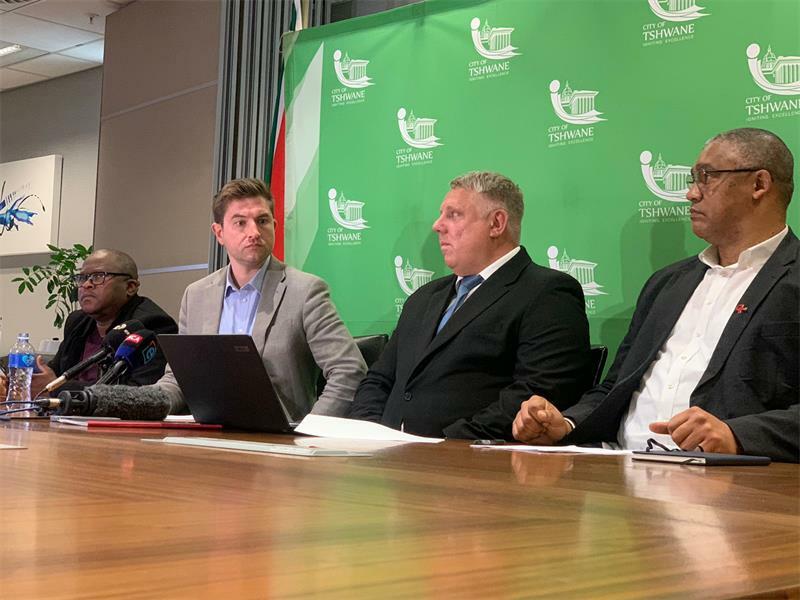
The Tshwane metro has disconnected 3 000 clients within a mere 14 days as it tries to collect more than R3-billion it is owed.
It was part of the metro’s campaign Tshwane Ya Tima campaign.
“We have resolved to implement an aggressive revenue collection drive to arrest declining revenue. From the middle of June, we have deployed more than 100 teams across Tshwane to disconnect arrears debtors, with our focus on individual accounts of R50 000 or more, which are the highest levels of debt.
“We will ensure that anyone who owes money is disconnected.”
Despite this, Tshwane mayor Cilliers Brink told the media on Tuesday that the metro’s finances were still in a critical state.
Its finances were, however, still “recoverable”.
Brink said that systems and controls will also need to be improved to address the metro’s financial problems.
He said the metro wanted to resolve its debt by tackling its revenue chain systems.
“If we do not rebuild this revenue value chain, there will be no City of Tshwane.
“We need to ensure that whatever is consumed at Tshwane’s bulk expense needs to be metered, billed. If no bills are paid, credit action needs to be applied.”
He said stricter enforcement on those using metro services would help fix the current inadequate revenue streamline.
“We have identified complete collapse and institutional resistance to fix systems that are broken.”
Brink said there were automated revenue systems that were sabotaged in the past few months.
“Systems were disconnected and cited as IT problems, which is a red flag. Although there is no evidence of fraud or corruption, this is still a red flag of an automated system for billing checks and balances being disconnected for IT issues.”
He said despite these red flags, Tshwane’s financial recovery would not happen without enhancing revenue streams.
He added that a significant number of properties did not have meters.
“We cannot obtain access [to meters], or the boxes are locked. We have resorted to using internal Tshwane teams to deal with these problematic properties.”
He said quality checks on disconnections to root out corruption or bribery were conducted.
“Any contractor found to have accepted a bribe to stop a disconnection or to facilitate an illegal reconnection will have criminal charges laid against them and be removed as a service provider of the City.”
Brink said Tshwane was also recently able to settle its short-term overdrafts for the previous financial year.
He said the settlement was part of dealing with many findings flagged by the Auditor-General (AG) for the July 2021 to June 2022 financial year.
“If we do not deal with core findings of the AG, in particular trade payables and cash flow, we will face another adverse finding.”
He said the Tshwane would further not face a positive outcome for the recently concluded financial year ending June 30.
Brink was, however, hopeful that in the next cycle, a different outcome would emerge.
He said Tshwane had sanctioned an executive tracking committee that would investigate commitments made to the AG on actions of material irregularities such as the fuel tender flagged.
He said the officials would work to address the asset valuation, issues concerning the management of creditors, and the overall cash flow.
“These three items are the crux of the adverse audit opinion, and we hope to make significant progress, particularly regarding the management of creditors and cash flow. However, the issues on the asset valuation will take a bit longer, but we are making progress in refining the methodology that will be used to address this in the future.”
Brink said from the 118 findings that affected the audit report, Tshwane had ensured that 97% of
these were addressed.
He said the council was further investigating the R10-billion of the R19-billion on fruitless, unauthorised, irregular and wasteful expenditure.
Tshwane Finance MMC Peter Sutton explained that the R10-billion had not been missing; instead, processes were not followed, and a recovery plan has since been implemented.
The adverse audit opinion meant that Tshwane submitted financial statements were unreliable and could not be used for oversight and decision-making.
The AG found that the metro misrepresented its financial statements, as they did not accurately reflect its financial performance and health.
The AG cited the loss comprised of R769-million, lost in distribution between the source of generation and the consumer, and R1-billion lost to administrative and technical errors such as negligence, theft, tampering with meters, illegal connections and faulty meters.
The AG cited that water worth R866-million was lost in the distribution network and R216-million to meter inaccuracies, consumption estimations, non-metering of water and unauthorised consumption.
Car thieves, hijackers target particular car models in Sinoville
Do you have more information about the story?
Please send us an email to editorial@rekord.co.za or phone us on 083 625 4114.
For free breaking and community news, visit Rekord’s websites: Rekord East
For more news and interesting articles, like Rekord on Facebook, follow us on Twitter or Instagram