Tshwane denies closing references prematurely
Frustrated residents and councillors say complaints vanish from the system, despite unresolved faults.
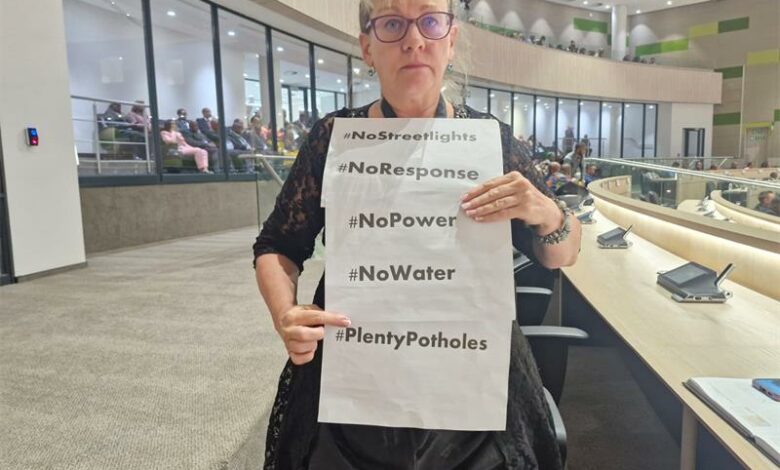
Frustrated Tshwane residents and councillors have raised concerns over service delivery complaints being closed without any actual work being carried out.
However, the metro has denied closing off references prematurely.
East resident Mientjie Wooldridge believes the newly launched Tshwane WhatsApp channels could improve communication, but says they don’t solve a deeper issue.
“When there’s a power or water outage, they give a reference number if you can get through, and then after a few days, they say it’s fixed.”
“However, it’s not true,” she said.
Ward 83 councillor Siobhan Muller said she’s received dozens of complaints about logged calls being closed before work is done.
“They say the system closes them automatically. That’s rubbish. Some of them are closed in under 24 hours,” said Muller.
She explained that the issue has been escalated to high-level officials in the metro.
Muller said she has been asked to send the cases to a specific official who is now tracking them.
“I ask residents to send me the old and new reference numbers so I can prove they were closed without resolution,” she said.
According to Muller, this premature closure problem is especially prevalent in the Region 3 electricity department.
She added that this isn’t a system error, but someone at the depot is closing the tickets manually.
“Phoning in is useless. The app-based logging works best, but even then, jobs are marked done when they’re not.”
Ward 83 councillor Andrew Lesch agreed, saying that although Tshwane denies it, unresolved calls are being closed across various departments.
“Just this morning, a streetlight complaint was closed without any work done,” he said.
Lesch believes the system needs urgent upgrading.
He explained that it must be able to identify and merge duplicate complaints instead of closing them haphazardly.
“It’s not about 48 hours, but it’s about poor oversight.”
Lesch said he has flagged the issue several times during regional forums and called for regular spot checks on so-called “completed” work.
Ward 56 councillor Shaun Wilkinson said the same problem occurs frequently in his ward.
“Jobs are marked as completed, but no one has been to the site. I’ve verified several such cases myself, mostly with electricity faults,” he said.
Wilkinson suspects internal pressure to meet performance indicators may be driving premature closures.
“Managers close jobs to boost KPIs [Key Performance Indicators]. Then only after escalation does a team actually show up, sometimes three days later.”
He said this has created a massive credibility gap between field operations and the city’s back-end reporting systems.
According to Wilkinson, it looks good on paper with a technician assigned and work done.
“However, on the ground, nothing happens.”
Metro spokesperson Lindela Mashigo has denied the allegations, stating clearly that reference numbers are not closed before work is done.
He explained that a “does not exist” error may appear when residents track a request if the number was entered incorrectly.
“Possibly due to a typographical error,” said Mashigo.
“There is no system that automatically marks requests as ‘completed’ after 48 hours.”
According to Mashigo, reference numbers remain open until the relevant department, either the finance back office or the service delivery departments, attends to it.
“All reference numbers are closed once the work is completed.”
He said if a request was prematurely closed, residents are urged to follow up with the relevant department.
Mashigo added that there is no official policy for the automatic closure of requests after 48 hours.
“All reference numbers should remain active until the work is confirmed as completed by the responsible departments.”
He clarified that service delivery departments may choose to close duplicate requests if several reference numbers are generated for the same issue.
“For example, when a water interruption is reported for a large area and multiple residents log complaints, individual references may be closed while one remains open.”
He added that issues which may have disappeared from the system can still be followed up.
Mashigo encouraged residents to contact the metro by calling the call centre, sending an email, engaging via their official social media platforms (Facebook, X) or visiting a customer care walk-in centre with their original reference number or details.
While the metro maintains there’s no policy to close requests automatically, Mashigo said any evidence of such practice will be reviewed and corrected.
“Feedback from residents is vital. If something is going wrong at the depot level, we want to know,” he said.
He confirmed that the metro’s customer relationship management and power failure reporting systems maintain a complete audit log.
Mashigo also addressed the recent launch of WhatsApp Channels by Tshwane.
He said Tshwane’s new WhatsApp channels are for broadcast only.
“Residents cannot log faults via WhatsApp or receive reference numbers.”
He said their purpose is:
– To provide timely and relevant service delivery updates (eg, power/water outages, sewer spills);
– To announce other service alerts, including roadworks, grass cutting, and waste collection;
– To share educational content on service delivery;
– To ensure transparency and accountability by keeping councillors and residents informed; and
– To act as a one-way engagement tool and official source of truth.
“WhatsApp Channels serve as a one-way communication platform. Residents cannot report faults or receive reference numbers,” said Mashigo.
“The purpose is to replace informal communications with one central, authoritative communication channel.”
Do you have more information about the story?
Please send us an email to bennittb@rekord.co.za or phone us on 083 625 4114.
For free breaking and community news, visit Rekord’s websites: Rekord East
For more news and interesting articles, like Rekord on Facebook, follow us on Twitter or Instagram or TikTok.