Report exposes metro’s waste management collapse
While the metro defends its new city cleansing levy as a constitutional duty, its own council report paints a picture of failing waste services, crumbling infrastructure, and an overwhelmed system.
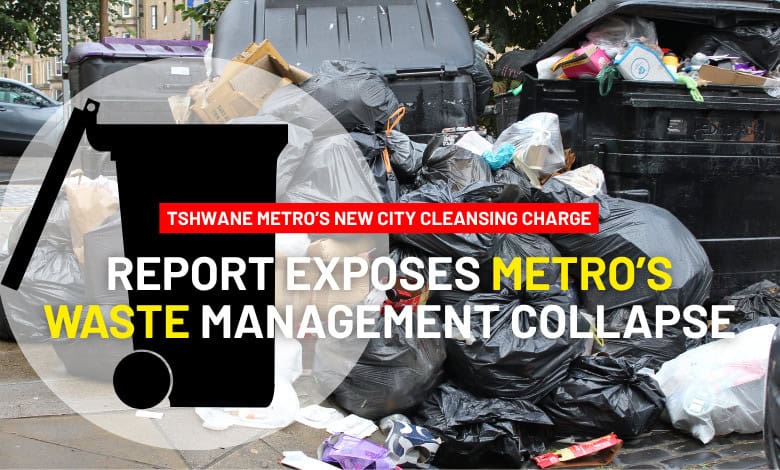
The Tshwane metro’s new city cleansing charge, implemented on July 1, has become a lightning rod for criticism from AfriForum.
While metro officials defend the tariff as both necessary and legally mandated, a recent report tabled before Council in June paints a damning picture of the metro’s current ability to provide effective waste management services.
The council report, prepared by the metro’s Department of Environmental and Agricultural Management, outlines severe operational and structural challenges that are crippling the city’s waste management system.
According to the report, the metro’s solid waste division is plagued by inappropriate structural arrangements, governance weaknesses, low cash revenues, and insufficient investment.
The report also finds that the split in responsibility between trading services, corporate services, and finance has resulted in poor financial transparency and weak management accountability, and has caused long-term underperformance.
Two of the findings of the report state that:
– The primary aim of a municipal trading service is to provide sustainable access to essential services such as waste removal.
– Sustainability… depends on generating sufficient revenue through tariffs, improving service management, containing costs, and maintaining and investing in infrastructure.
According to the report, Tshwane’s waste management unit is failing on nearly all these fronts.
It further stated that the infrastructure is in a state of decline, with budget constraints hampering maintenance and capital investment, and that this has contributed to the quality and reliability of services falling.
The report also warns of a growing trend of illegal dumping across the city, especially in informal areas where waste infrastructure is lacking.
Other items from the report include:
– Some communities have now started burning their refuse, which releases toxins into the air.
– Poor waste management worsens flooding in some areas, as rubbish blocks stormwater drains, making local climate change worse.
– Environmental setbacks undermine the city’s constitutional obligation to provide a safe and clean environment.
Despite these findings, MMC for Environment and Agriculture Obakeng Ramabodu maintains that the new cleansing charge is necessary and legally sound.
According to him, municipalities in South Africa have a constitutional duty to deliver public services such as refuse removal and street cleaning.
The metro’s cleansing charge, he explained, reflects the costs associated with all waste-related services, including the collection, transport, and disposal of litter from public areas.
He confirmed that the tariff was approved by the Council and is intended to ensure that all residents benefit from a cleaner city.
“We take note of the dissatisfaction expressed by some civil organisations, who have gone to court to challenge the charge.
“However, the city is committed to continuing its mandate and to ensuring that our systems are correctly configured to apply the tariff as intended,” Ramabodu said.
He acknowledged that the rollout of the new charge may lead to billing mistakes on some residents’ accounts, and said a team has been set up to respond to all related queries.
Residents can lodge complaints via the city’s call centre or through a dedicated set of email contacts.
In complexes and estates, the metro advises that body corporates consolidate and submit queries on behalf of residents.
However, AfriForum is unconvinced by the metro’s assurances, with Arno Roodt, the organisation’s co-ordinator for Greater Pretoria South, saying the tariff is nothing more than a stopgap measure.
“The so-called city cleansing levy is not, as required by law, based on actual usage.
“This levy is a fundraising project aimed at covering up poor planning and financial mismanagement. It’s completely arbitrary and unfair,” he said.
According to Roodt, the metro intends to collect roughly R58-million per month from about 260 000 households and businesses across the metro. Yet, the same council report suggests that the metro is not yet capable of handling waste at this scale.
Roodt said that in 2019, the metro had only 136 functional garbage collection trucks, while an estimated 464 trucks were needed, and that infrastructure shortages include garbage bins, weighbridges, and the management of landfill sites.
“The metro’s own court submissions have labelled residents using private services as ‘freeloaders’, yet the report estimates a revenue loss of R148-million over the last five years from its own landfills due to poor operational oversight and broken systems,” Roodt added.
Roodt said the metro has acknowledged the existence of more than 670 illegal dumping sites, and that this costs the city about R30-million annually.
He added that the report recommends urgent interventions, such as repairing landfill infrastructure and boosting security at waste facilities, but these actions are overdue and remain largely unimplemented.
Roodt’s concerns are echoed by Deidré Steffens, AfriForum’s advisor on Local Government Affairs, who says the levy amounts to double taxation.
She said residents and businesses already pay for private refuse removal and property rates, yet they are now being forced to pay for a service they do not use.
Steffens alleges that the new charge violates Section 74(2) of the Municipal Systems Act, which requires tariffs to reflect usage and be applied fairly.
The North Gauteng High Court has yet to make a ruling in AfriForum’s legal challenge against the charge.
Do you have more information about the story?
Please send us an email to bennittb@rekord.co.za or phone us on 083 625 4114.
For free breaking and community news, visit Rekord’s websites: Rekord East
For more news and interesting articles, like Rekord on Facebook, follow us on Twitter or Instagram or TikTok.