No tangible progress on Olievenhoutbosch Police Station angers residents
Serving up to 350 000 residents across 75 square kilometres, the Olievenhoutbosch police station is battling severe infrastructure shortages, safety concerns, and overcrowding. Oversight committees and investigating authorities have come and gone and still there is no progress, complain the residents.
For more than a decade and a half, Willem Needham (61) has watched Olievenhoutbosch grow rapidly while its police infrastructure has stood largely still.
A resident of Mnandi Agricultural Holdings and a member of the Community Policing Forum’s Sector 1 structures, Needham said the gap between population size and policing capacity is now impossible to ignore.
From inadequate facilities to safety risks inside the station itself, he believed urgent intervention was needed to protect residents.
Authorities have come and gone, promises have been made, but there was just no momentum or political will to move projects forward, Needham said.
The Olievenhoutbosch SAPS began as a satellite station of the SAPS’s Wierda Brug station, operating from the premises of what was then the community centre owned by the metro.
Around 2010 or 2011, it was officially declared a fully-fledged police station.
However, since its inception as a satellite station, no permanent expansion of the buildings on the premises has taken place.
Instead, several mobile or temporary offices have been added over time.
Today, the station serves an expansive geographical area of roughly 75 square kilometres. Its boundaries stretch from the R511 in the west to the Shoprite warehouses in Midstream in the east, to the R562 in the south, to Knoppieslaagte, Ruimte and Uitsig roads in the north.
Within these borders lie municipal wards 106, 77, 48 and 6, encompassing 11 schools, two hospitals, seven taxi ranks, 19 clinics, 80 churches, 67 registered on-premises consumption taverns, 20 off-premises liquor outlets, 270 spaza shops, and 29 second-hand goods shops.
It also includes two national key points, the Minerva substation and the South African Mint, as well as the rural agricultural holdings of Knoppieslaagte, Mnandi, Timsrand and Monavoni.
Between 300 000 and 350 000 people are estimated to live within the precinct.
Despite this scale, the station remains of lieutenant colonel stature, with an allocated human resource complement of 180 personnel and 33 vehicles.
Needham questioned how much of this equipment is functional at any given time, saying it is often less than 50%.
However, he argued that the core issue is not simply the size of the resource allocation, but the inadequacy of the facilities to house those resources.
The current state of the station raises serious concerns.
There are no holding cells. Suspects of crimes warranting arrest are detained behind the reception and complaints counter in the Community Service Centre.
This means that victims often have to face and interact with the person against whom they are laying a complaint.
It is an extremely undesirable situation and a safety hazard for complainants, particularly when detainees attempt to escape or become violent.
Sanitation facilities are also grossly inadequate. The station has one men’s toilet with no functional urinal and a single hand basin. There are two female toilets, also with only a single hand basin.
About 30 detectives share a 2.1 metre by 5.4 metre office containing just two desks, located inside a park home.
The station has no meeting rooms or dedicated interview rooms. There is no lighting around the premises at night, and it does not have a functioning backup power source.
Its location is regarded as extremely unsafe. After dark, the station locks its gates, creating further access challenges for residents who need to report crimes urgently. Public parking space is almost non-existent.
For the residents in Olievenhoutbosch, the consequences are significant.
Residents may hesitate to report crimes due to the intimidating and unsafe conditions at the station. Victims of theft, assault or domestic violence must navigate an environment where privacy is compromised and safety cannot be guaranteed.
The absence of proper holding cells and interview facilities undermines both victim protection and investigative integrity.
Needham believes that while manpower allocations appear substantial on paper, they are undermined by infrastructure failures.
“The facilities simply cannot accommodate the personnel or allow them to perform their duties effectively. In practice, this creates bottlenecks, delays and frustration for both officers and community members,” said Needham.
To him, the impact on vulnerable groups, particularly women and children, is especially concerning.
He pointed out that in cases of domestic violence or sexual offences, the lack of private interview rooms and safe spaces can deter victims from coming forward. The prospect of encountering an alleged perpetrator in the same open reception area poses a real risk.
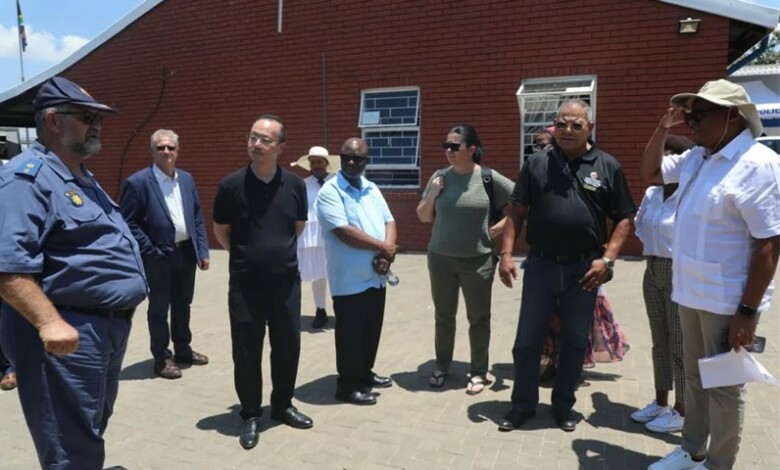
Oversight bodies have taken note. A recent report by the Community Safety Committee of the Gauteng Provincial Legislature followed an oversight visit to the station, highlighting infrastructure shortcomings and safety risks for both the public and police officers.
The CPF has attempted to intervene. During 2023 and 2024, the forum approached safety and security structures within the Gauteng government.
Initial progress toward securing larger, safer and more accessible premises from the metro, adjacent to the municipal library in Olievenhoutbosch, appeared promising.
However, when the coalition governing the council was disbanded, the initiative stalled.
Continued lobbying by CPF chairperson Lukas Olivier contributed to an announcement in October 2025 by the metro that it had approved the transfer of two properties adjoining the current police station to the Department of Public Works (DPW).
For the CPF, this represents a potential turning point, but once again, they feel there has been no momentum since then.
Provincial SAPS spokesperson Colonel Dimakatso Nevhuhulwi clarified the division of responsibilities.
“The building of police stations is not the key function of the province but the Department of Public Works in consultation with the National Head Office,” she said.
“However, the management of SAPS in Gauteng Province has escalated the matter to the SAPS National Head Office. National Division Supply Chain Management has intervention measures in addressing infrastructure gaps as one of the identified priorities in the SAPS five-year strategic plan.”
She added, “The stations throughout the province are provided with necessary resources to carry out their mandate. Every financial year, the Provincial Commissioner, through Provincial Supply Chain Management, assess the specific needs of police stations and that assessment considers factors, like population density.”
For Needham and other residents, what they would like to see is tangible progress.
First, the formal transfer of the identified properties to the DPW must be finalised.
Thereafter, sustained public pressure will be required to ensure prompt, appropriate construction of facilities that match the scale and complexity of the Olievenhoutbosch precinct.
Until then, the mismatch between population growth and policing infrastructure remains a daily reality for hundreds of thousands of residents who depend on the station for safety and justice and the oversight visits remained full of broken promises and empty commitments.
Rekord has requested comment from the DPW, but none had been received by the time of publication.
ALSO READ: DA MPL barred from inspecting abandoned Staatsmuseum
Do you have more information about the story?
Please send us an email to bennittb@rekord.co.za or phone us on 083 625 4114.
For free breaking and community news, visit Rekord’s websites: Rekord EastFor more news and interesting articles, like Rekord on Facebook, follow us on Twitter or Instagram or TikTok or WhatsApp Channel