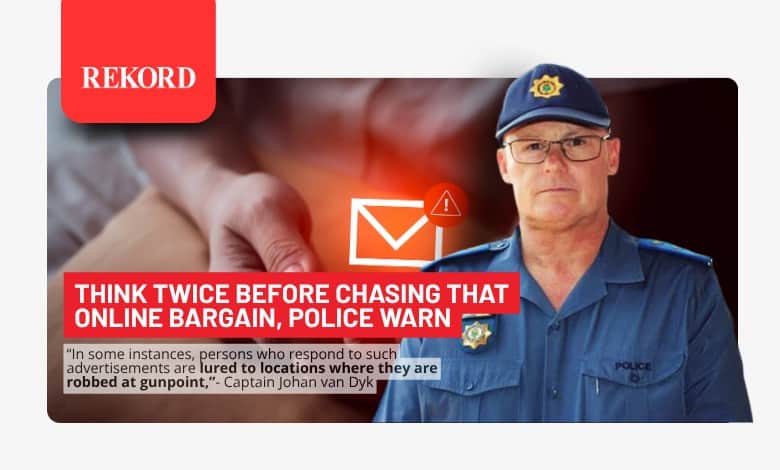
Online buyers are increasingly being lured to isolated locations in Pretoria and robbed at gunpoint.
According to Police spokesperson Captain Johan van Dyk, criminals are increasingly using social media platforms and online marketplaces to advertise goods at prices well below market value to attract unsuspecting buyers.
Van Dyk said members of the public should be cautious when responding to unusually cheap offers, as what appears to be a good deal could be a trap.
“In some instances, persons who respond to such advertisements are lured to locations where they are robbed at gunpoint,” he said.
He stated that this was of particular concern in the northern parts of Pretoria, including Winterveldt, where items are sometimes advertised below market related prices as part of scams.
Residents who arrange to meet sellers they have only dealt with online are therefore urged to take precautions to avoid putting themselves in potentially dangerous situations.
Van Dyk advised that transactions involving unknown individuals should preferably take place at recognised public locations where other people are present. Where appropriate, a police station can also be considered as a meeting point, rather than meeting a stranger at an isolated location or private residence.
However, the risks associated with online transactions are not limited to physical robberies.
“Fraudsters continue to use online platforms to manipulate potential buyers and sellers into making payments or sharing sensitive information.”
Van Dyk noted that potential buyers should not allow the prospect of securing a bargain to cloud their judgement, particularly when a seller creates a sense of urgency or pressures them to make an immediate payment.
“Taking a few extra minutes to verify the seller, the item and the payment details can prevent individuals from becoming victims of fraud,” he said.
Residents are also urged not to make deposits or payments until they are satisfied that the advertised item exists, the seller is legitimate and the transaction has been properly verified.
Another tactic involves criminals asking victims to scan QR codes, sometimes claiming that the code is needed to receive money, process a refund or complete a transaction.
Van Dyk warned residents not to scan a QR code simply because an unknown person tells them to do so. They should first establish what the code is for and independently confirm that the request is legitimate.
Payment scams are another concern, with criminals able to manipulate screenshots or electronic proof of payment to make it appear that money has been transferred.
“Community members should never rely solely on a screenshot provided by a buyer or seller. Where possible, the recipient should independently check their bank account to confirm that the money has actually reflected before handing over goods,” Van Dyk said.
“Residents should pause when a seller insists on immediate payment, refuses to provide verifiable information or offers an item at a price that appears unusually low,” he added.
Buyers who suspect that they have encountered a fraudulent advertisement are advised to gather as much evidence as possible.
This includes the original advertisement, telephone numbers, messages exchanged with the seller or buyer, banking details and any proof of payment or attempted transaction.
Van Dyk added that this information should be provided to the police, as it could assist with investigations.
Do you have more information about the story?
Please send us an email to bennittb@rekord.co.za or phone us on 083 625 4114.
For free breaking and community news, visit Rekord’s websites: Rekord East
For more news and interesting articles, like Rekord on Facebook, follow us on Twitter or Instagram or TikTok or WhatsApp Channel