Shange sets personal best time in Australia
If he keeps improving like now, Lebogang Shange can soon improve his mentor, Chris Britz's, national record in the 20 km walk.
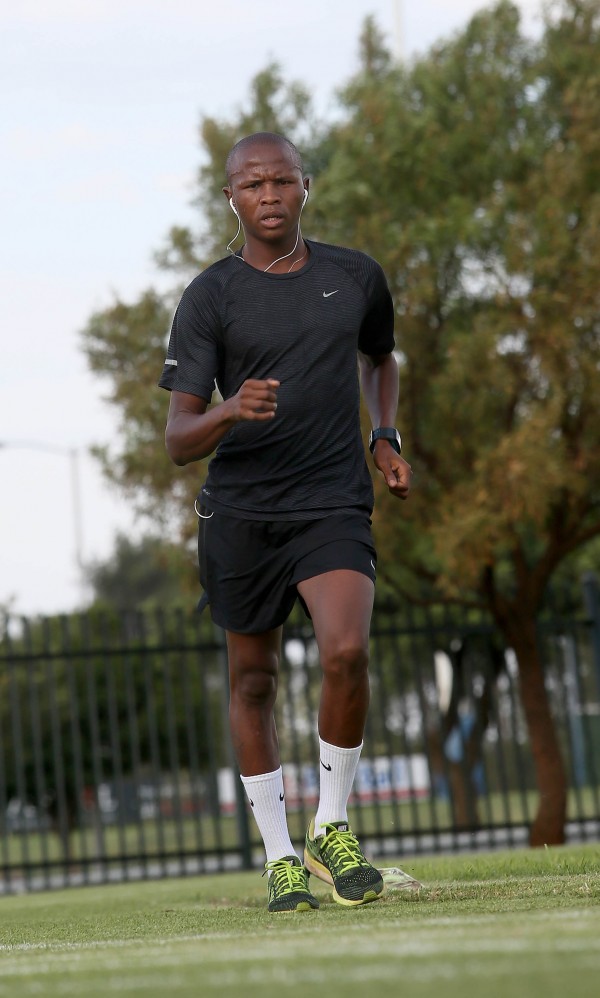
Lebogang Shange (HPC/Nike), South Africa’s race walking ‘ace’, immediately continued his quest to seriously challenge the stopwatch every time he competes.
Over the weekend, at an international training camp in Canberra that was attended by some of the world’s best 20km race walkers, he clocked a time of 41 minutes and 2 seconds in a 10 000 metre track race organized by the Australian Institute of Sport (AIS). It was his first race in 2016.
Shange, who finished third in the race, was justly proud of his performance.
“It is my best time in a 10 000 metre track race. It is exciting to be able to set such a fast time so early in the season. I am certainly learning a lot by training with some of the best race walkers,” he said.
Canada’s Ben Thorne, who won a bronze medal at last year’s World Championships, won the 10 000m race.
Shange’s time was merely 28 seconds slower than the South African record (40:32.78) set by Chris Britz in 1995.
Britz, Shange’s coach, confidently predicts that it will be only a matter of time before the HPC athlete will improve on his record. It might even be towards the end of the training camp.
It is interesting to note that Shange is currently the national record holder in all the distances in which he competes except the 10 000m track event. He will begin to compete over 30 and 50 kilometres at a later stage.
Shange’s first serious race will be on 21 February when he will compete in Australia’s National 20km Championships in Adelaide.
Britz wants Shange to change his race strategy. Last year Shange mostly started out conservatively and then accelerated towards the end of the race. Using this strategy he set a new South African record and finished 11th at the World Championships in Beijing. (See video)
“This race strategy is all well and good if you are merely racing to get a top ten finish, but any athlete who wants to have a realistic chance of medalling at the Olympic Games in Rio will have to race from the front. It is, therefore, important that Lebogang gets used to doing so. He might ‘over cook’ it once or twice by starting off too fast but he has proven that he is able to learn from his mistakes.”
Britz predicts that the racing conditions in Rio will be as tough as it was during the 2008 Olympic Games in Beijing. Russia’s Valeriy Borchin won in 1:19:01.
According to Britz the winning time in Rio will again be round about 1 hour 20 minutes.
“Our goal is for Lebogang to finish in the top five and, if he has a good race, he could even challenge to win the bronze medal.”