Mariska Venter wins the Lithuania Open Wheelchair Tennis Tournament
The young wheelchair tennis star, Mariska Venter, won the second major tournament in her short career last week.
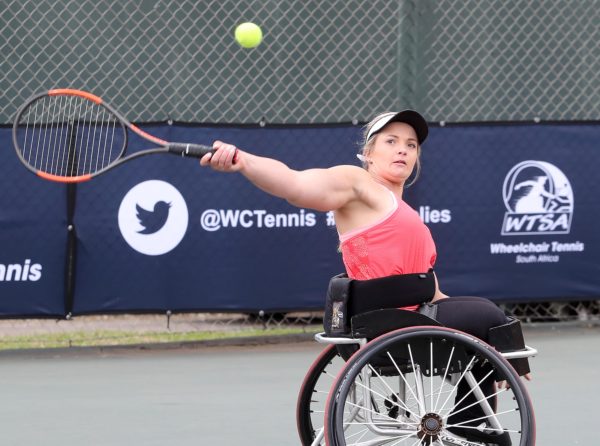
“Giving up is a term that I don’t understand. I live to see what my limits are and then when I find the limit I try to push the boundaries even further.”
With such an attitude it is not surprising that the South African wheelchair tennis rising star, Mariska Venter from the Tuks High Performance Centre managed to win the Lithuania Open Tournament last week. It is a major breakthrough for her as it is only her second major success in senior international tennis. In 2015 she won the Mauritian Open. In 2012 she was the top-ranked under-18 player in the world.
Venter’s life changed dramatically in 2004 when she and her family were on their way back home after a trip down to the Western Cape.
“It was nine at night just outside Bloemfontein when a car passed a truck. The driver did not see us coming. It led to a head on head collision. My father passed away as well as my oldest brother. I broke my back amongst other things and was left paralysed from the waist down,” said Venter who was only eight years when the accident happened.
“All though it was a really traumatic experience I was never going to quit on life. I believe no matter what happens to you in life you can always choose to stand up and become the great person you are meant to be. Nothing is impossible, if you really, really want it you can get it.
“It certainly helped that I have amazing support through family and friends who have always encouraged me and kept me motivated. But the most important reason and the only reason I stand up every day and take on every challenge that comes my way are because of God.”
Venter took up wheelchair tennis in 2014. According to her she immediately took a liking to chasing balls on a court and trying to outfox her opponents. She has been playing professionally for the last three years. She describes tennis as a very complex sport.
“Put a wheelchair with that and you have a great challenge. Not only do you have to hit the ball by using your arms but you also have to run around the court using those same arms, so it gets very complicated. To keep moving on the court is the hardest part of the game for me. It is something I constantly have to work on.
“My most challenging opponent is the one on the other side of the net. In tennis, there is always a person who plays the ball back to you, you can never expect what you are going to get.
“Different surfaces always play a role in tennis besides the ball that bounces completely different and travelling faster or slower the chair can also move slower on the clay and grass courts which make you work even harder. My favourite court is the hard courts as that are the courts we practice on every day. I also love a fast-passed game.”
She credits her coach, Gerald Stoffberg, and her HPC support team as the reason why she is more confident when playing tournaments. Part of her preparation includes training with the Tuks Wheelchair rugby team two nights a week. It helps her to improve her fitness and agility.
When not playing tennis she works as a beauty therapist.
For free breaking and community news, visit Rekord’s websites:
For more news and interesting articles, like Rekord on Facebook, follow us on Twitter or Instagram