
UNIVEN student tackles research into HIV drug resistance
Tendani, a Master’s degree student, says that her research seeks to improve understanding of how HIV mutations can impact drug efficacy.
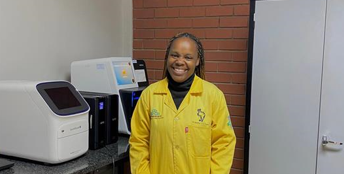
LIMPOPO – Tendani Matamela, a 25-year-old Master’s degree student at the University of Venda (UNIVEN), is making strides in the fight against HIV drug resistance with her groundbreaking research.
Hailing from the rural village of Dopeni in Nzhelele, Matamela is also the chairperson of the department of biochemistry and microbiology.
Under the guidance of Dr Nontokozo Daphney Matume and Prof Pascal Obong Bessong, Matamela’s project focuses on constructing a plasmid model with uncharacterised mutations.
This model aims to determine the long-term effectiveness of Dolutegravir, a key HIV medication, for first-time users.
In an interview with CV, Matamela explained that her research seeks to improve understanding of how HIV mutations can impact drug efficacy.
“My work is designed to lay the groundwork for future research on HIV drug resistance and the effects of genetic changes on Dolutegravir’s effectiveness. By constructing a plasmid with altered DNA, we can conduct experiments to see if Dolutegravir remains effective against new strains of HIV,” she said.
Matamela’s project involves documenting and analysing genetic changes known to cause resistance, as well as those previously unstudied.
She and her team introduced these changes into a plasmid and used online software to predict their impact. Both the predictions and lab experiments proved successful.
Passionate about science from a young age, Matamela’s interest in microbiology and biochemistry stems from her desire to understand the microscopic world and its impact on human health.
“I’ve always been fascinated by how tiny microorganisms cause diseases and wanted to contribute to finding solutions,” she explained. Her focus on HIV is driven by the pandemic’s global impact and the urgent need for effective treatments. HIV’s ability to rapidly evolve, poses a significant challenge to treatment, particularly in countries like South Africa where drug resistance is prevalent,” she said.
Matamela recently attended the 28th SASBMB Congress at The Ranch Hotel outside Polokwane, hosted by Univen’s department of biochemistry and microbiology.
The event was a significant milestone for her, offering the opportunity to engage with international researchers and professionals.
“It was an exciting and educational experience, interacting with esteemed scientists and peers from around the world,” she said.