Hyacinth is flourishing in rivers and dams around Bronkhorstspruit
“Managing hyacinth worldwide has become a well-known subject and most obvious one should begin the process of combatting hyacinth by stopping the high nutrient sources which are most commonly sewage and agricultural waste and effluent.”
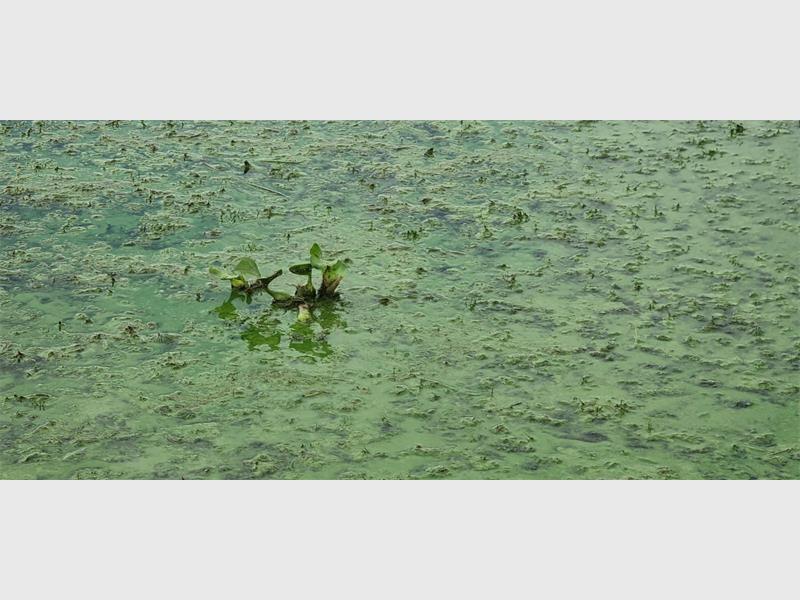
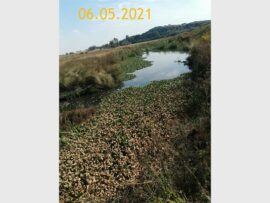
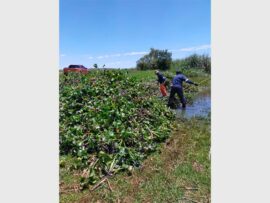
The Wilge River Dam (Premier Mine Dam) and much of the Bronkhorstspruit River are often covered in a blanket of hyacinth.
The residents downstream of Bronkhorstspruit report that this has been occurring for almost 10 years with the last two years considered as extreme cases.
This problem has not gone unnoticed and residents along with the Department of Environmental Affairs, the mine and the Bronkhorstspruit Catchment Forum have banded together to try and solve this problem over the last three years.
“Managing hyacinth worldwide has become a well-known subject and most obvious one should begin the process of combatting hyacinth by stopping the high nutrient sources which are most commonly sewage and agricultural waste and effluent.
“To combat the source of nutrients, one has to track back to the beginning of the catchment area which begins in Delmas (Victor Khanye), Bapsfontein, Sentrarand and Breswol,” said Cara Stokes, chairperson of the Bronkhorstspruit Catchment Management Forum (BCMF).
In Delmas, there are three wastewater treatment works, namely Delmas and Botleng1 and Botleng 2.
Between these three plants, about 16 megalitres of partially treated wastewater, including industrial effluent is discharged into a tributary of the Bronkhorstspruit River.
The river then travels for about 27km past various land-users such as chicken and pig farms, industrial waste sites, mines and informal settlements.
The Osspruit joins the catchment at the Bronkhorstspruit Dam from the Bapsfontein area which is also an intense agricultural area farming such as cattle.
These and others are all the sources of the nutrients and other pollutants that begin to be added to the Upper Olifants Water Catchment Area which leaves South Africa via the Olifants River and ultimately leads into the Limpopo River and exits the African continent into the Indian Ocean in Mozambique Xai Xai.
“Since the sources of pollution are widely varied and relatively long-term, problems to fix one still needs to address the current situation where hyacinth chokes river and dams and prevents recreation, agriculture and other activities,” said Stokes.
Both the town of Bronkhorstspruit and Cullinan Diamond Mine use the water in the Bronkhorstspruit River for domestic purposes.
Water quality testing is done on the river and shows high e-coli levels from beyond the Bronkhorstspruit Waste Water Treatment Plant.
However, at the Draai, the e-coli levels are luckily much lower as this abstraction point is before the Bronkhorstspruit sewerage farm, although the Honde River enters at the Draai and has been contaminated in the past by sewerage overflows on the Zitobeni line.
“Authorities have used spraying for the last few years through both a helicopter and from the land through the working for water programme,” said Stokes.
A spraying contractor was employed by the DEA to spray the hyacinth with Kilomax in October 2018.
The river was sprayed, but the feedback from river residents is that some areas of the river are inaccessible from a helicopter and therefore cannot be sprayed effectively.
This is not the first time the river has been chemically sprayed.
A natural scientist, Jacqui Dabrowski, was requested in January 2017 to investigate a fish kill downstream of the Premier Mine Dam in the Wilge River.
Her scientific report pointed out that during the site visits, “extensive mats of water hyacinth were seen to be covering the Bronkhorstspruit River and the Premier Mine Dam. Large masses of dead (brown) hyacinth were also observed in and along the banks of the Wilge River, downstream of the dam.”
Stokes said the Bronkhorstspruit Catchment Management Forum are the co-ordinators of the Bronkies River Integrated Hyacinth Plan, which is a combination of mechanical, biological and chemical management of the hyacinth.
“This is a very long-term plan as the seeds are now in the silt of the river and unless you removed the seed bank the hyacinth will continue to re-appear year after year. Improving the water quality is the first step in reducing the hyacinth, which is exactly what the forum is attempting through involvement from the Department of Water and Sanitation as well as the Human Rights Commission. There are wastewater treatment works from the start of the catchment to the end and each one must comply,” said Stokes.
“It will probably always be a mystery as to how the hyacinth came to arrive in the downstream and now the upstream of the Bronkhorstspruit River, but luckily there is no mystery of what is feeding the hyacinths in the upper Olifants water management area and the public, residents and civil organisations will continue to fight to ensure that your right to the environment is upheld and protected continuously.”