Experts share practical tips to prevent veld fires
As veld fire season nears, are you prepared? Learn how to protect your property, stay safe, and act fast with expert advice from Neels de Klerk and local fire authorities.
With the veld fire season approaching, Neels de Klerk of the Govan Mbeki Community Awareness and Emergency Response shared tips on how to handle veld fires.
When you come across a veld fire:
• Report it by calling 112, asking to be directed to the local fire department;
• Don’t drive near veld fires or into their smoke;
• Stop in a clearing or by the roadside where the vegetation is short;
• Turn off the ignition and turn on the hazard lights and headlights;
• Stay inside unless near a shelter. Keep the vents, windows, and doors closed. Lie inside, below window level;
• If the heat or fumes inside worsen after the main fire passes, leave and move to already burnt ground;
• If caught in a veld fire, don’t drive through the flames and avoid thick smoke;
• If it is safe, enter the burnt area and stay until the fire passes.
According to De Klerk, the rising frequency and intensity of veld fires in SA have caused extensive property damage and injured many people.
He urged people to have preventative and evacuation measures in place. The primary causes of veld fires are lightning and human activities such as uncontrolled braai fires, burning, or arson.
Extreme weather, like strong winds and heatwaves, increases fire intensity.
“With winter approaching, now is the time for landowners to take preventative measures. Knowledge is key to preventing fires. With the information in this article, you can learn how to prepare for, prevent, and handle veld fires on your property,” De Klerk said.

He added that firebreaks don’t always have to be burnt; areas can be ploughed, scraped, raked, or sprayed with herbicides.
“If you create firebreaks, remember they should be strategically placed, cost-effective, and practical to implement,” said De Klerk.
“It is also important to document your agreed firebreaks with neighbours. Local Fire Protection Association (FPA) rules must be followed when implementing firebreaks,” said De Klerk.
He also explained what legislation requires of individuals.
According to the National Veld and Forest Fire Act (No 101 of 1998), property owners must:
• have a fire control committee or work according to their local FPA;
• work with neighbours during the planned burning of firebreaks;
• have sufficient equipment and personnel on hand to control the fire.
Plan the firebreaks:
• Timing: Burn firebreaks only when the local FPA authorises the burning;
• Weather conditions: Choose a day with low wind speeds (less than 15 km/h), high humidity (more than 30%) and moderate temperatures;
• Demarcation: Mark the firebreak areas by cutting the grass or ploughing;
• Remember, large fires can create their own winds.
Get the right equipment and personnel:
• Fire protection equipment: Water pumps, firefighting systems and fire beaters are required;
• Safety measurements: Always have an escape plan and medical emergency equipment available;
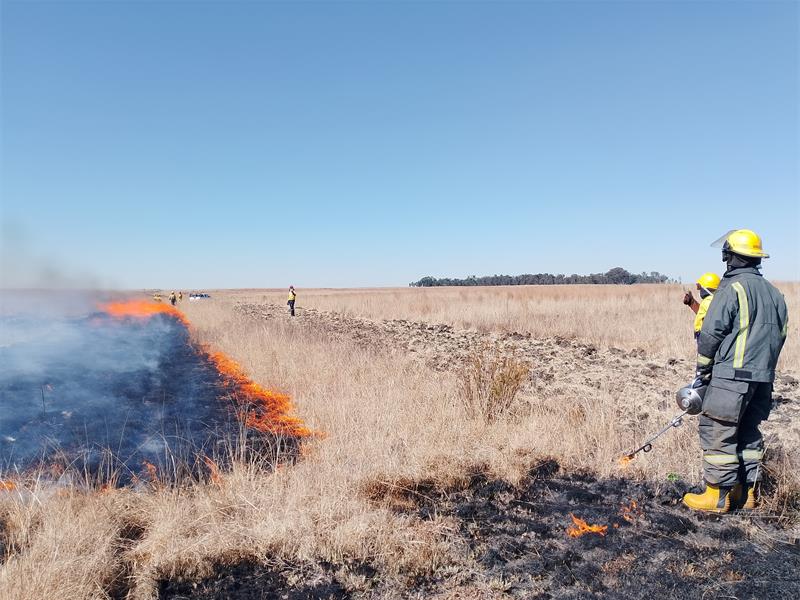
• When implementing the firebreak, always start downwind, allowing the fire to spread slowly;
• Use the back-burn technique or a natural barrier, where a fire is set on the windward side to combat a bigger fire. Continuously monitor it and be ready to extinguish it if necessary.
Extinguish and monitor:
• Ensure the fire is wholly extinguished and no smouldering areas remain;
• Animal dung might reignite after some time;
• Monitor the area for at least 24 hours afterwards.
Please note:
Firebreaks:
• should be broad and long enough to have a reasonable chance of preventing a fire from spreading to or from neighbouring properties. Check with your local municipality, fire brigade or FPA to confirm the rules and regulations for your area;
• must not cause or contribute to soil erosion;
• must be reasonably free of unnatural flammable material (tyres, plastic and more);
• should be implemented and maintained during the fire season.
How to respond to a fire:
• If you are in the veld and see a fire, immediately move away from it;
• Never ignore a fire, even if it seems distant. It can quickly grow and engulf you;
• If you feel threatened and can’t outrun the fire or are surrounded, try to find a safe zone – an area already burnt or completely clear of any fuel, like a wide road or a house.
For more information, contact the Mpumalanga Umbrella Fire Protection Association, the Highveld Fire Protection Association, the Department of Forestry, Fisheries and the Environment, or the Fire Protection Association of Southern Africa.
De Klerk said Working on Fire (WOF) is an SA programme launched in 2003 as part of the government’s initiative to create jobs and reduce poverty.
It focuses on training and employing young people as veld and forest firefighters. About 5 000 youths participate in the programme, which operates from over 200 bases nationwide.
WOF implements an integrated firefighting strategy that covers prevention, readiness, response and rehabilitation. They work closely with local authorities and FPAs to minimise the impact of veld fires.
In collaboration with FPAs, they provide training in firefighting, fire management, and prevention, which particularly benefits farming communities.
De Klerk also had tips on how to manage wildfires in general:
• Maintain your property by trimming trees and shrubs, removing dead leaves and debris, and ensuring the gutters are clean;
• Join your local FPA or a WhatsApp group in your community to stay informed of fires in the area;
• Always keep emergency contact numbers for help on hand;
• Know the evacuation routes to leave the area in case a fire spreads;
• Plan what to do with your livestock in the event of a fire;
• Have the necessary equipment, protective clothing and trained personnel to extinguish fires;
• Stock up on emergency supplies, including masks or respirators that filter particles from the air you breathe.
• Keep an outdoor water source filled. Sand is a highly effective method of fire control if water is not readily available.