Policewoman from Secunda thrives in her forensic work
From as young as she can remember, Warrant Officer Diana Britz from the Secunda SAPS’s forensics Local Criminal Record Centre wanted to be a voice for the dead and bring the perpetrators to book.
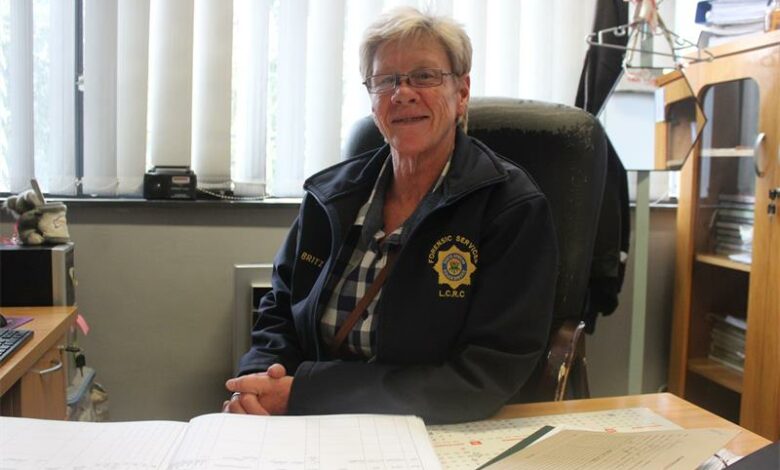
Warrant Officer Diana Britz (55), aka ‘Britsie’, could be described as a series character, Dexter, but without the serial killer traits.
After 34 years with the SAPS, Britz continues to bring her expertise to the forensic Local Criminal Record Centre (LCRC).
Britz graduated from the police college in Pretoria and began her service at Evander Police Station in 1991, where she remained until 2009. She then transferred to the Secunda Police Station, where she has been since.
She was born and raised in Standerton. From as young as she can remember, the dead held her fascination when her father, Jacob (Jack), worked for the railway police before becoming the town’s sheriff.
“My father had an old brown suitcase at the top of his cupboard. It contained black and white images of crime scenes,” said Britz.
She would get their domestic worker to take down the suitcase for her.
“I would go through the photos without him knowing. If he found out, there would have been big trouble,” said Britz.
She would scan over every photo, from scenes, the deceased, to railway accidents. Her father would investigate the scenes, collect the corpses and do the postmortems.
“No one ever knew. I chose to watch horrors and thrillers over a love story. I would pay the aunty at the video shop R5 to give me a horror film without my parents knowing,” said Britz.
A small mind watching horrors, one would think she had trouble sleeping at night. But Britz said she slept through it all like a baby.
“I was never afraid of the dark. I would rather have played in the dark than in the day. I feared nothing.”
Her father did not want her to join the police, but her mother, Anna, signed her up behind his back for the police college.
“It was my dream to join the forensics department, but I never knew how to get in. I took a chance when a position opened with the mortuary in 1994,” said Britz.
She left the mortuary in 1998 and continued her duties as a uniformed police officer at the Evander Police Station. However, she continued to work closely with the mortuary until 2009, when she joined the LCRC.
“Forensics is a unit that speaks for the deceased who can’t be heard anymore. We collect evidence and process the scene to find the offender,” said Britz.
She said that everywhere a person goes, some form of DNA is left behind, whether it is hair, fingerprints, a drop of blood, saliva or semen.
“We are a specialised unit that does fantastic work with the technology we have today. We are just like every other person who has parents, family, children and is affected by crime. We go the extra mile to get the answers for those left behind,” said Britz.
She said cases involving children and the elderly (the vulnerable) can be traumatic. However, through her years of experience, she knows how to deal with such matters.
Britz said it is also important to leave work at work and switch off once home.
“We see things that not every person gets to see, and deal with many cases. Everyone is different, but I believe you will go mad if you can not separate your work from home,” said Britz.
She said she would change clothes up to three times a day when she worked in the mortuary.
“There is a specific scent around the dead. Not everyone is cut out to handle the sights, scenes or trauma,” said Britz.
For Britz, a bloodied scene is fascinating because the blood tells her a story, and she can determine everything that happened at a scene through a single drop of blood.
With her years of experience, she can determine a scene from beginning to end and the modus operandi or weapon used.
“Blood can give you all the answers if you know what you are looking for,” said Britz.
She said a postmortem can also determine the weapons used, as the weapon can also leave an imprint on the deceased.
“Evidence collected from a scene is just as important, like hair or the smallest thing you could think of. Evidence can also be gathered from the deceased during a postmortem. We all leave behind some form of DNA,” said Britz.
Although she is not present on scenes, Britz has handled cases from behind her desk since 2017. Her duties include ensuring that all dockets are processed completely with all evidence before the matter heads to the detectives and then the courts.
She said a crime scene is like a book or a movie; there is a beginning, middle and the end.
“If you bring all the evidence together and follow all the steps, you can bring the perpetrator to book and justice for all can be served,” said Britz.
Forensics is Britz’s calling and passion, and she said she could not see herself in any other career.
Her advice to youth wanting to pursue forensics as a career is: “Forensics is not a job, it is a passion. If you don’t have the passion, you will never catch the perpetrator. There is no such thing as a perfect murder; somehow, somewhere, the perpetrator will be caught,” concluded Britz.