SA braces for scorching summer as ‘strongest El Niño in living memory’ looms
Widespread drought risk and record global temperatures are expected to impact southern Africa as Pacific ocean warming intensifies.

A strong El Niño event has formed in the Pacific Ocean and is likely to intensify further this spring, according to South African Weather Service (SAWS) communications manager Hannelee Doubell.
In fact, the latest weekly-averaged sea surface temperature anomalies over the eastern central tropical Pacific Ocean are already exceeding the threshold that defines a very strong El Niño.
“The latest predictions are indicative that the El Niño will likely intensify further to become the strongest event in living memory,” Doubell said.
“A strong El Niño refers to an event where three-monthly averaged sea surface temperature anomalies over the eastern central tropical Pacific Ocean are exceeding 1.5°C with respect to climatology, while during a very strong El Niño, this part of the ocean is 2°C warmer than normal.”
The latest forecasts indicate that the current event will very likely exceed the 3°C threshold.
Drier and warmer conditions ahead
Doubell said most El Niño events bring conditions of below-normal rainfall and above-normal temperatures to the southern African region. Two of the most impactful El Niño events for the region occurred in 1982/ 83 and 2015/ 16, which brought widespread drought. The very strong El Niño event of 1997/ 98, however, was associated with slightly above-normal rainfall over parts of the country’s summer rainfall region.
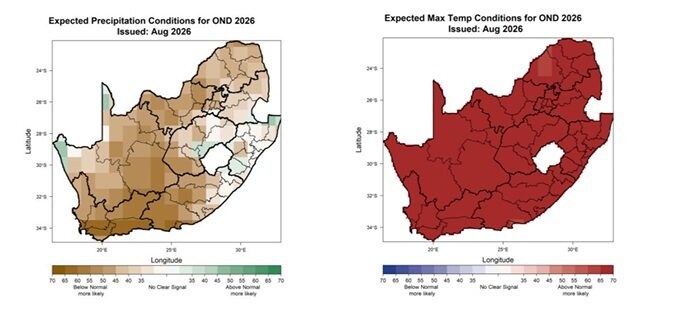
“Although below-normal rainfall is statistically the most likely outcome in southern Africa this summer, not every single El Niño event is associated with drought. The latest seasonal forecast of the SAWS for the October to December period indicates that below-normal rainfall is the most likely outcome over most of the country.”
According to Doubell, the October to December period is also very likely to be associated with above-normal temperatures. The rainfall and temperature forecast for the November to January 2027 period mirrors that of the October to December 2026 period, indicating drier and warmer conditions over most of the country.
Potential record heat
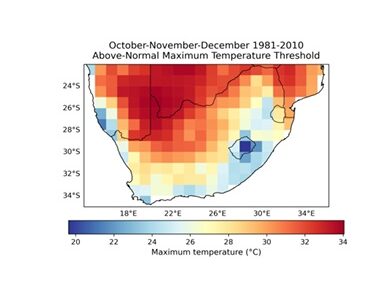
She added that the expected very strong El Niño of 2026/ 27, in combination with global warming, will likely result in 2027 being the warmest year ever recorded. The 2015/ 16 event brought unprecedented heatwaves to the southern African region.
“In the 11 years that have since passed, the southern African region has also continued to warm. If the 2026/ 27 El Niño event brings the expected below-normal rainfall to southern Africa, a high frequency of heatwaves will likely co-occur.”
These heatwaves could be severe; however, as current forecasts show an exceptionally strong event, uncertainty remains regarding its ultimate strength and regional impacts. Consequently, the extent of expected heatwaves and water scarcity will be closely monitored and communicated to disaster management structures, weather-sensitive industries, the media, and the public.
The public and affected industries are strongly advised to monitor monthly seasonal forecasts and daily short-term updates to prepare for heatwaves and high-impact weather.