News24 investigative journalist launches explosive book at Killarney Mall
News24 investigative journalist Jeff Wicks was determined to uncover who ordered Babita Deokaran's hit and why, and in his new book he may have done just that.
August 23 marked fours years since Babita Deokaran, a chief accountant at the Gauteng Department of Health, was shot down in a hail of bullets outside of her home in Mondeor, and four years since News24 investigative journalist Jeff Wicks became determined to find the motive behind the assassination.
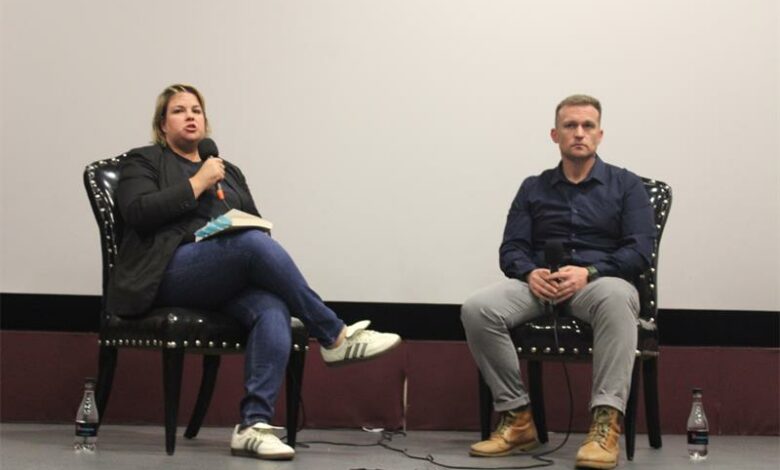
On August 27, at Killarney Mall’s Cinecentre, Wicks, in conversation with journalist Mandy Wiener, launched his book The Shadow State, delving into a bold web of nefarious officials, ANC politicians, and extraction syndicates, including notorious Vusimuzi ‘Cat’ Matlala, siphoning away billions meant for patients in Gauteng’s public hospitals.
Among the attendees were Deokaran family members and members from the Active Citizens Movement.
When Wicks was asked what committed him to the reporting of Deokaran’s assassination, he explained that it was obvious that Deokaran was a civil servant who was murdered for a purpose, and what that purpose was, was important to the investigative journalist. A story was published about a Whatsapp message from Deokaran, which read: ‘Morning CFO, I am just worried that the guys in Tembisa are going to realise we are onto something. Our lives could be in danger’. “I was convinced there could be answers on [Deokaran’s] cell phone,” said Wicks, “and wanted to understand the rest of the conversation. We had an assumption that her death was caused by something that originated from Tembisa Hospital, but there was more to that.”
Read more: Greenside resident launches poetry book inspired by trees
Wicks noted that the Gauteng Health Department was a den of iniquity, and because of decades of mismanagement, graft, and corruption, it was a 50/50 chance whether you live or die if admitted to a state facility. He need more information “We contacted our sources within the Hawks, and former Minister of Health Dr Zweli Mhkize’s name came up immediately.”
Wicks couldn’t simply dismiss Mkhize’s mention out of hand, but he didn’t know enough. Then things changed. “Within days the izinkabi (assassins or hitmen) were arrested, and they spilt the beans, pointing to the former minister as the potential pay master.”
Mkhize later released a media statement distancing himself from Deokaran’s assassination, and denying any involvement, but Wicks and his team were not convinced. They sought out to prove that Mkhize was the one who ordered the assassination, by looking into the lives of Phakamani Hadebe, Zitha Radebe, Phinda Ndlovu, Sanele Mbhele, Siphiwe Mazibuko, and Siphakanyiswa Dladla, the six izinkabi, which led him to ‘Hitmen’s Hollow’.
Nhlawe
Answering Wiener’s question about why he decided to visit, what he called ‘Hitmen’s Hollow’ in the book, Wicks explained: “There was one word ‘Nhlawe’, a small village outside Weenin in KwaZulu-Natal, buried in the pile of court documents. The genesis of the trip to Nhlawe was born out of desperation, because we were on the story for months and we were struggling to take it forward. Even though we were following the court processes with the hitmen, they did nothing to advance us towards the ‘why’ or ‘who’.”
Wicks elaborated that the trip was maddening, because all he and his colleague had was a list of six names. “It is a dry, arid village in the heart of a valley, and no one wanted us there. As soon as we started asking questions about these men, we received warnings about how dangerous the hitmen were. This trip told us that there was credence to the claim that these were hitmen. They knew each other from birth, spent their formative years in the valley, and all left in search of a better life in the reef, falling into the taxi trade, which is blood-soaked ground itself.”
The investigative journalist noted that there has been a vicious turf wars between rival villages in Nhlawe, and that it was known as a proving ground for assassins. He added that these were likely not six innocent men who were just rounded up by police looking for success.
Building trust and a relationship with the Deokaran family
Wicks said, early in the pursuit of finding out who assassinated Deokaran , he managed to convince Deokaran’s brother, Rikash, a man gripped by grief, into meeting him. “It took work to convince him to see me. I told him that what happened to his sister was a tragedy, and that I believed we could investigate, and see the story through to the end. That was the start of the friendship which lives on today.”
Also read: Greenside resident launches poetry book inspired by trees
Wicks highlighted that the relationship established with the Deokaran family was built slowly with intention, as he was mindful of what they were going through. “I wanted to convey to them, not only in words, but actions, that I was committed, and that I would follow through with the story. I made it clear that I wasn’t chasing a headline. When I called Rikash, I told him that I’m not looking for a quote, I needed to talk to him because I had questions.”
Impact of the investigative articles
Closing off the book launch dialogue, the investigative journalist tackled Weiner’s question about whether his articles, written surrounding Deokaran’s death, had an impact on the book. Wicks agreed that they did, to a certain extent. “Three weeks before her death, Babita filed a report about suspected corruption at Tembisa Hospital. In her report, her recommendation was an urgent forensic investigation into R850m in transactions, and a freeze on R1m. Instead, she was lied to by Gauteng health management and was killed.”
Wicks noted that after the chief accountant’s death, no action was taken to implement the recommendations. There were no forensic investigations, the money was unfrozen, and it was business as usual for the Gauteng Department of Health. “When we first confronted [the Gauteng Department of Health] with the information, they denied the existence of the report. We proceeded to put it to them, but they denied that it was a report, and then denied that it was received by Deokaran’s line manager. We then published an email showing [Deokaran’s line manager] had received the report.”
At the end of the several stories Wicks and his colleagues published, they managed to get Deokaran’s line manager, and Tembisa Hospital’s CEO, at the time, Dr Ashley Mthunzi, placed on suspension. “That allowed the entry point to the Special Investigations Unit (SIU) to do their work. Through the trail set by our reporting, they uncovered something massive, something we still don’t understand the true scale of. That was the benefit of this story; it gave us a rare view into the depth and depravity of the way extraction operates.”
The Shadow State is available at Exclusive Books nationwide
Follow us on our WhatsApp channel, Facebook, X, Instagram and TikTok for the latest updates!