My Vote Counts and JCA break down municipal coalition rules and hung councils
As local government elections approach, non-profit organisation My Vote Counts unpacks hung councils, proportional representation, and voting requirements.
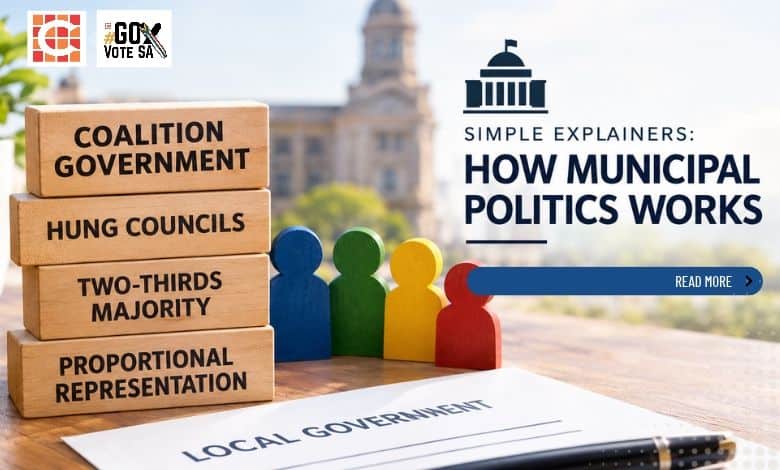
Coalition governments, hung councils, two-thirds majorities and proportional representation can sound like complicated political jargon.
Behind those terms, however, are decisions that have a direct impact on residents, including how councils make decisions, approve budgets and hold municipal leaders accountable. With local government elections on the horizon, advocacy lead Noxolo Mfocwa, from civil society organisation My Vote Counts, a non-profit, non-partisan organisation working to promote transparency, accountability and inclusiveness in South Africa’s political system, broke down basic political leadership concepts.
Understanding coalitions
“A coalition government is formed when no single political party has enough seats to govern on its own, and two or more parties agree to work together to form a governing majority,” Mfocwa said.
At municipal level, this can mean parties negotiating an agreement to elect a mayor and other office-bearers, while agreeing to support crucial decisions such as the budget and municipal policies. Mfocwa added that coalitions are not inherently good or bad for residents. “They can strengthen democracy by requiring parties to negotiate, compromise and work with political opponents.”
Read more: Crisis Alliance demands the mayor steps down or he will be removed
She said the challenge arises when political negotiations overshadow the actual business of running a municipality. “They can become unstable when parties prioritise political bargaining and positions over governing effectively. For residents, the important question is not simply whether their municipality has a coalition government. The real question is whether that coalition is stable, transparent and focused on delivering services and governing in the public interest.”
Proposed law seeks binding agreements
Yunus Chamda, a project co-ordinator at Joburg Crisis Alliance (JCA), a civic organisation formed to hold the City of Johannesburg accountable for governance failures and service delivery crises, said that under the current Municipal Structures Act, there is no statutory regime making municipal coalition agreements legally binding as coalition agreements. “They are, therefore, principally political agreements between parties.” He cautioned, however, that their provisions may have contractual or other legal consequences depending on the wording and circumstances.
Chamda said the proposed Municipal Structures Amendment Bill, B23-2026, would, for the first time, expressly regulate coalition government in the Municipal Structures Act. The bill defines a coalition agreement as a written agreement between two or more parties, and potentially independent ward councillors, to form a coalition where no party has a majority of council seats.

Under the proposed changes, parties and participating independent ward councillors in a hung council would have to enter into a coalition agreement regulating their participation in governing the municipality. The agreement would have to be signed by authorised representatives, submitted to the municipal manager, sent to the provincial MEC for local government and published in the provincial gazette. “The intention is to create binding coalition agreements,” Chamda said, adding that the proposed contractual relationship would be legally enforceable. However, he said the bill is still before parliament and is not yet law.
The proposed bill would create a statutory framework for coalition agreements and make them legally enforceable. A coalition agreement would also not be able to override the constitution or legislation governing councillors and councils.
In a municipal council, a governing majority generally means having enough support to secure the votes needed to take decisions. For most ordinary council decisions, a majority of the votes actually cast is required, provided that a majority of councillors are present. Some decisions, including approving a municipal budget and passing by-laws, require the support of a majority of all elected councillors.
Hung councils and voting thresholds
A hung council occurs when no party achieves an outright majority, requiring parties to negotiate to gain support for key decisions. “There is an important misconception to clarify here: two-thirds is not the general voting threshold for municipal council decisions in South Africa,” Mfocwa said. Under Section 160 of the constitution, a majority of councillors must be present before a council can take a decision. Most ordinary questions are then decided by a majority of the votes actually cast.
For example, in a council with 100 councillors, at least 51 councillors must be present for a vote to take place. If 60 councillors attend and 50 vote on an ordinary motion, with 26 voting in favour and 24 against, the motion passes. It does not ordinarily require 51 votes simply because the council has 100 members.
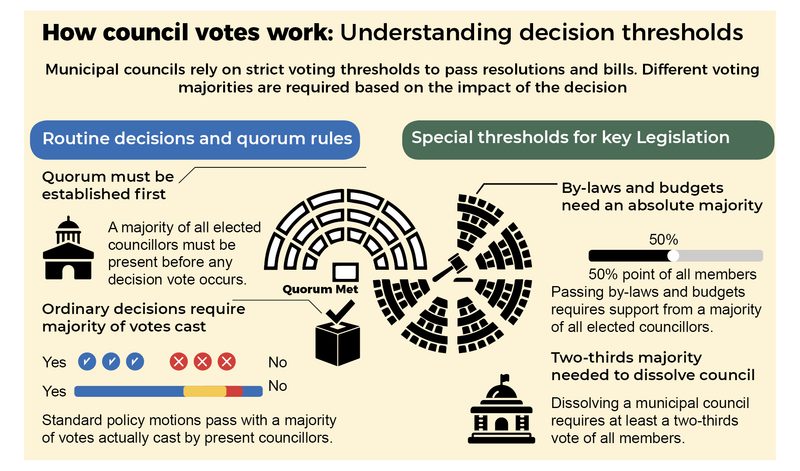
An ordinary decision could include a council resolution adopting a recommendation concerning a municipal programme or policy that is not one of the specially protected matters in Section 160(2) of the constitution. Certain decisions require the support of a majority of all elected council members, rather than simply a majority of those present. These include passing by-laws, approving the municipal budget, imposing rates, taxes, levies or duties, and raising loans. In a council of 100 members, these decisions would therefore require at least 51 votes in favour. The two-thirds threshold is not a general requirement for municipal decisions or motions of no confidence.
One clear statutory two-thirds requirement applies when a municipal council seeks to dissolve itself. Under Section 34 of the Municipal Structures Act, this requires the support of at least two-thirds of councillors and ordinarily can only happen after two years have passed since the council was elected. In a 100-member council, that would mean at least 67 councillors supporting the resolution.
Chamda said the proposed Municipal Structures Amendment Bill does not introduce a general two-thirds threshold for motions of no confidence. Instead, it proposes restrictions on how frequently such motions can be brought. For example, a motion to remove an executive mayor would generally only be allowed once in a 12-month period, however, an additional motion could be brought within that period on specified grounds, including constitutional violations, certain criminal convictions, financial misconduct, serious breaches of the councillors’ code of conduct or an inability to perform the functions of office.
Similar provisions are proposed for the speaker, whip and executive committee members. Chamda said the proposed restrictions are intended to create a ‘cooling off period’ and reduce repeated motions that contribute to instability.

Impact of council instability
When a council becomes dysfunctional, service delivery suffers. “A dysfunctional council can struggle to pass budgets, adopt policies and by-laws, make key appointments and provide effective oversight over the municipality’s executive and administration,” said Mfocwa. “Prolonged political instability can therefore undermine the municipality’s ability to plan, spend public money responsibly and deliver services.”
Mfocwa emphasised that voting determines who represents residents, manages municipal resources and holds executives accountable.
How seats are allocated
There is no fixed number of votes that automatically equals one council seat. Municipal councils use a proportional representation system, with the exact allocation of seats depending on the votes cast and the number of seats available.
In metropolitan municipalities and local municipalities that use wards, voters have two votes: one for a ward candidate and one for a political party. Approximately half the council seats are ward seats, while the remaining seats are filled from party lists through proportional representation (PR). A ward councillor therefore wins a seat by winning their ward, while PR seats are allocated afterwards in a way that takes account of the party’s overall electoral support and the ward seats it has already won.
A party does not have to win a ward to obtain representation on the council. A party can fail to win a single ward and still obtain PR seats if it receives enough overall support. “For example, imagine a 100-seat council with 50 ward seats and roughly 50 PR seats,” explained Mfocwa. “If Party A receives about 20% of the relevant overall vote but wins no wards, its overall support could entitle it to about 20 council seats, which could then be filled through its PR party list.” By contrast, if Party B’s overall result entitles it to about 40 seats, but it has already won 30 ward seats, it would broadly require about 10 additional PR seats to bring its representation towards its proportional entitlement.
Also read: Coalition. What coalition?
The actual calculation is more technical, but the principle is that ward seats determine who directly represents particular geographic wards, while PR seats help ensure that the overall composition of the council reflects the votes parties received across the municipality. “The system is designed, in general, to ensure that the composition of the council reflects the votes cast by residents,” said Mfocwa.
Winning a seat gives a representative the authority to participate in proceedings, vote on decisions, serve on committees and exercise oversight. In a hung council, even a small number of seats can determine whether key decisions pass.

What happens on election day
Voters must present a valid South African identity document, a green bar-coded ID book, Smart ID card or temporary identification certificate, at the voting station where they are registered.
In metropolitan municipalities, such as the City of Johannesburg, voters receive two ballots: a ward ballot for a specific candidate and a PR ballot for a political party. Residents in local municipalities that form part of a district municipality receive a third ballot for the district council. “The ward vote determines the councillor representing your ward,” said Mfocwa, “while the PR vote contributes to the overall proportional representation of political parties in the municipal council.”
If a voter spoils a ballot before placing it in the box, they should ask an election official for assistance so it can be cancelled and replaced. Once placed inside the ballot box, it cannot be removed.
Voters should make one clear mark next to their chosen candidate or party and avoid writing any identifying details.
Follow us on our Whatsapp channel, Facebook, X, Instagram and TikTok for the latest updates!