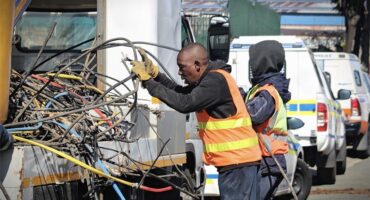
The high cost of power theft: Why Johannesburg’s honest customers keep paying the price
Johannesburg loses billions of rands to electricity theft and ageing infrastructure every year, undermining service delivery and pushing City Power deeper into financial distress. Experts say fixing the crisis will require far more than bigger budgets.
Presenting the City of Johannesburg’s 2026/27 budget, MMC for Finance Loyiso Masuku announced that about 92% of residents now have access to electricity.
She was quick to add, however, that access does not equal reliable supply. “A home connected to electricity still suffers if the network is unstable.”
Masuku acknowledged that the city incurs massive electricity losses, currently sitting at about 27%.
“These losses run into billions of rands that cannot be invested in upgrading the utility’s ageing infrastructure. This is why infrastructure, maintenance, revenue recovery and institutional reform are at the centre of the budget,” she said.
Read more: Bryanston streetlight outages expose wider challenge for City Power
While City Power is allocated a budget of R28.3b in the 2026/27 financial year, the utility faces an infrastructure backlog estimated at more than R40b.
The pain of unreliable supply is felt mostly by paying customers across the city, who, despite being compliant, are regularly plunged into indefinite darkness due to challenges linked to massive non-compliance.
The reasons behind the unreliable supply
City Power spokesperson Isaac Mangena confirmed that electricity theft and infrastructure vandalism continue to be major challenges affecting City Power’s ability to provide a reliable and sustainable electricity supply.
Mangena said the electricity losses are currently at 26.8%, consisting of both technical and non-technical losses.
“Technical losses are mainly caused by ageing infrastructure, overloaded feeders and unbalanced loads, resulting in energy losses across transformers, conductors and other network assets, and are currently sitting at 9% to 11%.
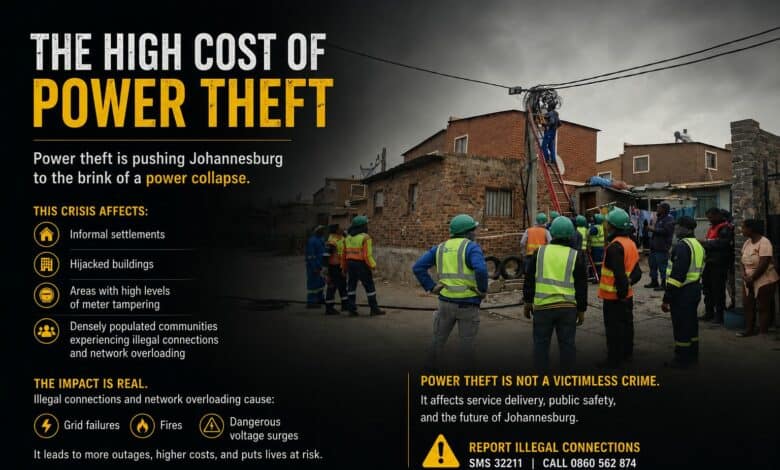
“Non-technical losses are primarily driven by illegal electricity connections; widespread meter tampering; electricity theft; and unmetered consumption, and are currently sitting at 15.8% to 17.8%,” he said.
Also read: City Power says only one councillor pays for electricity in Alexandra
Hotspot areas for the highest levels of electricity losses
According to Mangena, the highest-risk areas are generally associated with:
- Informal settlements
- Hijacked buildings
- Areas with high levels of meter tampering
- Densely populated communities experiencing illegal connections and network overloading
He added that areas of concern identified include parts of Alexandra, Kya Sands, Msawawa, Crown, parts of Roodepoort, Lenasia and the inner city, to name a few.
Losses incurred due to electricity losses
City Power continues to experience significant non-technical losses, which are currently estimated at R4.5b.
Mangena said while the percentage of losses is showing a downward trend, the rand value continues to increase year on year due to factors such as rising electricity purchase costs from Eskom, increased selling tariffs, and higher electricity consumption across Johannesburg.
“The exact value of non-technical losses fluctuates depending on electricity consumption patterns, tariff increases, collection levels, and prevailing network conditions.
“However, the trend indicates that while technical losses have remained relatively stable, non-technical losses have increased significantly since 2011 and have become the dominant contributor to overall electricity losses.”
Total losses increased from about 28.42% in 2020 to 31.86% in 2024, before the current improvement trajectory.
City Power’s projected revenue contribution to the city for the 2025/26 financial year and the actual amount collected
City Power’s projected revenue contribution for the 2025/26 financial year was R25.4b. As at the end of May 2026, actual revenue recorded was R23.1b, with total collections, including prepaid electricity sales, at R21.4b.
As of June 2026, the total outstanding debt owed to City Power stands at about R13.3b, owed by residential customers, businesses and Large Power Users (LPUs) across the entity’s supply areas.
Could the paying customers pay higher tariffs due to these losses in the future?
Mangena said electricity tariffs are not determined by electricity losses alone.
Tariffs are approved annually by the National Energy Regulator of South Africa (Nersa) following a regulated tariff review process that considers several factors, including Eskom’s bulk electricity purchase costs, infrastructure maintenance requirements, operational costs and the long-term sustainability of the electricity network.
Also read: Kew residents endure weeks of electricity disruptions as City Power investigates cable fault
“For the 2026/27 financial year, City Power implemented an average tariff increase of 8.63%, which is lower than both Eskom’s approved increase and those of some other metropolitan municipalities.
“While reducing electricity losses strengthens the entity’s financial sustainability, tariff adjustments remain subject to Nersa’s approval and apply across municipalities through the national regulatory framework.”
However, Johannesburg Crisis Alliance programme coordinator Yunus Chamda argued that City Power’s 27% electricity losses directly affect paying residents through unreliable supply, infrastructure failures, persistent billing inaccuracies and the likelihood of higher tariffs to recover lost revenue.
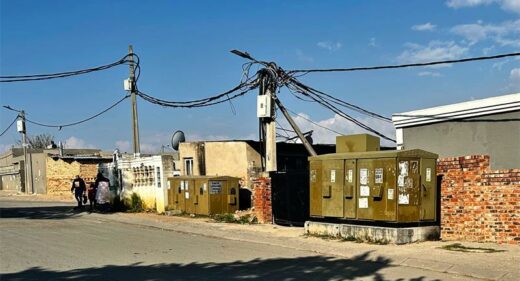
“While anti-theft initiatives are necessary, they have yet to deliver a measurable citywide impact. Stronger enforcement, accurate billing, and accountability are essential.”
How City Power is addressing the issue of electricity losses to ensure reliable electricity supply
To reduce losses and improve revenue collection, City Power has introduced several interventions:
- Deployment of the Intelligent Distribution System (IDS) in high-loss areas to identify meter bypasses, illegal connections and abnormal electricity flows in real time. The IDS monitors supply at the substation level, detects faults downstream, identifies theft, and tracks phase imbalances and reactive energy in real time.
- Smart meter replacement and improved automated metering systems, through the normalisation programme across the city.
- Proactive standby meter and replacement of tampered and bypassed meters.
- Collaboration with the City of Johannesburg’s Revenue Shared Services Centre (RSSC) to strengthen the end-to-end revenue value chain, including data verification, billing accuracy, and post-billing recovery.
- Intensifying public awareness and customer engagement campaigns to encourage payment compliance.
- The recent temporary suspension of all post-paid meter conversions to prepaid, which forms part of a broader review aimed at ensuring that future conversions are handled accurately, fairly, and efficiently.
- As part of City Power’s broader turnaround strategy and efforts to reset the contracts with all of their customers, they have assumed full responsibility for electricity billing from the City of Johannesburg, effective July 1 2025.
Also read: City Power explains delay in fixing Bryanston streetlights amid cable theft crisis
City Power’s interventions’ effectiveness over the years, and what remains a persistent issue
Total electricity losses increased from about 28.42% in 2020 to 31.86% in 2024, before the current improvement trajectory, which is now at 26.8%.
The interventions show positive results in targeted areas.
For example, at mini substation 4209, measured losses reduced from about 15.35% before interventions to 10.80% after IDS deployment, and further reduced following the correction of meter bypasses and other metering issues.
At mini substation 2940, losses were reduced from about 7.23%.
The entity also assumed responsibility for the electricity billing function on July 1, 2025, and since then, billing queries have reduced from approximately 8 000 to below 2 000.
Since the stand-by-stand meter audit programme was intensified in July this year and focused on verifying that every meter is linked to a valid customer account, identifying unbilled customers and improving billing accuracy, City Power teams have successfully audited 124 921 sites.
However, illegal connections and electricity theft remain widespread challenges requiring sustained enforcement and investment.
City Power continues to encourage residents to report illegal connections, electricity theft, corruption, extortion, intimidation or infrastructure vandalism to their Security Risk Management unit on 011 490 7900 / 011 490 7911, or via WhatsApp on 083 579 4497, as well as to report the matter to the South African Police Service.
Also read: City Power bleeds as only 4% of 40 000 customers in Alexandra pay for power
How often does City Power conduct proactive meter audits and compliance inspections? How many were done in the 2025/26 financial year?
The stand-by-stand meter audits are conducted by City Power’s dedicated metering teams across Johannesburg on a weekly basis.
The teams conduct physical inspections, verify meter installations, assess the integrity of metering equipment and ensure that electricity consumption is accurately recorded and billed.

During these operations, City Power does experience challenges, including instances where some customers are reluctant to grant access to properties for meter inspections.
This can delay the completion of audits and limit the ability to identify and resolve potential irregularities.
City Power continues to engage customers and communities on the importance of allowing access for legitimate inspections, as accurate metering protects the integrity of the electricity network and ensures fair billing for all customers.
In February, City Power acting CEO Charles Tlouane said the utility would work with law enforcement agencies to ensure illegal electricity users are arrested and charged.
Illegal connections have been identified and disconnected since the commitment was made.
With more than 300 informal settlements and growing electricity demand outpacing housing delivery, enforcement remains a daily operation for City Power.
While exact totals are updated frequently as operations continue, dozens of major disconnection blitzes have been conducted in the past months, resulting in the removal of thousands of illegal connections and the disconnection of high-debt customers.
Also read: City Power confirms widespread meter tampering on 11th Avenue
Arrests made, charged, and successfully prosecuted.
Between January and May 2026, City Power recorded 433 infrastructure-related incidents across Johannesburg, comprising 112 incidents in January, 97 in February, 65 in March, 89 in April and 70 in May.
During the same period, 97 suspects were arrested for infrastructure-related crimes, with arrests peaking at 31 in April.
During the third quarter of the 2025/26 financial year, 21 suspects were convicted and received a combined 146 years of imprisonment. This represents a 52% increase compared to the same period in the previous financial year, when five convictions resulted in 49 years of imprisonment.
Amount dedicated to infrastructure upgrades, maintenance and revenue recovery for the 2026/27 financial year.
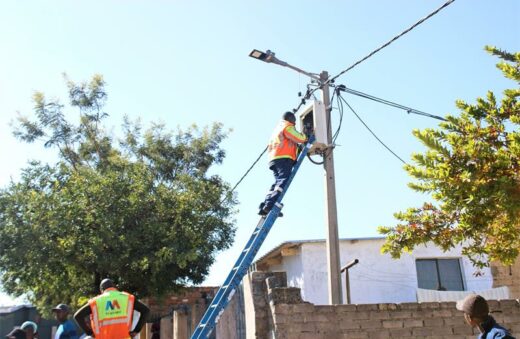
For the 2026/27 financial year, about R2.3b has been allocated towards infrastructure upgrades, including network strengthening, smart metering, bulk infrastructure and revenue enhancement initiatives.
A further R1.3b has been allocated to infrastructure maintenance to improve network reliability and reduce technical losses.
Energy analyst and consultant Chris Yelland says R28.7b alone will not fix the City Power crisis.
While the City of Johannesburg has allocated R28.7b to City Power in the 2026/27 financial year, energy analyst and consultant Chris Yelland believes the funding, on its own, is insufficient to stabilise and modernise the electricity network.
According to Yelland, City Power’s challenges extend far beyond ageing infrastructure and maintenance backlogs.
Also read: Electricity crisis pits neighbour against neighbour
“The problems also involve revenue collection, cable theft, and all kinds of losses in the system. Some of it is criminal activity, poor practices and management, revenue collection, metering fraud, bypassing of meters; there’s a systematic breakdown in the operations of City Power.”
Yelland added that while the utility does face a serious maintenance and infrastructure backlog, its financial position makes addressing those issues increasingly difficult.
“They have a cash flow problem. They owe a lot of money to Eskom. Even if you throw money at the problem, it’s not enough. You need to spend that money wisely. Simply allocating R28.7b is not the solution.”
Energy analyst Ruse Moleshe echoed these sentiments, saying City Power requires significantly higher capital investment than currently allocated if it is to stabilise and modernise its ageing infrastructure.
“The city’s 2026/27 budget includes an operational allocation of R28.3b for City Power, covering staff, contractors, repairs, and day-to-day operations.
City Power’s network is between 50 and 60 years old, requiring extensive reinvestment to ensure long-term sustainability. Electricity losses remain another major concern.
She added that City Power has reported losses of around 27%, down from over 40% previously, but still well above international benchmarks.
Also read: Resident accuses City Power of using blackouts to force payment
“Current allocations support critical repairs and some upgrades; they do not address the scale of infrastructure renewal required to secure long-term reliability.
Experts warn losses already threaten City Power’s future.
City Power has reported electricity losses of around 27%, with non-technical losses alone costing approximately R3.8b annually.
Yelland said when technical and non-technical losses are combined, the utility is effectively losing around 30% of its potential revenue.

“Electricity losses can be divided into technical losses and non-technical losses. Together, they total approximately 30%. No business can stand to lose 30% of its revenue and survive. It is an existential problem when you have losses at this level.”
When do these losses become a threat to the utility’s long-term financial viability?
“It’s already a threat. It is an existential threat to City Power’s long-term financial viability. When we look at City Power’s debt level to Eskom, a real debt, which is approximately R6 billion. That is a symptom that City Power is not able to collect its money the way it should. If you can’t collect your money, you can’t sustain the business.”
Community disconnections do not address the problem.
Yelland said he does not think one should look at it at a community level, nor do I think you should cut off communities, because within those communities are people who do pay for the electricity and who are not stealing electricity.
Also read: City Power says only one councillor pays for electricity in Alexandra
Instead, he believes enforcement should focus on individual offenders.
“Theft and non-payment have to be handled on a customer-by-customer basis, not at a community level. If a customer is not paying, then that customer should be disconnected.”
“Utilities have to work closely with communities and community leaders. Good customer service and strong customer relationships are critical.
Revenue recovery and loss control have to be worked on every day, forever. There is no quick fix. Without a holistic approach, City Power cannot solve this problem.”
Moleshe said improving revenue collection efficiency would be critical to reducing losses, strengthening service delivery, and preventing further deterioration of ageing electrical infrastructure across Johannesburg’s distribution network.

“You need proper customer data, meter audits, and feeder-level analysis. Otherwise, you are just guessing.”
Johannesburg is losing roughly one in every four units of electricity it buys, while City Power faces a backlog exceeding R40b and customer debt of R13.3b.
Analysts warn that unless theft, governance failures and infrastructure underinvestment are unaddressed simultaneously, the utility’s financial position will continue to deteriorate.
Follow us on our WhatsApp channel, Facebook, X, Instagram and TikTok for the latest updates!