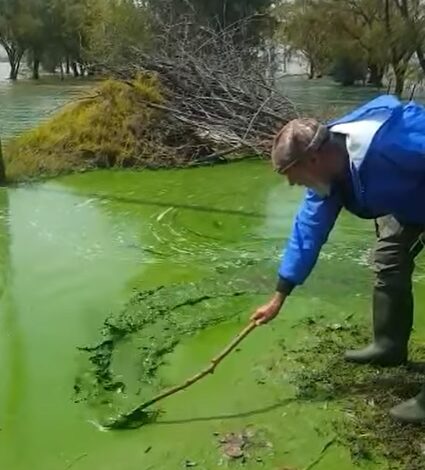
Many small dams from the main dam in the Deneysville area are full of it. As soon as it dries, it acquires a peculiar blue colour.”
So said Bert Stander, who has been fishing regularly in the Vaal Dam for 62 years.
He is not the only one who has noticed in the past two weeks that the water is bright green in some places.
Vaal Dam shore residents who contacted Vaalweekblad (Sedibeng Ster sister newspaper) last week said that they had never seen the dam so green. They also complained that the smell is unbearable.
In addition, they are concerned about the water quality as the Vaal Dam provides drinking water to more than 12 million people.
Residents of Oranjeville reported that they saw a similar green slime that looks like ‘pea soup’ in the vicinity of the Magrieta Prinsloo bridge.
A local water quality expert, who preferred to remain anonymous, said that it is almost 100% certain that the green water is a sign of an active blue-green algae outbreak.
Although it is called algae, it is not really algae but cyanobacteria that thrive in a water environment that is polluted by sewage and industrial wastewater. What makes this type of contamination dangerous is that cyanobacteria not only “steal” nutrients and oxygen from other aquatic life in the aquatic ecosystem, but that they also produce cyanotoxins that can be harmful and even deadly to aquatic species and terrestrial animals.
People who come in contact with such contaminated water can also become very ill.
Some blue-green algae can produce both nerve toxins (neurotoxins) and liver toxins (hepatotoxins). People who get it can show symptoms such as a rash, stomach pain, diarrhea and vomiting, numbness of the lips, tingling in the fingers and toes, as well as dizziness.
In animals, the symptoms include weakness, a stumbling block, difficulty breathing and convulsions, and death can eventually ensue.
Signs of poisoning usually appear within 15 to 20 minutes after ingestion of contaminated water. It is advisable to contact your doctor or veterinarian immediately if you or your pets or livestock show any signs of poisoning.
The organization, CyanoLakes, which monitors outbreaks of cyanobacteria using satellite images, warned on their website on March 14 that a high risk for cyanobacteria has been identified in limited parts of the Vaal Dam since February.
CyanoLakes has warned that water sports that require direct contact with the water of the Vaal Dam will be discouraged as long as the condition persists.
A blue-green algae outbreak usually occurs in the hot summer months, especially from January to March. The first two weeks of March 2022 were particularly hot in the Vaal Triangle and Vaal Dam area, which could have contributed to the outbreak. Good news is that the toxins eventually break down in the water and are naturally destroyed.
* Vaalweekblad inquired with the Department of Water and Sanitation about the current water quality of the Vaal Dam, but had not yet received feedback at the time of going to press.
Rand Water says on their website that the quality of water supplied to local authorities is measured against the World Health Organization’s (WHO) guidelines for drinking water quality.
Although a number of issues have been identified with regard to the current water quality in the Vaal River system, the water provided by Rand Water is safe for human consumption.
At Caxton, every story is written by humans. We use AI only to perform quality checks - never to generate the news. Happy reading!