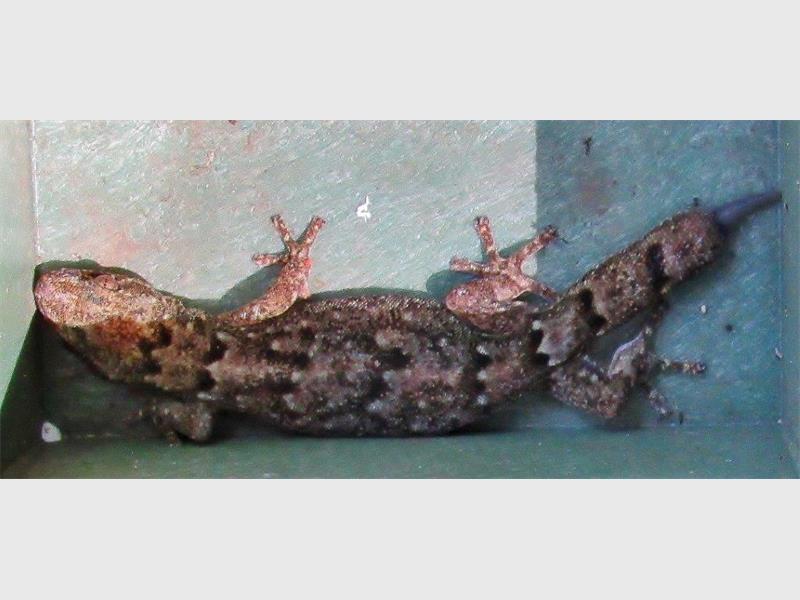
SOUTH Coast Conservation Forum committee member Peter Vos is appealing to local nature lovers to report any sightings of our less common indigenous gecko species.
He said that while South Africa, particularly its western areas, boasted a substantial list of lizard and gecko species, the South Coast did not have too much variety regarding these fascinating little creatures.
“The South Coast’s lizard-list is short, but shorter still is our list of gecko varieties. The place seethes with tropical house geckos (Hemidactylus mabouia). This is technically an alien invader whose natural range extended down from the tropics only as far as Maputaland until it was trans-located internationally, especially by the timber trade,” he said.
Peter explained that the adaptable and aggressive tropical house gecko species was out-competing our natural nocturnal geckos, the endemic Pondo flat gecko (Afroedura pondolia) and the near-endemic spotted gecko (Pachydactylus maculatus) that occurred on the South Coast. Our last gecko, the common dwarf gecko (Lygodactylus capensis) was diurnal. For this reason it was largely escaping direct competition with the house gecko and was flourishing.
The Pondo flat and spotted geckos were both currently classified in the ‘Least Concern’ category, having large ranges for gecko species, and they were widespread and common, according to the Atlas and Red List of Reptiles (Bates et al, 2014).
“Both are small, fat-bodied, around 100 mm long (half of this length being tail) with much fatter tails than the house gecko. The spotted gecko’s tails get hugely fat when food is plentiful.
The Pondo flat gecko has six dark bands on its back. The spotted gecko has four rows of elongated spots. The Pondo flat is a climber, associated with rocky, well-wooded areas and it sometimes enters houses.
The spotted gecko is terrestrial, normally hiding under logs and leaf-litter. They both have scanor pads on their feet that enable them to stick readily to surfaces in true gecko fashion.” said Peter.
An avid and knowledgeable nature lover, Peter has lived on the South Coast for many years. However, he has never seen a spotted gecko and only recently saw his first Pondo flat gecko, on the ground in dense forest in Scottburgh.
“There was nary a rock in sight. Instead it was hiding upside down under an irrigation valve cover. It stayed still for a short time, allowing me one quick snap, then he took his half-regrown tail and scuttled off into the leaf-litter,” Peter said.
In spite of the literature, Peter is concerned about the fact that our indigenous geckos are so seldom seen. He would appreciate information about any sighting, together with photographs and the dates and places where they were spotted. You can contact him at bushboyvos@gmail.com.