Paper recycling continues to rise – but better awareness and separation-at-source still needed
Last year, the paper recycling industry along with conscientious consumers and thousands of informal collectors, kept 1.3 million tonnes of paper products, cardboard boxes and liquid (milk and juice) cartons out of landfill. Enough to cover 233 soccer fields!
Just ahead of World Environment Day on June 5, the Paper Recycling Association of South Africa (PRASA) has announced the country’s 2017 paper recycling rate.
YOU MAY BE INTERESTED IN: From my Hide: Reduce, re-use and recycle for World Environment Day
Last year, the paper recycling industry along with conscientious consumers and thousands of informal collectors, kept 1.3 million tonnes of paper products, cardboard boxes and liquid (milk and juice) cartons out of landfill.
Enough to cover 233 soccer fields!
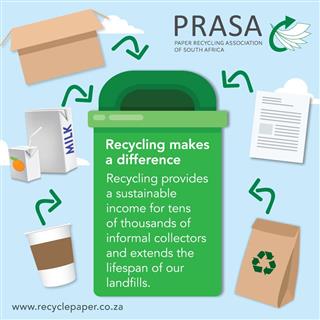
This represents 70 percent of the 1.8 million tonnes of paper available for recovery, and excludes books, archived records and unrecyclable paper like toilet tissue.
“We are delighted with these statistics as they show that people are recycling more,” says Ursula Henneberry, PRASA operations director. In 2015, the association had set a target of 70 percent by the year 2020.
In the past six years alone, a total of seven million tonnes of paper and paper packaging has been recovered for recycling.
“The unsung heroes are our country’s informal recycling collectors along with industry players who operate collection and drop-off schemes,” notes Henneberry.
Considerate waste habits make a big difference
“There is still more that can be done by improving awareness about recyclable paper products and better separation-at-source within homes, at schools and particularly in business and office environments,” she says.
“Conscientious and considerate waste habits can make a big difference, especially for recycling collectors,” says Henneberry. “By keeping paper clean, dry and separate from wet waste, recycling collectors can get more money for what they sell to buy-back centres.” Dry, clean paper produces a better quality fibre for paper manufacturers.
By simply putting paper recyclables into a separate bag (preferably clear), collectors can immediately see that it is for recycling. It also saves them having to dig through your week’s worth of household, school or business waste.
What becomes of your recycled paper and packaging?
Paper that is reclaimed for recycling is repulped at a paper mill and made into sheets of paper and paperboard. These are then converted into products that you use every day:
- Old corrugated boxes and magazines become new corrugated boxes and cartons.
- Newspapers, magazines and mixed paper grades are used to make newsprint and moulded fibre packaging such as egg boxes and take-away cup holders.
- Office paper, newspapers and printer off-cuts can be made into tissue products, kitchen and industrial paper towelling.
- Office paper, corrugated boxes, printer off-cuts and cardboard trims can also be turned into cereal and medicine boxes.
- Milk and juice cartons and paper cups are repulped to separate the paper fibre from plastic and foil layers. Good quality paper pulp is then used to make high-strength paper-based packaging such as boxes and sacks.
Yes, liquid cartons and paper cups are recyclable!
South Africa now has the recycling technology to separate paperboard from non-paper layers in liquid cartons and poly-coated cups and containers.
Juice, custard and long-life milk cartons are made from a mix of at least 75% paperboard, and thin layers of plastic and aluminium (referred to as polyalu). All these layers are necessary for food protection. In the case of paper cups, they comprise mostly paperboard wiith a plastic coating.
After the paper is removed, the plastic and polyalu can be used to make plastic-based products such as pallets, crates and shopping baskets.
Five recycling rules
- Get to know what paper products are recyclable and which are not. Visit www.recyclepaper.co.za.
- Separate your waste.
Separate recyclables from wet waste. Paper items that are wet (used paper plates) or soiled (tissues and disposable nappies) cannot be recycled.
Separate any non-paper packaging from paper or cardboard. - Always keep paper clean and dry as this ensures quality fibre for making new products.
- Make it convenient. Invest in or make a paper-only bin or box for easy sorting. Space permitting, you may want to have smaller paper-only bins around the house – kitchen, bathroom (for cosmetic boxes and toilet roll cores), garage etc.
- Decide what you want to do with your recyclables – have them collected or drop them off? You can also support a local school or community centre if they collect paper for fundraising.
Key dates:
- World Environment Day – 5 June
- World Oceans Day – 8 June
- Cleanup and Recycle SA Week and National Recycling Day – 10-16 September
HAVE YOUR SAY
Like the South Coast Herald’s Facebook page, follow us on Twitter andInstagram
For news straight to your phone, add us on WhatsApp 082 421 6033