Borer beetle from Asia could spell doom for South Coast trees
Pesticides have been proven to be ineffective due to the beetle's ability to hide deep within the tree. According to scientists, the beetle has infested an estimated 200 species of trees worldwide.
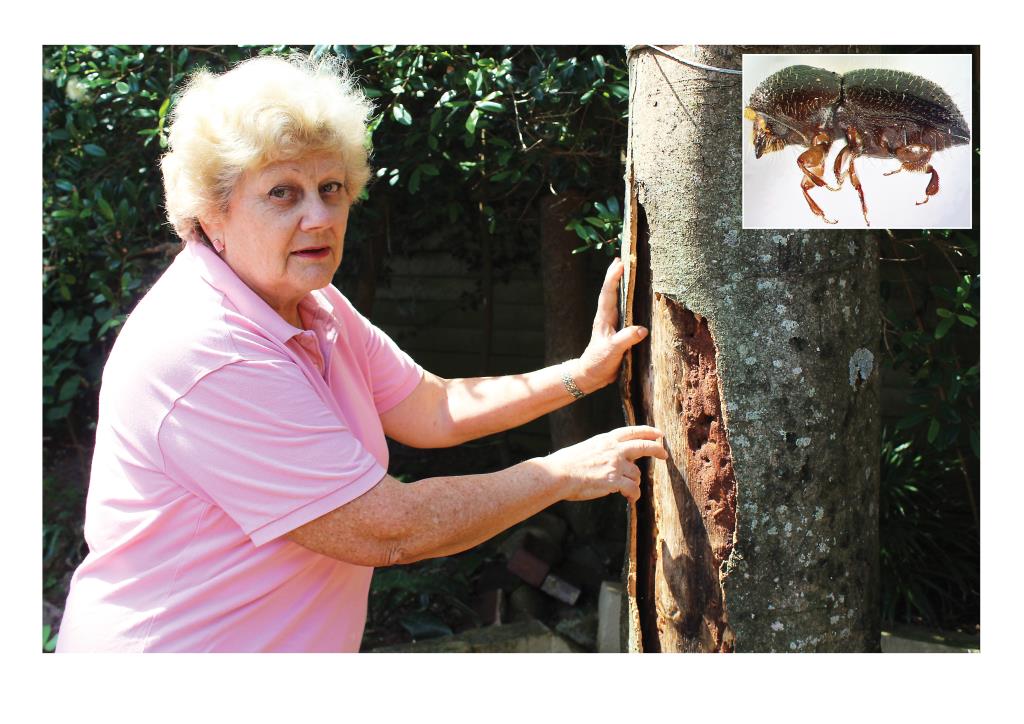
MILLIONS of trees are being killed across the planet by a Southeast Asian beetle known as the shot hole borer beetle and now this species of beetle has landed in Scottburgh.
For months now, the beetle has been targeting a variety of trees in South Africa and was first discovered in KwaZulu-Natal in 2017 when it was found that several London plane trees had become host to the beetles in a street opposite the KZN Botanical Gardens.
Now, this beetle appears to be drilling its way into a Scottburgh local’s trees.
Countless tiny holes, measuring slightly larger than the tip of an average pen, riddle the trees and, inside the holes are a network of tunnels in which these beetles thrive and spread a fungus which will eventually cause the death of the host tree.
ALSO READ: New app will help fight borer threat
The fungus, known as Fusarium euwallaceae ensures that the beetles continue to survive and feed their larvae. The fungus grows within the tree’s vascular system, meaning that the host tree is unable to send vital nutrients throughout its system to sustain its health and growth.
So far, the beetles have struck in the North American state of California, as well as China, Taiwan, Vietnam and Israel.
More locally, the beetle is known to have spread to Johannesburg, George, Knysna, Bloemfontein, Hartswater, Pietermaritzburg and Durban.
Pesticides have been proven to be ineffective due to the beetle’s ability to hide deep within the tree. According to scientists, the beetle has infested an estimated 200 species of trees worldwide.
Dr Trudy Paap of the Forestry and Agricultural Biotechnology Institute, who first discovered the beetle in South Africa, has published a paper on the beetle.
“The fungus grows in the galleries (tunnels) of the beetle and serve as a ‘vegetable garden’ for the beetle larvae, but in susceptible trees the fungus can spread through the sapwood causing disease or even death of the tree. In its native environment in Southeast Asia, it seems as if the beetle and fungus do not cause serious damage because tree species have evolved with the beetle-fungus complex and have resistance towards them.”
ALSO READ: Green group needs your help
It was said that various commercial crop trees planted in South Africa, such as the peach, pecan, orange and avocado trees, are also susceptible to infestation.
From what was discovered at Erica Badsey’s property in Scottburgh, the beetles had infested a Flatcrown tree as well as an avocado tree. The infestation was first noticed some months ago. However, Mrs Badsey only realised exactly what the beetle was following an episode of Carte Blanche some two weeks ago.
According to information, the light brown beetles are male and the darker, almost black beetles are female.
They measure around 1mm in size however some have been measured at 2mm. If you suspect that your tree has been infested with the beetle, contact TreeSurvey via WhatsApp at 082-3597518 and provide your exact location, a close-up photo of the bark as well as a photo of the tree, which will allow for identification of the species of the tree as well as its general health.
Although optional, providing your name and email address would be beneficial should TreeSurvey need to make contact with you.
The Forestry and Agricultural Biotechnology Institute at the University of Pretoria have been sent samples of bark, branches and beetles to confirm the presence of the beetle in the tree. Preliminary examinations indicate that it is the borer beetle however, further examinations are being conducted.
HAVE YOUR SAY
Like our Facebook page, follow us on Twitter and Instagram
For news straight to your phone, add us on WhatsApp 082 421 6033