South Coast scientists help with getting ahead of the Covid-19 curve
Using this system, say the developers, an entire building could be tested at a fraction of the cost of carrying out nasal or throat swabs.
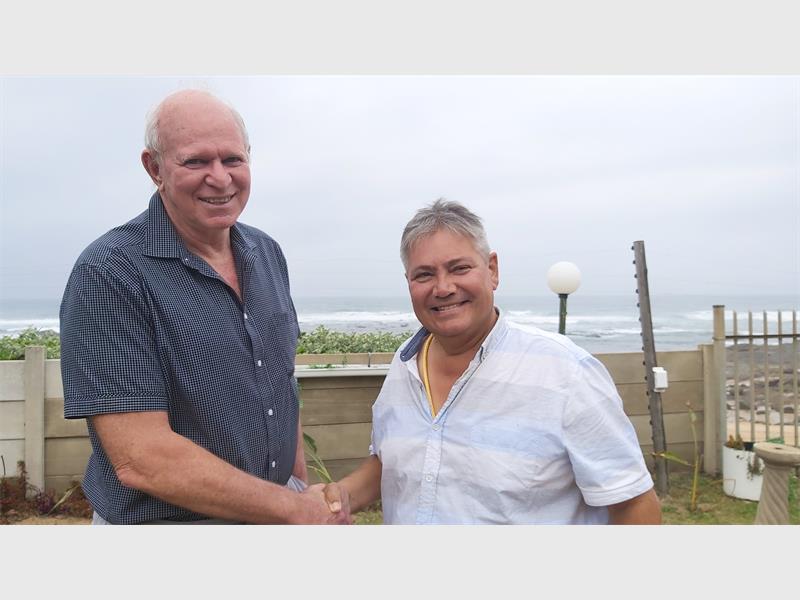
Two South Coast scientists, Professor Anthony Turton and Doctor Giles Hartman, are part of a team which has pioneered a new system for detecting Covid-19 that has enormous implications for identifying outbreaks and containing them quickly.
In an exclusive interview with the Herald, Prof Turton and Dr Hartman described this as a world-first development, ‘bleeding edge’ technology.
“No government is on top of Covid-19, and while they try to flatten the curve we are getting ahead of the curve by managing to isolate/convert ribonucleic acid (RNA) into actual intelligence,” said Prof Turton.
Ribonucleic acid is a nucleic acid present in all living cells.
Covid-19 is a global, multi-dimensional problem and Prof Turton pointed out that it was now about how to move forward to assist people and companies, restoring investor confidence, creating jobs and improving cash flow.
He specialises in water resource management, is the founding member of the South African Water Chamber, and also the director of a company called Virdect.
After the Netherlands research agency KWR entered into an agreement with the South Africa Business Water Chamber in April, Prof Turton and the team tracked down a laboratory based in Howick where they were able to extract Covid-19 RNA from various sewage samples taken in Gauteng.
“Human waste carrying forensic evidence can be harvested if done correctly,” explained Prof Turton.
Virdect was founded in 2020 with the aim of being the ‘first alerter’ to the presence of Covid-19 and other infectious diseases, through science-driven, forensic-based technology, focused on waste water testing.
Its key distinguishing feature is its site-specific testing technology, and the company is launching a pilot programme in the greater Toronto area in Canada, with a focus on schools, senior-care facilities and condominiums/apartments.
Founder, Dave Oswald, said wastewater testing was “a brilliant answer to the problem of detection”.
“We collect samples upstream at specific sites and can narrow it down to a room in a building, school or long-term care facility.”
Prof Turton said the detailed logistics of collecting the sample and transporting it to the laboratory for testing was what made this a benchmark process.
“We have been able to make the haystack smaller in order to find the needle (the virus),” he added.
Mr Oswald said wastewater testing had been hailed recently by public health authorities and research scientists as “an early warning system”.
“We are so much closer to pinpointing the precise location of an outbreak – potentially even down to a specific floor of a building – that we can advance an isolation schedule by days.
“In the case of an epidemic like Covid-19, that translates into massive savings in lives and money.”
Prof Turton said that using this system, an entire building could be tested at a fraction of the cost of carrying out nasal or throat swabs.
“We have experts right here in South Africa who are able to provide comparative virus data to detect any deadly virus in a waste water system.”
HAVE YOUR SAY
Like the South Coast Herald’s Facebook page, follow us on Twitter and Instagram