What’s ‘Appening’ with our shad
Finally, a fish identification App designed especially for the South African marine angler and fish enthusiast.

Shad season opened on December 1.
In South Africa shad season closes on October 1 and remains closed until the November 30.
This seasonal ban, designed to protect the shad during its peak breeding season, has been in effect since April 2005 and has proven most valuable in maintaining the South African shad stocks.
However, before the season re-opened the Herald fielded phone calls from concerned fishermen about the fish being illegally caught.
The Herald contacted the Department of Environment, Forestry and Fisheries (DEFF) for a response.
Zollie Nqayi of DEFF said the Fishery Control Officers (FCOs) from the department, together with the South African Police Services and other law enforcement partners, are responsible for the implementation of the Marine Living Resources Act (MLRA) along the KZN coastline, which includes the strip from Hibberdene to Port Shepstone.
The department in collaboration with law enforcement agencies also deploys operations in terms of Operation Phakisa, the Enhanced Coordinated Marine Protection Enforcement Programme, to address transgressions against the Marine Resource Act (MLRA) of South Africa.
Mr Nqayi said the fine is R500 for a person who transgresses the Marine Living Resources Act when they exceed the bag limits or by catching fish which are under the legal size limit.
A maximum fine of R5000 may be issued for up to 10 fish which are in excess or undersize.
Repeating offenders can also be arrested and criminally charged without being given an option of paying an admission of guilt fine.
If a person is in possession of more than 10 fish in excess or undersize, the suspect will be arrested, a criminal case will be opened without the accused having the option of a fine and the accused must appear in the local magistrate’s court.
The magistrate will determine a guilty or not guilty verdict based on the evidence presented.
Is the department seeing an increase in poaching?

No, says Mr Nqayi.
“What we see is a prevalence of community awareness about oceans’ activities including poaching and perceived poaching activities,” he said.
The public can report incidents to the following email address: environment@thehotline.co.za or call 080 020 5005 to report irregular marine activities.
Let’s obey the fishing regulations
According to the South African Association for Marine Biological Research (SAAMBRA) there are a limited number of shad in the ocean.
Over-fishing results if anglers catch more than can be replaced by their breeding.
To prevent this, there are fishing regulations in place to control the number of shad that are caught.
* The minimum size limit for shad is 30cm total length.
Minimum size limits give fish a chance to breed at least once before they are caught and protects the fish when they are growing at their fastest.
* The bag limit for shad is four per person per day. Bag limits restrict daily catches so that there will be enough fish for everyone. Scientists work out how many fish can be harvested safely. This information is used to set a bag limit that restricts the number of fish that can be caught per angler per day. This prevents more successful anglers from catching great numbers of fish, especially when the fish are ‘on the bite’, so leaving some behind for less successful anglers.
* The closed season for shad is October 1 to November 30. Closed seasons protect fish during vulnerable stages in their life cycles. The shad closed season protects the fish at the peak of their breeding season.
* You may not sell shad caught in KZN. The reason for this regulation is to help protect adult shad that migrate to KZN each year to breed.
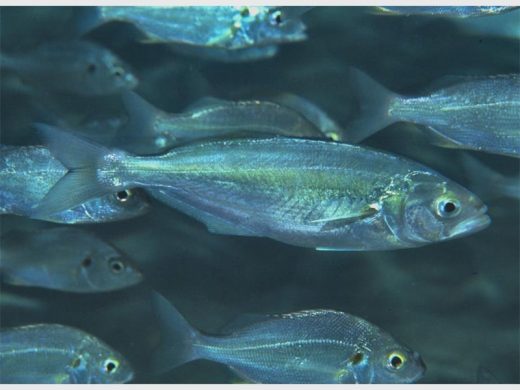
Shad, also known as elf, are one of South Africa’s most popular angling fish and they are pursued by hundreds of thousands of anglers every year. Their streamlined bodies are perfectly shaped for speed through the water and their silvery coloration, light beneath and metallic green or blue above, helps them to blend in with the ocean.
Shad are widely distributed in the warm temperate coastal waters of the Indian, Atlantic and Pacific Oceans. The South African stock is, however, distinct which means that we alone have the responsibility to look after the shad along the coast. Shad are found in sandy and rocky areas from the shore down to depths of 100m.
Fish App a first for South Africa
Finally, a fish identification App designed especially for the South African marine angler and fish enthusiast.
How many times have you seen a fish and wished you knew what it was? Or wished that you could simply measure your fish and know instantly what it weighed? Or that you could work out which species of kob you had landed?
Many years ago, Rudy van der Elst produced the popular ‘A Guide to the Common Sea Fishes of Southern Africa’, a book that became the ‘go to guide’ for anglers and fish lovers along the entire South African coast. But times have changed, and most people now have a cellphone in their pocket.
Imagine if you could have brilliant photos, up to date information, distribution maps, current regulations, a way to compare similar species and a length-weight calculator for 249 of the most common fish species caught along the South African coast.
Dr Bruce Mann of the Oceanographic Research Institute based at SAAMBR in Durban has produced the perfect App for you.
This App, which is a first for South Africa, is brilliant in that it contains information about the fish, closed seasons, the bag and size restrictions as well as the fishes natural behaviours and other interesting bits of information.
A fish scientist and a fisherman with over 30 years of experience, Bruce is the right person to compile the App. Not only does he have an in-depth knowledge of the 249 species in the App, but he also understands the needs of anglers.
Bruce has spent nearly two years working on the App, making sure the information is accurate, and easy to use.
All proceeds from the sale of the App will go towards the ORI Cooperative Fish Tagging Project. This means that every App sold will be supporting a better
understanding of our linefish.
“We made this App because of our passion for South Africa’s linefish. Collating all the information and photos for 249 species, and producing the App took longer than we ever imagined. We hope that anglers will enjoy using the App to learn more about the fish they catch. And we hope that the App will inspire everyone with an interest in fish to care a little more about our amazing linefish,” said Dr Mann.
‘The App is based on linefish research undertaken in South Africa over the last 50 years and includes the most recent information available. Each species profile was carefully researched and then written so that the information is accessible and easy to understand.
Dr Larry Oellermann, CEO of SAAMBR expressed his delight at the production of the App.
‘This is something I’ve dreamed of for years; a way of figuring out what species I’ve caught, and all the information I need to know about it. Now I have fifty years of linefish research, at my fingertips.”
To download the App go to the App store on your phone and search for Marine Fish Guide of Southern Africa.
Overfishing killing stocks
World Fisheries Day was celebrated last month throughout the world by fishing communities, non-government officials, fishing associations and government departments. The day helps to highlight the critical importance of fish and the lives they sustain, both in and out of water.
A recent United Nations study reported that more than two-thirds of the world’s fisheries have been overfished or are fully harvested and more than one third are in a state of decline because of factors such as the loss of essential fish habitats, pollution, unsustainable fishing methods and global warming.
Unless we address these issues such as collectively, the crisis will deepen.
HAVE YOUR SAY
Like the South Coast Herald’s Facebook page, follow us on Twitter and Instagram