Paws in Wars: Sergeant Stubby
Paws in Wars is a weekly series about the brave dogs who served their countries under fire.
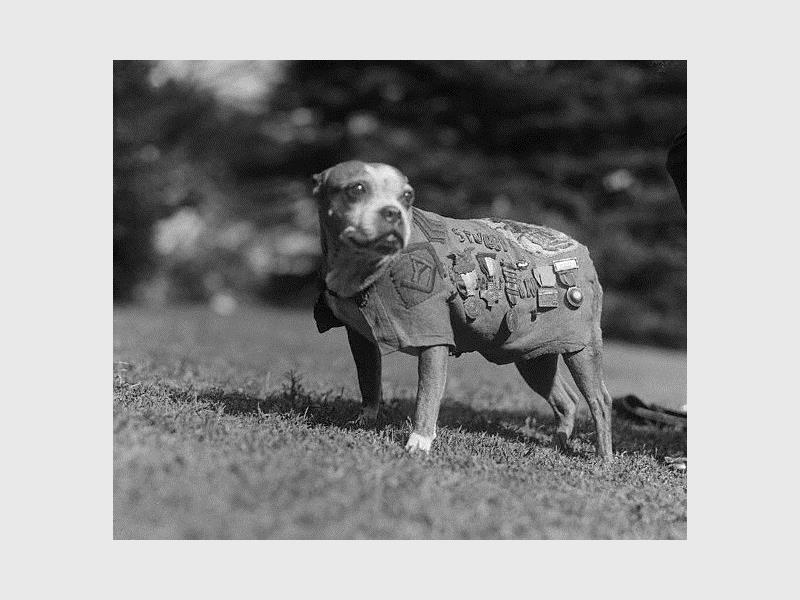
For eighteen months, Sergeant Stubby served with honour in the 102nd Infantry Regiment in France, taking part in seventeen battles. This is his story.
Stubby was a Boston terrier who was found wandering about the grounds of the Yale University in New Haven, Connecticut in July 1917. Members of the 102nd Infantry were using the grounds of the university for training purposes prior to overseas deployment in the First World War.
One soldier in particular, Corporal James Robert Conroy (1892-1987), took a liking to him and when the time came to ship out, Conroy smuggled Stubby on board the troop ship. When the troops disembarked in France, James hid Stubby under his topcoat. When he was discovered by Conroy’s Commanding Officer, Stubby saluted him as he had been taught. This impressed the Commanding Officer so much, that he allowed Stubby to stay!
Stubby entered the war on February 5, 1918, at Chemin des Dames, north of Soissons in France. During the April of 1918, his regiment was constantly under fire and during a raid on Seicheprey, Stubby was wounded in the foreleg by a German grenade and was sent back behind the front lines for medical attention and just as he had done on the front lines, he greatly improved the morale of his wounded comrades.
Upon recovering from his wounds, Stubby rejoined the battle. During his first year of service, Stubby inhaled deadly mustard gas and fell ill. After his recovery, he re -joined his regiment with a specially fitted gas mask. Thereafter, Stubby was invaluable at warning his unit of any impending mustard gas attacks. He would also locate wounded soldiers in no man’s land, and his acute hearing detected the whine of incoming artillery shells before humans could, thus, his barking would warn his unit to take cover!
He was solely responsible for capturing a German spy in the Argonne by hanging onto his pants until help arrived, causing their unit’s commander to nominate Stubby for the rank of Sergeant.
The women of the town honoured Stubby by making him a chamois leather tunic upon which to pin his many medals,
At the end of the war, Robert Conroy smuggled Stubby home with him where he became a much loved mascot, marching in and leading many parades.
In 1921, General of the Armies, John J. Pershing presented Stubby with an award from the Humane Education Society media. During that same year, he attended Georgetown University’s Law Centre with Conroy and was Georgetown Hoyas’ team mascot, (at half time, much to the delight of the crowd, he would nudge a football around the field.).
Stubby died peacefully in his sleep in March 1926. After his death, he was preserved by way of taxidermy and is currently on display at the Smithsonian National Museum of American History.
(Source: Wikipedia).
Next week we become acquainted with Judy.
Paws in Wars is a weekly series about the brave dogs who served their countries under fire.
HAVE YOUR SAY
Like the South Coast Herald’s Facebook page, follow us on Twitter and Instagram