Paws in Wars: ‘Sergeant’ Judy’s military career
Paws in Wars is a weekly series about the brave dogs who served their countries under fire.
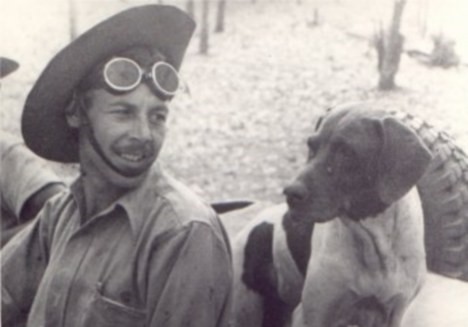
Able seaman Jan “Tankey” Cooper was given the responsibility of being the “Keeper of the Ship’s Dog” Judy. He was also the ship’s butcher. Judy was given an open box and a blanket to sleep on in the kitchen and she enjoyed the bits of meat and bones with which Jan kept her amply supplied. Judy’s acute hearing was a boon to the Navy, for she picked up the sound of approaching hostile Japanese aircraft long before any of the human crew could. Her “early warning system”, saved many lives. On an outing to Jiujiang, Cooper took Judy for a walk outside the city.
After a while, Judy began to run ahead dragging Cooper with her, much to his annoyance. But when he looked back, he was horrified to realise that she had been pulling him away from a leopard who had obvious designs on him for dinner! In November of 1937, the Gnat met with the American river gunboat USS Panay.
After spending time partying on aboard the Panay, the crew disembarked to return to the Gnat. The sailors only realised later that Judy was missing. They contacted the Panay via signal lamp, who replied that they had not seen her.
The following morning, the crew heard from a Chinese trader that Judy was indeed still on board the Panay. In retaliation, a party of crewmen from the Gnat boarded the American vessel and stole the ship’s bell, after which they contacted the Panay, offering them their bell back in return for Judy. She was returned within the hour.
In early 1938, Cooper was sent back to Britain, along with Judy, as part of the crew rotation. While their transport ship was docked in Hankou, Judy took a liking to another Pointer onboard a French gunboat called the Francis Garnier. The two ship’s companies held an impromptu wedding ceremony for the happy couple and the French pointer, Paul, remained aboard the Gnat for three days before returning to his ship.
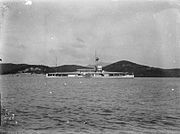
Judy conceived and gave birth to thirteen puppies. Ten of them survived and homes were found for them; one was destined for the Francis Garnier and another, the American gunboat USS Guam. Judy was involved in a nasty incident in October of that year, which curtailed her trips ashore in Hankou. Whilst being walked by two sailors from the Gnat, they were accosted by Japanese soldiers, one of whom dared to point a loaded rifle at Judy!
He was thrown into the Yangtze River for his pains. During the ensuing days, several Japanese officers came on board the Gnat and it was finally decided that it would be better for all concerned if Judy was confined to the ship. In June 1939, the larger Locust class gunboats arrived on the Yangtze River to take over operations from the Insect class vessels. A number of the crew of the Gnat transferred to HMS Grasshopper, including Judy.
After the British declared war on Germany in September of that year, several of the river gunboats, the Grasshopper included, were redeployed to the British base in Singapore. On the voyage, Judy suffered dreadfully from sea sickness but the crew saw to it that she was exercised regularly and properly hydrated. Fortunately, by the time the ship reached her destination, Judy had recovered. Initially the stay in Singapore was uneventful, with Judy staying with a customs official and his family for a week to acclimatize.
The HMS Grasshopper rode at anchor for much of the time until January 1942, when she was deployed with other gunboats to provide covering support along the coast of Malaya for the retreating troops and the occasional evacuations of personnel. The Battle of Singapore took place between February 8 and 15, 1942.
By February 11, the HMS Grasshopper and its sister ship the HMS Dragonfly were the largest vessels still stationed in Singapore. On February 13, the two ships were ordered to evacuate all remaining personnel and to leave Singapore. The two ships weighed anchor at 9pm that night, travelling in convoy.
They headed for Sinkep Island hoping that the island group it was part of, could be used as a hiding place. As they approached the island, Judy barked furiously, heralding the approach of Japanese aircraft and the anti-aircraft gunners took up their positions in readiness. The Grasshopper was hit with a single bomb before the planes passed overhead. Judy was below decks when they returned for another attack.
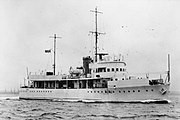
The Dragonfly was mortally hit by three bombs and sank. The Grasshopper was hit by a further two bombs, and the order was given to abandon ship as a fire was spreading dangerously close to an ammunition compartment. Life boats were lowered and the crew and evacuees were ferried just over a hundred yards to shore whilst the Japanese planes attacked the vessels.
It was only when they were ashore that they realised that Judy was not with them. He boarded the vessel, descending to below decks to search for any items that might be of use to the shipwrecked personnel. Miraculously, and to his utmost joy and relief, while he was searching in the gloom, he found Judy trapped under a row of lockers. He constructed a crude raft out of materials floating in the stricken Grasshopper and rowed the supplies which he had salvaged, along with Judy, back to the island.
The scarcity of water was becoming a grave problem, that is, until Judy began digging at a point near the waterline. It took just a couple of moments before she had managed to unearth a fresh-water spring and thereby, was credited with saving the survivors lives.
Next week: Sergeant Judy is taken prisoner. Paws in Wars is a weekly series about the brave dogs who served their countries under fire.
HAVE YOUR SAY
Like the South Coast Herald’s Facebook page, follow us on Twitter and Instagram