Paws in War: Smoky
She served in the South Pacific with the 5th Air Force, 26th Photo Squadron and flew 12 air/sea rescue and photo reconnaissance missions.
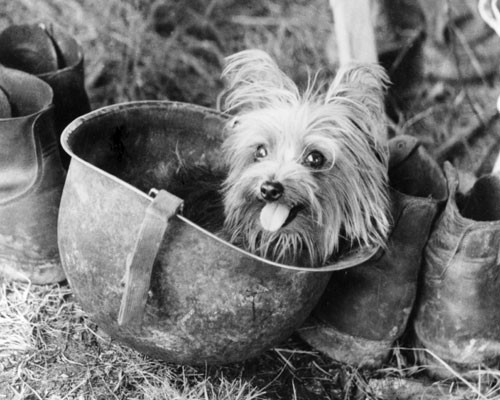
In February 1944, Smoky was found by an American soldier in an abandoned foxhole in the New Guinea jungle.
The soldier initially thought that the dog belonged to the Japanese, but after taking her with him to a Japanese prisoner-of-war camp, he soon realized that she did not understand commands in either Japanese or English, it was later discovered that she “spoke” French.
“Smoky” was eventually sold by the soldier to Corporal William A. Wynne of Cleveland, Ohio, for two Australian pounds and they remained inseparable right up until Smokey’s death in 1957.
SMOKEY’S MILITARY SERVICE DURING WORLD WAR TWO:
For two years, Smoky accompanied Wynne on combat flights, tucked into his back pack. While in the Pacific, she faced very difficult circumstances, living in primitive conditions in tents with Wynne in the sweltering heat of the New Guinea jungle and Rock Islands.
She shared Wynne’ rations and as a treat, sometimes, a tin of spam. Smoky had no access to a vet, like many other “dogs of war” did, nor did she have any special dog food to eat. Despite this, Smoky was never ill.
She served in the South Pacific with the 5th Air Force, 26th Photo Squadron and flew 12 air/sea rescue and photo reconnaissance missions. On these flights, she was required to dangle in a soldier’s pack for hours near machine guns which were firing continually at enemy fighters. She took part in twelve combat missions for which she earned eight battle stars.
Smoky lived through 150 air raids on New Guinea, also making it through a typhoon at Okinawa. She even parachuted from 30 feet (9.1 m) in the air, out of a tree, using a parachute made especially for her! Wynne credited Smoky with saving his life by warning him of incoming shells on an LST (transport ship), calling her, “the angel’ from a foxhole.”
Once, as the ship’s deck was booming and vibrating from anti-aircraft guns, Smoky warned Wynne in time to duck the fire that hit eight men standing next to them.
Smoky became an entertainer when the pair was on R&R. She learned tricks, which she performed much to the delight of troops with Special Services, and also in hospitals from Australia to Korea. In 1944, the Yank Down Under magazine named Smoky the “Champion Mascot in the Southwest Pacific Area.”
Smokey’s abilities to follow instructions came in handy when she was required to help engineers to build an airbase at Lingayen Gulf, Luzon, a vital airfield used for the Allied war planes. The Signal Corps needed to run a telegraph wire through a 70-foot-long (21 m) pipe which was 8 inches (200 mm) in diameter.
Sifting soil had semi blocked the pipe, filling as much as half in places, giving Smoky just four inches of headway to pull a string through the pipe, which was tied to her collar and then to a wire.
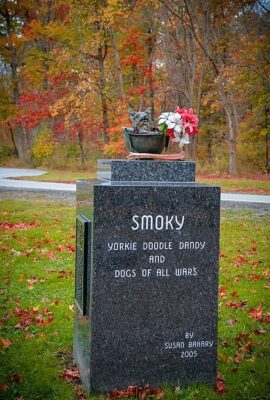
Photo: Wikipedia
When she was part of the way through the pipe, the string got caught, but she managed to pull it loose and carry on. For a while, her owner wasn’t sure if she would make it through, until he saw her bright button eyes appear at the opening to the pipe. The engineers patted and made a great fuss of her.
Smoky’s bravery had saved as many as 250 ground crewmen from having to move United States fighters and reconnaissance planes out of the way, while a construction detail dug up the taxiway, placing the men and the planes in danger from enemy bombers. What would have been a dangerous three-day digging task to place the wire, was instead, completed in minutes.
When Wynne and Smoky arrived home after the war in 1945 and over the next 10 years, the pair travelled all over the world, show casing Smoky’s remarkable skills, which included walking across a tightrope blindfolded. She appeared with Wynne on the television and eventually they had a show of their own on Cleveland’s WKYC channel called Castles in the Air, (Smoky performed in 42 television shows, never repeating a trick) and the pair were also much sought after to entertain patients at veterans’ hospitals.
According to Wynne, Smoky entertained millions during late 1940s and early 1950s.
On February 21, 1957, “Corporal” Smoky died unexpectedly at the age of 14. Wynne and his family buried Smoky in a World War II .30 calibre ammunition box in the Cleveland Metro parks, Rocky River Reservation in Lakewood, Ohio.
NOTE: According to an Animal Planet investigation, Smoky was the first recorded therapy dog. Her service in this arena began in July 1944 at the 233rd Station Hospital in New Guinea, where she accompanied nurses to see the incoming battlefield casualties from the Biak Island invasion.
Smoky was already a celebrity of sorts, as her photograph was in Yank magazine at the same time, which made it easy to obtain permission. Dr Charles Mayo, from the world renowned Mayo Clinic, was the commanding officer who allowed Smoky to go on rounds and also permitted her to sleep with Wynne in his hospital bed for five nights. Smokey’s work as a therapy dog continued for 12 years, during and after World War two.
(Source: Wikipedia)
HAVE YOUR SAY
Like the South Coast Herald’s Facebook page, follow us on Twitter and Instagram