IT is hard to describe the incredible love I have for that wonder-filled and infinitely beautiful chunk of arid southern African wilderness known as the Kgalagadi Transfrontier Park.
All of South Africa’s national parks are national treasures. All have something very special to offer and I could happily spend an extended holiday in any of them but I have to admit that I do have a favourite.
When that burnt orange Kalahari sand first found its way into my shoes it also drifted into my heart. To me, the Kgalagadi National Park has been a very special place for many years.
Fortunately Bill is just as smitten as I am. We go back there as often as we can. Our first visit was in 1997, when the South African side was still known as the Kalahari Gemsbok Park. Two years later, this national park and the adjoining Gemsbok National Park in Botswana were melded into the vast transfrontier or peace park, nearly twice the size of Kruger national park, that we know and love today. It is recognised as one of the most pristine wildernesses in the world.
Since our first visit we have made four return trips to the Kgalagadi. On our most recent stay, two years ago, we spent nearly a month exploring it. In spite of all the time we have been in the park, there are still massive areas we have not yet seen.
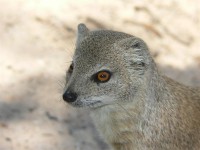
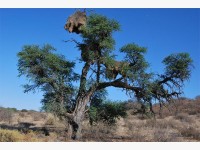
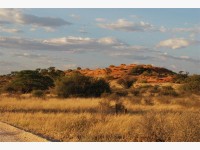
It is a place of red and ochre, pink and grey sand dunes, of dusty roads, of sparse, yellow-tinged grasslands, spiky grey green bushes, stunted trees and majestic camelthorns. While it lacks the plethora of plains animals seen in the better-watered parks, it provides incredible encounters with big cats and smaller carnivores, dryland antelope like springbok, gemsbok and red hartebeest, dancing ostriches and many fascinating little creatures.
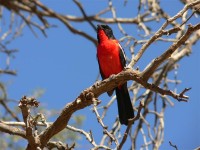
Birding is exciting, too. Raptors, from the massive martial eagle to the tiny pygmy falcon, are well represented. Tiptoeing secretary birds, pale chanting goshawks and graceful bataleurs are everywhere and there are resident lanner falcons, lying in wait, at almost every waterhole. There is also a fascinating suite of dryland birds to keep us twitchers twitching.
The Kalahari, in which the Kgalagadi is situated, is usually referred to as a desert although it is actually an arid region rather than a true desert . The south western section of the park, with its duneveld, is the most desert-like part. The north eastern part is mostly arid savannah, dry yellow grasslands scattered with scraggly trees.
It is a place of many moods, changing with the seasons, the light and even the hour of the day, and this is part of the Kgalagadi’s endless appeal. No two visits – no two minutes – are ever the same.
Two fossil rivers – they only flow after exceptional rains – meet at Twee Rivieren, the largest of three South African public rest camps and the main entrance to the South African side.
A road follows the Auob River north west to Mata-Mata, the smallest of the three South African rest camps, and the Namibian border post. The Nossob River, which forms the border between South Africa and Botswana, and its paired road, pass the third South African rest camp, Nossob, then they head further north to reach Namibia at Union’s End, the most northerly point of what was the Kalahari Gemsbok.
The three South African camps are comfortable, attractive and well maintained. All now have swimming pools, which are a godsend on those hot Kalahari days. They offer pleasant self-catering accommodation and perfectly lovely camping sites, spotless ablution blocks and an amazing array of wildlife. There are also a number of well-appointed, exclusive, self-catering wilderness camps in remote and beautiful parts of the park.
If you head into Botswana, however, be completely self-contained and prepared for very limited facilities – but these camp sites, all very basic, unfenced and isolated, offer premium wilderness experiences.
We have visited the Kgalagadi during the harsh, dry winter months and at the height of summer when the dune valleys are transformed into flower gardens and the great Kalahari storms rage. It was spring when we last visited the transfrontier park. A little rain had fallen and the river beds were flushed with green. The camelthorns and other acacias were quite magnificent in their bright spring greenery and there were baby animals everywhere.
Over the years we have accumulated so many magical memories of this ever-changing, always enthralling arid wilderness, To choose just one favourite memory is almost impossible, so to try and explain why we and so many other people love the Kgalagadi, let’s go back to the very beginning – to the first day of our very first visit.
It has been a long, hot, dusty drive to Tweerivieren Rest Camp at the entrance of the park. We have chosen our camp site and set up our tent. Now we have about an hour before gate closing time to take a look at this park about which we have heard so much. Perhaps we will even catch a glimpse of one of the famous Kalahari lions.
We drive into a hot, dry, dusty, grey world – an empty, monochrome world, a great expanse of nothingness. For quite a while we don’t even see any animals, let alone any of the much-talked-about great cats. We find the nothingness of the place almost overwhelming.
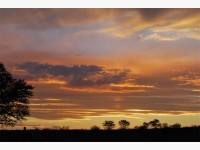
After a while we turn off the main road and head up the calciferous white Auob bank to a viewpoint that overlooks this dry fossil river. A solitary jackal trots past and below us a small herd of gemsbok suddenly appears. The washed out, late afternoon sky turns pearly then reddens as the setting sun bronzes the swirling dust.
As the hot dry air begins to cool an end-of-day gentleness seeps into this harsh landscape. The world is suddenly at peace – and so are we. The nothingness of this strange place, we begin to realise, is the illusion that conceals the magic of a dryland. Bursting with life, it slowly reveals its many wonders to those who grow receptive to them.
The barking geckoes are beginning their strange evening symphony as we drive back to camp. We have seen such a tiny, little bit of this amazing national park that at first confounded us, but already we have an inkling of what it is all about – and already we are both smitten.