THE Northern Cape’s Mokala National Park, proclaimed in 2007 and one of the newest members of the Sanpark stable, is in the middle of nowhere. Literally. And it is this that makes it so interesting.
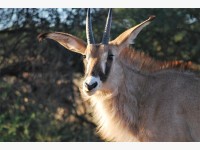
It is a place where east meets west. Near Kimberley, it falls in the transitional area between South Africa’s western drylands and its moist eastern regions. On a north-south axis, it straddles two great drylands, the Kalahari and the Karoo. Although not a big-five park, this in-between place offers suitable habitat for a wide range of antelope and plains animals. Because of this, one of its main functions is to protect and to maintain a breeding programme for rare and endangered antelope. Two of its star attractions are its herds of roan antelope and the sable.
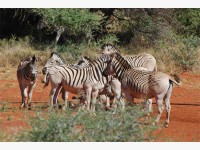
It is also home to both black and white rhino, lovely herds of disease-free buffalo, tsessebe and their look-alike red hartebeest, and both the black and blue wildebeest. The zebras are particularly striking, big, strong animals that have been selectively bred for their qwagga-like pale rumps. The springbok herds include some rare black specimens and we also spotted one with a coppery sheen. Then there are mountain reedbuck, giraffe, plenty of gemsbok, eland, some truly magnificent kudu with massive horns, ostrich, impala, duiker and steenbok.
Being a transitional area, Mokala offers a broad spectrum of avian residents, too, including enough LBJs and other difficult grassland species to keep the serious twitchers busy. Even in camp, our binocs were always handy and we whiled away a good couple of hours enjoying some relaxing armchair birding there.
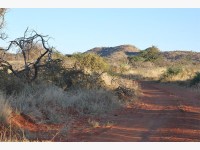
The vegetation, typical of the drier areas, is also interesting. Mokala gets its name from the Setswana word for the camelthorn (kameeldoring), a striking arid-area survivor that is one of the rugged trees to be found in the reserve. It really is a lovely park from a scenery point of view. We were there in summer, when the green vegetation contrasted dramatically with the red earth and rust and burgundy rocks. It was gorgeous.
A low range of rocky hills encircles the undulating thornveld and grassland that dominate the main area. The more remote Lilydale section of the park is flatter, offering grand vistas of sweeping grasslands and a small birdhide, overlooking a pan and a view that seems to go on forever.
Mokala’s visitor facilities are excellent. We were among the last campers to be accommodated in the rustic Haak and Steek camping ground and we had this lovely spot all to our selves. However, we had a look at the luxurious new Motswedi camp, where campers are now accommodated. It is most impressive. Each stand has its own ablution facilities and a kitchenette, equipped with gas burner and fridge, all powered with gas and solar power. Like Haak and Steek camp, it has its own waterhole, too. It really is a luxurious set-up and camping there must be a pleasure but I am glad we had the privilege of staying at the more rustic camp before it was decommissioned.
Generally, the park accommodation is pretty up-market and includes attractive self-catering chalets and a couple of lovely lodges, including the remote Lilydale, beautifully situated on the cliffs above the Riet River. A first-class restaurant at the park’s main reception area offers great, reasonably priced food, an imaginative menu and friendly service. There is a well-established network of tourist roads that all offer excellent game viewing although we also had some of our best sightings in camp at the waterhole there.
Near the camp, the Doornlaagte and Kameeldoring Loops form a figure of eight and offered us a good couple of hours worth of lovely scenery and interesting game viewing, tree-hugging and birding. The Tsessebe Loop, near the main entrance and en route to the reception area, proved to be the most scenic loop but we found the Matopi Loop the most rewarding, game-wise. The shady Matopi picnic site halfway along the loop proved a wonderfully remote spot to while away an hour or two in blissful solitude.
All the picnic spots are attractive and well-appointed and there are a number of waterholes. The large hide overlooking Stofdam was never disappointing. Not only did it offer interesting birding but good sightings of larger mammals as well.
We’ve only managed one, five-day stay at Mokala, two years ago, on our way home from a holiday in the Kgalagadi Transfrontier Park. We’d heard so much about the park from fellow travellers who’d been there and who had unanimously given it rave reports. It certainly didn’t disappoint and we would return to fascinating and well-run Mokala at the drop of a hat.
While we had so many great experiences there, my favourite memory has to be of an unforgettable afternoon sitting on our tent ‘stoep’ overlooking the Haak and Steek waterhole. A constant parade of blue wildebeest, hartebeest, tsessebe, springbok and zebras keeps us thoroughly entertained for a good couple of hours, then we are delighted when a white rhino and her baby come down to the water.
There is a lull in the afternoon viewing until the meercats arrive. The colony stays quite a while and is such fun to watch. When these dear little creatures eventually leave, the sun is low in the sky and suddenly it is rush hour at the waterhole. We are absolutely entranced when a herd of gorgeous roan antelope join the many visitors drinking and wallowing in the mud.
As the sun sets, the waterhole traffic slows down again and then a herd of eland appears. We haven’t yet spotted any of these ghostly creatures at Mokala so we are thrilled to see them. They don’t stay long. A massive herd of buffalo arrives and the eland quickly make way for the big guys. The buffalo stay for ages enjoying long drinks and mudbaths until after dark, when they melt away, passing close to our tent, a string of silent shadows, etched against the rising moon.
As a grand finale, just before we retire to bed, we are visited by a pair of rufous cheeked nightjars. Their strange churring calls add to the night time bush symphony that eventually lulls us to sleep.