ONE of South Africa’s lesser known national parks encircles South African’s most southerly point, a rather desolate shore where two oceans meet.
Although nothing like Kruger and the other spectacular big game reserves that are part of the Sanparks portfolio, little Agulhas National Park still is a fascinating place and it deserves a special mention on South Africa’s must-see list.
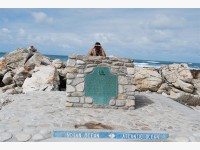
It is quite something to stand there, at the edge of the sea at Cape L’Agulhas, next to the plaque that bears the legend, ‘You are now at the southern-most tip of the continent of Africa’. Agulhas means needles and the name derives from the needle-like rocks along this dangerous, shipwreck-strewn stretch of coastline. However, it also refers to the needle of a compass. Here, your compass would show no real deviation between true and magnetic north.
On the ground in front of the plaque a line is drawn, indicating where the Indian and Atlantic Oceans meet. Many people mistakenly believe that our two seas bump into each other off Cape Point, but the International Hydrographic Organisation has decreed that the official boundary between them is the meridian of 20 degrees east, snaking out from from Cape L’Agulhas southward all the way to the Antarctic.
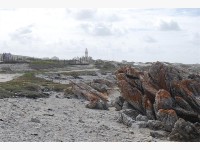
These two claims to fame alone would make a visit to Agulhas National Park worth the effort but this conserved southern corner of Africa is far more than a tourist curiosity. It is also wild and bleakly beautiful. A boardwalk, stretching across the scrubby fynbos and sugary sand, follows the rocky coastline to the small cairn that denotes the most southerly spot. It is an awe-inspiring place that hints at the infinite power of Mother Nature.
The national park, situated in the Western Cape’s species-rich Cape Fynbos Region, safeguards valuable wetland and the unique lowland fynbos vegetation that is a feature of the Agulhas Plain. It contains an amazing 1 750 plant species. The rugged coastline supports a rich marine life and the different terrestrial habitats make it a good spot to look for an interesting assortment of wetlands, fynbos and coastal birds.
This southern-most region of South Africa has also long been inhabited by man and, for this reason, the national park is of cultural significance, too. It conserves shell middens, stone hearths, pottery and the ancient fish-traps that were used by Late Stone-Age people.
Bill and I have only paid one brief visit to this, our most southerly national park but we will definitely plan a longer stay next time we meander through the Western Cape. We didn’t give ourselves enough time to try out the walks and to explore this fascinating piece of coastal wilderness but I have a lovely memory of a little adventure that offered a bird’s eye view of the reserve and its surroundings:
Overlooking Cape L’Agulhus is the second oldest working lighthouse, after Green Point, in South Africa. Built in 1848 and inspired by the Pharos of Alexandria, it is a striking red and white striped beacon flanked by stone towers. It now houses an interesting lighthouse museum,.
After taking a look at South Africa’s most southerly point and a short walk along the shoreline, we decide to see the museum before we leave. Then Bill comes up with the bright idea of climbing to the top of the lighthouse.
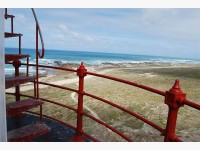
I am not too keen on the idea but I am persuaded – much against better judgement. We climb up and up and up. The ascent up the final, almost vertical ladder is absolutely terrifying but when we reach the top, the dizzying climb is well worth the effort. From up high the view is amazing.
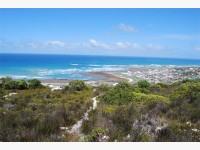
L’Agulhas, spread out at our feet, is such a pretty little seaside town and the brightly coloured roofs offer a colourful contrast to the pastel shades of Africa’s windswept southerly tip. And from up here we can appreciate the wild beauty of this rugged piece of shoreline and patchwork quilt of vibrant greens and limes and yellows that is the windswept fynbos. In size, Agulhas National Park might not be one of South Africa’s big five national parks but this unique patch of conserved wilderness, at the foot of Africa where two oceans meet, is truly one of our country’s national treasures.