
OF all the wonderful places north of South Africa’s border, it is big, bountiful, beautiful Botswana that really tugs at my heartstrings. My love affair with this northern neighbour of ours is a fairly recent development. Bill and I had often driven between South Africa and Zimbabwe via Botswana’s Gaborone, Francistown route and we had skirted the top of Botswana on our way to Namibia. Botswana had always intrigued me but it was only in 2006 that we did a thorough exploration of this peaceful and prosperous African country.
We did the tourist thing, travelling to Nata, Nxai Pan National Park, Maun, Moremi Game Reserve and Chobe National Park then we left Botswana for a short visit to Namibia’s Caprivi Strip and Kaudom National Park. After we reentered Botswana at Mohembo we took a look at the western Panhandle area and Tsodilo Hills before making our way slowly homeward via Makgadikgadi Pan, Lekhubu Island, Khama Rhino Reserve and Gabarone.

Every holiday is special but there was something so very magical about our Botswana camping trip. This big, flat, wild, wide open country is so awesomely African, offering incredible natural beauty and outstanding wilderness experiences. And Botswana’s helpful, friendly, confident people are so welcoming and warm. I was absolutely smitten by the time we returned to South Africa.
Since then we have done a few return trips to Botswana, exploring the intriguing Tuli Block, revisiting Khama Rhino Sanctuary and enjoying extended stays in the Botswana side of the Kgalagadi Transfrontier Park. We still haven’t got to the Central Kalahari Game Reserve but it is close to the top of our wish list, as is a return visit to the Okavango Delta.

There are so many wonderfully wild places to explore in Botswana but I think it is the massive and spectacular watery places in their contrasting arid settings, the Okavango Delta and the wide and wild Chobe River, that really intrigue me. It is perhaps this strange contrast that is at the heart of Botswana’s special mystique. For Botswana is all about sand – specifically the Kalahari, the largest stretch of sand in the world – and water – its large rivers and the annual deluge that fans out across the parched earth as an inland delta and ends its life as a trickle in the sand.

It is strange to think that Botswana has a much more lush and rain-swept past, but the ancient Makgadikigadi Lake once covered all of what is now the Okavango Delta, the Makgadikgadi Pans, the Mababe Depression, Nxai Pan and Lake Ngami. Gradually this great lake dried up and filled with sediment carried by the Okavango River.
Over the eons small faults in the earth have had enormous effects on this enormous, flat piece of land. The Okavango River, which brings its flood waters into Botswana from Angola, causing the delta region’s annual inundation, flows between two faults along what is known as the pan-shaped delta’s panhandle. It then crosses the Gumare fault, a mere ripple in the earth but big enough to cause the water to fan out across the flat terrain and to form the amazing inland Okavango Delta.

At right angles to the flow is another fault that creates the Thamalakane River, which flows though the town of Maun. Just outside Maun, the river makes a 90 degree turn where it becomes the Botletli River. This eventually flows into Lake Xau and then into the Makgadi Pans. A little of the water, probably only three percent of the 11 billion square metres that initially enter the delta every year, flows south westerly into Lake Ngami.
It is an insignificant amount of water but it carries a great deal of salt away from the delta and keeps the delta water fresh. Some of the remaining salt does accumulate on the islands of the delta, gradually destroying the surrounding vegetation and forming the strange, barren, dead-looking outcrops that are a common sight.
So much water enters this amazing system and the annual inundation of the life-giving moisture is a sight to behold. Almost all of it is eventually lost to evaporation and transpiration by the time the Okavango ends its long, hot journey every year. If you are venturing into the delta and travelling there via Maun do yourself a favour. Treat yourself to a sightseeing flight over the delta to find our what this amazing place is all about.
From above, it is an other-worldly place of acid greens and yellows, of stretches of blue water or channels of glittering silver, of islands thick with trees or bare and salt-laden, like strange bubbles or blisters on the surface of the surreal landscape. As we flew above this amazing place we saw herds of elephants walking in lines and a big herd of buffalo enjoying a swim.

The next day, it was a simply heavenly drive from Maun to Moremi and on to Xakanaxa camp, where we spent three unforgettable nights. For most of the way we travelled through stands of mopane trees but as we reached the camp the vegetation changed to swampy grassy sections, reeds and magnificent broadleaf trees.
Our well-treed campsite overlooked swampy land on both sides and we were constantly aware that we were surrounded by water. Game viewing and birding were amazing and game drives were always an absolute joy. Elephant constantly wandered through our camp to feast on the ripe fruit of a massive marula tree. A pair of otters frolicked in a natural splash pool near our camp.
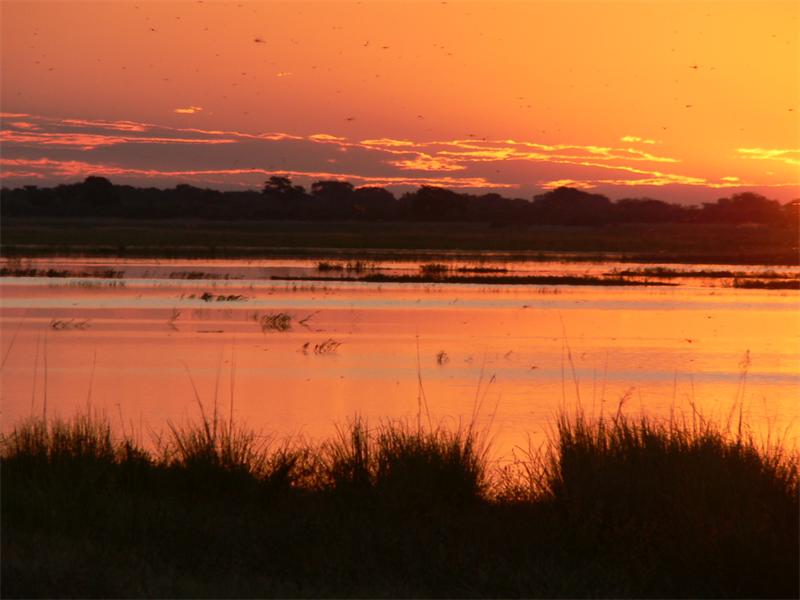
We spent an unforgettable afternoon and evening on a boat on the water, our knowledgeable guide adding to our enjoyment by providing us with a wealth of information. He took us on a winding journey along narrow channels through masses of floating vegetation into silent lagoons and past well-treed islands. We ticked off countless interesting birds and saw quite a few red lechwe and other interesting animals but the grand finale was one of the most beautiful sunsets I have ever seen.
Although it was May and should have been drier, there had been late rains. We even experienced a magnificent thunderstorm on our second evening there. Because of the rains, the roads were wet and muddy, some of them even closed. We were unable to get to Third Bridge as planned but it gave us extra time at lovely Xakanaxa.
It was a wonderful drive from Xakanaxa to our next overnight destination, Moremi’s scenic North Bridge camp. The highlight was having a leopard stepping onto the road right in front of our vehicle. We followed it as it strolled slowly along the dusty road for about a kilometre before it turned off the road and disappeared into the thick bush.

North Gate was spectacular, with literally hundreds of water birds in the marshy grasslands on the edge of the water. We only spent a night there and our stay was way too short. We went to sleep to the sound of happy hippos and lions hunting nearby.
With plenty of mud puddles slowing us down, it was a long but interesting drive to Savute. We put up our tent in a pretty corner of this lovely camp and enjoyed an excellent game drive that evening. The next night, at Ihaha Camp alongside the Chobe River in Chobe National Park, was one of the highlights of the holiday. This African Eden was home to thousands of water birds and there seemed to be a resident African fish eagle pair in every one of the big trees that lined the river.

Chobe is famous for its huge concentration of elephant and we spent a wonderful hour watching a big breeding herd at its evening ablutions. Hundreds of hippo, buffalo, lechwe, puku, impala and kudu shared this heavenly space and game and bird viewing was absolutely superb.
Above all, the wide Chobe River, such a huge body of unfettered water, with its untamed shores, was beautiful beyond description.
We were sad to leave this watery paradise, but enjoyed our brief visit to Namibia. After returning to Botswana we spent about a week exploring the western side of the delta, including the top, panhandle section. This is a less expensive option as visitors can stay at private lodges, many of which have excellent and reasonably priced camping facilities, without having to fork out the expensive conservation fees charged by the national parks.
This section of Botswana is lovely and well worth visiting, but if you are doing a camping trip through Botswana it is worth splashing out and paying the conservation fees to spend some time in Moremi as well.

All in all, there was so much to see on our Botswana road trip and every minute of it was a joy – but it was Moremi National Park and the truly fantastic Ihaha camp in Chobe National Park that made the greatest impression. There must be very few places in the world quite as majestically beautiful and pristine as these two wonder-filled, wild and watery places.



