
LET’S linger in Botswana for a while and take a virtual trip to some of its lesser known tourist attractions, to places like the Tuli Block, in my opinion one of the country’s most under-rated treasures. The Tuli Block is that remote little corner of Botswana where the Shashe River flows into the Limpopo River and where the frontiers of Botswana, Zimbabwe and South Africa converge.
Harsh, rocky country, it is incredibly scenic, teems with game and it is amazing how much life springs from its stony, seemingly inhospitable soil. Undulating mopane scrub and woodlands dominate, broken by rocky, jagged ridges and koppies, many of them sporting fat baobab trees. Elsewhere, solitary baobabs and huge old marula trees stand proud, dwarfing the surrounding scrubby bush. Greener ribbons of vegetation follow the dry, sandy water courses that criss-cross the terrain.

Much of the Tuli Block comprises private lodges, reserves and game farms, with the Tuli Game Reserve at its eastern extreme. The reserve is run on a private concession basis with accommodation mainly exclusive, upmarket lodges – out of our price range so we stayed at a private establishment, the absolutely lovely Limpopo River Lodge.
It offered a range of accommodation options including excellent camping facilities and we spent five wonderful days in a heavenly camping site right next to the hippo-filled Limpopo River. The attractive sites, stretched out along the banks of the river, all had their own little riverside patios, circles fashioned out of red bricks, in the centres of which were generous fire pits.

The network of game viewing roads provided good game viewing and birding as well as dramatic scenery. We were there in September, before the advent of the rains, but spring was making itself felt. A sprinkle of spring colours, yellow and orange, contrasted vividly with the luminous greens of newly-sprouted mopane leaves. The rocky soil showed through the sparse covering of dry grass, adding a rusty red to the palette.
A smaller tree species caught our attention. On the way to the camping area, an avenue of Terminalia prunioides or purple-pod cluster-leaf, heavily laden with deep maroon pods, was a sight to behold. It was perhaps the magnificent riverine trees, though, that give the lodge its special atmosphere. The huge ana trees (Acacia albida) that shaded our campsite were particularly lovely. Covered in creamy spikes of flowers, they were filled with bees from morning to night. Further down the river was the biggest weeping boer-bean we have ever seen. In full flower, its crimson blossoms dripping with nectar, it was a magnate to all the insects and birds in the area including an assortment of jewel-coloured sunbirds.
One morning we crossed over the Motloutse River to take a look at the Tuli Game Reserve , but casual day visitors must stay on the main road and are not really welcome. Our main objective, though, was to see Solomon’s Wall, which once dammed up the Motloutse River at the point where the deep sand 4X4 track now crosses it. Although all that remained of the natural dam were crumbly walls of blocks of red rock on either side, it was an impressive sight. The wall looked almost man-mad.

Mostly, though we spent our time exploring the extensive Limpopo River Lodge Grounds. Our stay there was such a treat and to us, the Tuli Block has become a very special place. Very different from the rest of Botswana, it really is worth a visit and for South African visitors, it is a section of the country that is easily accessible.
One of our very favourite smaller reserves in southern Africa is the Khama Rhino Sanctuary, near Serowe, the birthplace of Sir Seretse Khama, Botswana’s first president. If you are planning a trip to Botswana the sanctuary is one a real little gem and it is well worth spending a couple of days there.
Extremely well run, with first class tourist facilities, it offers excellent game viewing and birding, but there is something special about this sanctuary that is hard to define. Perhaps it has something to do with the friendly staff, with the iconic, rather magical Mokongwa trees that shade each roomy, secluded camping sites or with the peaceful atmosphere at the busy waterholes. Khama is simply a lovely place to be.
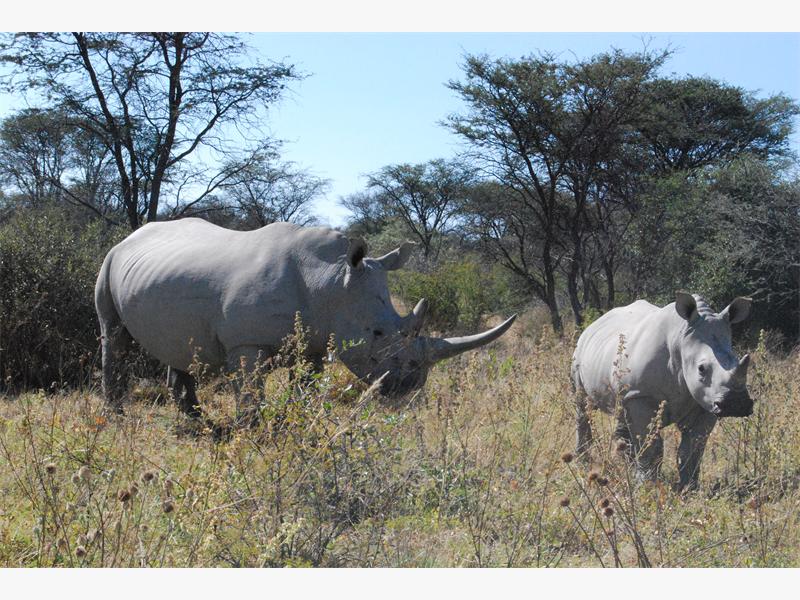
Of course, the white rhino are the stars there and are very easy to spot. We once saw a gathering of 20 of these gentle giants at one of the water holes. The reserve was established to serve as a breeding centre for these endangered creatures, as part of a plan to reintroduce rhino in Botswana. Covering 4 300ha of Kalahari sandveld and containing large pans and natural waterholes, it offers prime rhino habitat – and the round-the-clock protection afforded by the park’s proximity to a Botswana Defence Force base.

Khama isn’t a big five park but the rhino share their home with giraffe, zebra, blue wildebeest, red hartebeest, gemsbok, impala, kudu, steenbok, brown hyena, black-backed jackal, bat-eared fox, leopard, many interesting smaller mammals and more than 200 species of birds. It is an attractive park, too, with plenty of well-used watering points and interesting and varied vegetation.
One of our favourite spots to while away an hour or two was the pleasant bird hide overlooking a pretty little pan. We often saw interesting raptors and smaller mammals there, but it was the constant procession of colourful little birds that really captivated us.
The idea of setting Khama Rhino Sanctuary in a place that once teemed with game was conceived by a group of Serowe residents in 1989. Today it is governed by a board of trustees elected from local communities. As such it relies on donations and money generated from tourism. Perhaps the dedication and idealism that is at the core of its success is part of what makes it so special.
And, as more and more of southern Africa’s rhinos fall victim to the poachers’ bullets, it is good to know that Khama Rhino Sanctuary exists and flourishes. On our first trip to Botswana we paid a day visit to a the strikingly scenic and rather mysterious Tsodilo Hills, in the north west of the country. A World Heritage Site it consists of, four isolated inselbergs, hills known as ‘male’, ‘female’ ‘child’ and ‘grandchild’, rising out of a flat plain. The conical male, about 400m high and with an elevation of 12 395m above sea level, is one of the highest peaks in Botswana.
The record of its settlement by man goes back some 100 000 years and it is considered a holy place by the San and the Hambukushu groups. It is also an amazing gallery boasting about 4 500 rock paintings. A number of trails and hiking routes give visitors access to the amazing and varied rock artworks.
We took a look at the very interesting and attractively compiled museum then spent most of the day doing the Rhino Trail, a magical and fairly easy hike around the female mountain, with access to a number of fascinating rock art site. We had a good guide book with us and didn’t need a guide but professional and knowledgeable guides are available. With plenty of stops to look at the art and to ponder its meaning, it took us nearly three hours.

Apart from some steep uphill sections and a tricky descent it was a reasonably easy walk. It did start badly for Bill, who nearly stood on a puff adder sleeping on the path. Bill does not like snakes but seems to attract them, particularly puff adders. In fact he expects to see at least one puff adder on every trip we do and is seldom disappointed. Apart from the puff adder, our visit to Tsodilo Hills was one of the high points of our Botswana explorations. Finally, before we leave big, bountiful, beautiful Botswana, let me tell you about one most unforgettable nights we spent in Botswana, at a rather spooky but awesomely beautiful place called Lekhubu Island.
The 18km stretch across Sowa Pan to Lekhubu looked very short on the map but crossing the eerie expanse of grey emptiness and unrelenting heat, following the faint track etched on the grey surface of the pan, the route seemed endless. Nothing moved. No sounds disturbed the silence, except for a whisper of wind and the comforting sound of the vehicle skimming over the smooth, dry pan. We were relieved when through the heat haze, like a mirage of a ruined castle, the tree-covered granite mound finally appeared.
Lekhubu Island is right on the edge of Sowa Pan which, together with its twin, Ntwete, and a scattering of smaller pans, make up Botswana’s famous Makgadikgadi Pans.This wild, remote and starkly beautiful geographical feature covers an inhospitable 12 000 square kilometres. It must be incredible to see it when it is filled with water.
The island itself was lovely, more than meeting our expectations and the night we spent there was well worth the convoluted detour from our original route to reach it. It is a strange place. About a kilometre in length, it is a collection of rounded granite boulders, rising out of the surrounding sea of dry mud.
There is something almost mystical about this it and we were not surprised to learn that it is considered a sacred place. The muted chalky colours, shades of grey touched with pink and gold and bronze, add to it haunting mood. So do the giant baobabs and other lovely trees that have colonised this rocky patch. In between the trees and rocks, sparse, stringy grass struggles to cover the ground.
Given its remoteness and its lack of water, we were surprised to learn that Lekhubu is a site of ancient habitation. Stone Age implements have been left behind by people who lived there quite a few thousand years ago, when the area was much better watered. Signs of habitation also include the half-moon, dry stone wall, built between 1 000 and 1 700 years ago, probably soon after the heyday of the Zimbabwe empire. Some stone cairns erected on the island are similar to cairns found in what is thought to have been an initiation centre in Great Zimbabwe.

The Basarwa people still visit Lekhubu to pray for rain and they frown upon anyone removing any natural object, even stones or fruit, from this sacred place. The sense of mystery of this unearthly place deepened as the sun dropped below the grey horizon and we watched a technicoloured sunset from beneath the sheltering boughs of our baobab. As the harsh light softened it seemed to intensify the reds and bronzes in the rocks and the baobab bark. The ever-changing sunset colours were gently reflected on the surrounding pan. Then the sky burned blood red for a few moments before the island was plunged into deep, dark night. The magic continued as the full moon slowly rose and lit up the mysterious pan.
Lekhubu is under the management of the Gaing-o Community Trust. Rustic but attractive campsite are set out beneath massive baobabs and, although facilities are rudimentary, the scenery and mystical atmosphere more than make up for any discomfit visitors might experience.



