
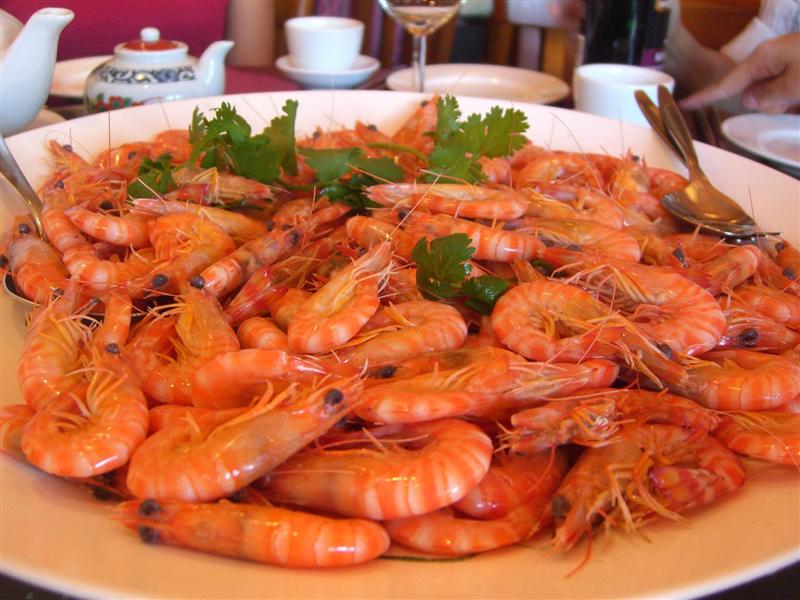
I’M sure that like us you enjoy your shrimps, and not just in the traditional cocktail. They are good in curries, in jambalaya, in fish pies, in fact they are simply good.
But, like so many popular items on the menu these days, shrimp has become problematic, mainly because from a basic food source for coastal people in tropical zones, shrimp has become a fashion item on menus around the world.
A little less than half the world’s current consumption of shrimp comes out of the ocean and the rest is farmed, mainly in China and South East Asia. The trawled shrimp is problematic because it is being over-fished and because the by-catch (other creatures that are unintentionally caught and killed) is so huge.
As far as farmed shrimp is concerned, the problems are multiple, including the toxic effluent from the coastal farms, which not only pollutes the sea, but also nearby estuaries and therefore rivers and even surrounding farmlands.

Worse is the massive destruction of coastal mangroves to create the shrimp farms, mangroves that are natural buffers against extreme weather events such as cyclones and tsunamis. Mangroves are also incredibly rich as far as biodiversity is concerned and their large- scale destruction is therefore an environmental disaster.
Are there any answers? Yes, apparently. There are more sustainable ways to produce shrimp, both from the wild catch and from farms, and in part it’s up to us to try to encourage that. Ask the fishmonger where you buy your frozen shrimp if he can vouch for the producer, it’s worth a try.
Now I’d like to talk about a book that has landed on my desk, Wildlife of East Africa: A Photographic Guide. It’s by Dave Richards and is published by our own Struik Nature in Cape Town*.
In general terms there are chapters covering the geography and climate of the three East African countries reviewed, that’s Kenya, Tanzania and Uganda, vegetation zones, identifying, watching and photographing wildlife, and conservation policy, then come a series of specific descriptions.
These cover mammals, birds, reptiles and amphibians, insects, trees and shrubs and wildlife flowers. There are four of each of these descriptions on a page, with a colour photograph, English name, scientific name and local name, habitat, dimensions, horns and conservation status. Then comes a brief description and the best place to see the species in question.
We have been on holiday and assignment to Kenya and Tanzania a number of times and I have been on assignment to Uganda a couple of times too and between us we’ve seen quite a lot of East Africa, and all I can see is that I wish we’d had this book then.
It really is most useful and one must realise that, as well as one may know the wildlife scene here in southern Africa, it is all very different in East Africa and a good pocket guide (that would have to be a bush jacket pocket) is going to be most useful. Cheers!
READ MORE ‘FROM MY HIDE’ HERE.
Source: News24.com
*Wildlife of East Africa: A Photographic Guide, Dave Richards, Struik Nature, Cape Town, 2013.



