
I MUST say right at the outset that I have nothing against cats, specifically cattus domesticus, that would be Garfield, Moggie or Bustopher Jones (my favourite cat), but they have been named as a serious threat to the world’s wildlife.
A new scientific study conducted in the United States* says that domestic cats are one of the biggest threats to American wildlife, killing billions of animals every year.
The study shows that cats kill up to 3.7 billion birds a year and up to 20.7 billion mammals.
The scientists say that stray and feral cats are the biggest culprits, but that domestic cats also play a role in the killing
spree.
The domestic cat’s killer instinct has been well documented on many islands around the world, where felines accompanying their humans have preyed on the local wildlife, at times and in places creating havoc.
Who can ever forget the experience of Marion Island, South Africa’s tiny possession in the far south Indian Ocean? Just five cats: one neutered tom, one female and three kittens, were introduced to the island in 1949 to deal with a mouse problem.
Sadly, they did more than eat mice. Over the years they managed to become thousands upon thousands of cats, not eating mice but rather the many rare seabirds on the island.
The Marion Island Cat Eradication Programme was introduced and eventually the cat problem was more or
less resolved.
In the United States it is mainly indigenous birds that are being targeted, like the American robin, and then
mammals like mice, shrews, voles, squirrels and even rabbits.
Are there any answers? Well, yes, cat bells, at least for domestic cats. No, seriously, it’s said that a properly fitted collar and bell reduces a cat’s hunting success rate by at least a third.
I must finish this with a quote: “She is deeply concerned with the ways of the mice – their behavior’s not good and their
manners not nice….”.**

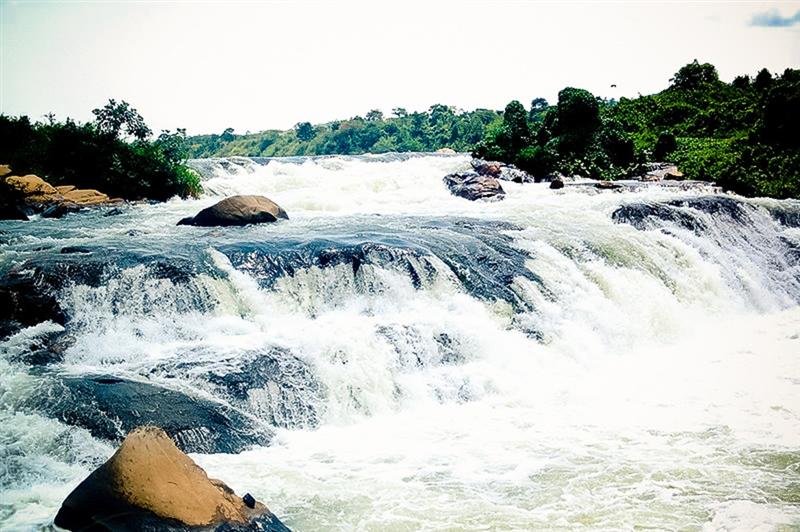
And now a vanishing waterfall. I remember the Bujagali Falls on the White Nile in Uganda with affection.
They are great steps in that great river with much in the way of white water rapids in between. In fact it’s a scene famous for its white water rafting.
It’s also a wonderful spot for fishing, mainly for the famous Nile perch, a great fighter and one of the best eating
fishes in the world. Sadly, all this is now in the past tense, for the Bujagali Falls is no more***.
Yet another hydro-electric scheme on the Nile has flooded back and completely covered the Falls. Bujagali is just below Jinja, once famous for being the source of the Nile where it crashed over the Owen Falls coming out of Lake Victoria.
Now a mere beacon marks the spot where the longest river in the world starts its journey to the Mediterranean, another hydro-electric scheme covered those Falls years ago.
Sad, that progress and development must cause such loss to our natural environment. Cheers!
*BBC News
**The Old Gumbie Cat from T.S. Eliot’s Old
Possum’s Book of Practical Cats.
***Tony Weaver, the Cape Times.



