Tent Travels: Magic mountains and a special little town
There is nothing contrived about the charming Eastern Cape village of Rhodes.
I CAN’T think of any region in South Africa more under-appreciated as a tourist destination than the magnificent, remote and unspoilt Eastern Cape mountains.
However, this might be starting to change. After leaving Cedarville, the first overnight stop of our ‘Filling in the Gaps’ road trip, we spent the morning travelling to the Eastern Cape village of Rhodes, in the foothills of the Drakensberg, along some of the most spectacular mountain roads and passes that South Africa has to offer.
It is an amazingly empty area, and its dramatic scenery, so rich in tourism potential, is barely being exploited. This time, though, we did notice that a few new tourist facilities had sprung up en route since we’d last travelled these roads.
For the first part of the journey we followed the undulating R56 from Matatiele to Maclear, enjoying the dramatic wintry mountain scenery. Tourism organisations are actively promoting the lovely ‘Route 56’ as a pleasant, interesting, quieter and scenic alternative to the better known but often congested N2 Cape route. If you have a little time to spare, exploring this byway is most rewarding.
At Maclear we turned north, with happy anticipation, onto the less-travelled R396 and were soon rewarded with the amazing sight of literally hundreds of grey crowned cranes, spur-winged geese and red-knobbed coots at a dam and surrounding wetlands and agricultural fields. To me cranes are very special birds and seeing so many of them gathered together beneath the sheltering mountains was exhilarating. They were also a good excuse for a roadside coffee break before setting off to conquer the Pot River Pass. It was quite a spectacular little mountain pass but was completely outclassed by its big brother, Naude’s Nek, further along the R396.
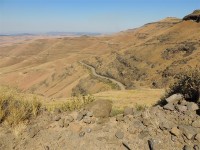
For 7km, the rocky, narrow, gravel Naude’s Nek road hugged the rugged mountains, thrilling us with its dramatic views and alarmingly steep drop-offs. At the Maclear turn-off we had been about 1 100m above sea level but by the time we reached the snow-encrusted crest of Naude’s Nek, we’d soared to a thin-aired 2 500m.
From there it didn’t take us long to coast into the charming village of Rhodes, one of our very favourite South African dorpies.
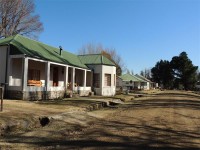
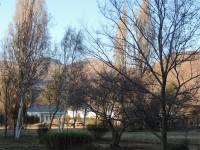
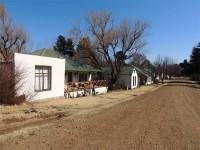
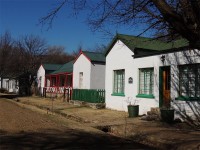
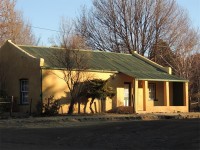
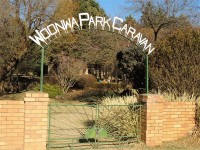
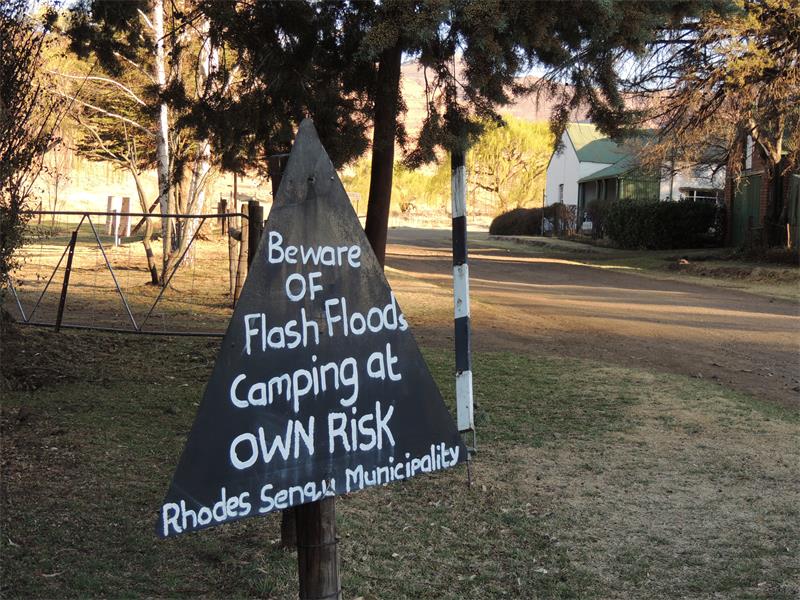
Although its gardens and avenues of street trees were still enjoying their winter slumber, Rhodes was looking as pretty as ever, its lovingly restored and maintained cottages all spruced up and ready for spring. Our first stop was the quaint little camping ground in the centre of town where, for the princely sum of R50 a night per campsite, we set up our camp.
Owned by the local municipality, the simple but pretty camping ground was well maintained, with neat flower beds all lovingly cared for and ready to put on a spring display. The basic ablution facilities were clean and neat and the grounds well-tended and litter free.
Rhodes puzzles us. An attraction is its proximity to the Tiffendale Ski Resort but apart from that we don’t understand what sustains it. The town is just so remote, difficult to reach and off the beaten tourist track that we are always surprised to note its seemingly thriving tourism industry. Inns, guest houses, bed and breakfast establishments and self-catering options abound and weekend cottages that go on sale seem to be quickly snapped up by people from distant main centres.
Although there are only a couple of little shops, a few professional firms and, apart from tourism and farming, no industry to speak of Rhodes seems to have a growing permanent population. Soon after setting up camp we took a walk around the town and met many of its friendly residents. The tennis club was in full swing (pun unintended) and a lively aerobics class was in progress in one of the halls. We noticed that a private school had opened, too.
Perhaps the very factors that should be holding back progress – its remoteness, its dusty streets, its old-fashioned, unpretentious charm – are in fact the attributes that help Rhodes to hold its own against the many trendier, more easily accessible weekend retreats closer to the main centres. There is nothing contrived or twee about Rhodes and its rustic charms are authentic. Perhaps all this is what makes it such a special, sought after haven.
Whatever the reasons, we were delighted to see this gorgeous little village so well-maintained, spotlessly clean and apparently thriving. We thoroughly enjoyed our overnight stay there.
It was cold when we woke up the next morning. While we were waiting for the kettle to boil we had a look at the thermometer. There was thick frost on the ground and although the first rays of sunlight were creeping over the mountain tops it was still two degrees below zero. All the same, the crisp mountain air was invigorating and as we sipped our early morning tea, we watched the charming little village wake up with a smile. People waved at us as they walked or jogged past the camping ground and a dimple-cheeked little boy who was on his way to school on his skateboard, stopped and leant on the fence for a chat. It is rather fun camping in the centre of a friendly town like Rhodes.
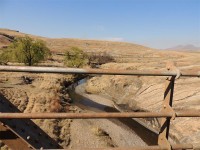
It didn’t take us long to pack up our minimalistic overnight camp and we were soon heading out of town along another backroad towards Barkly East. The dramatic mountain route offered stark winter views of wide, rocky river courses, crumbly cliffs and range upon range of mountains in every direction. We were heading towards Gariep Dam on the Orange River – where we had booked two nights at Oviston Nature Reserve – but we were planning a slow meander with lots of sightseeing that day and we had no set plans for that night. We would simply stop over somewhere on route when we found a pleasant spot.
After the attractive little town of Barkly East, the route flattened out a little, following river courses deeply etched into smooth, rocky surrounds and prosperous, extensively cultivated valleys. We planned to take a look at the Aliwal North, on the banks of the Orange River, to see if we could find a pleasant riverside resort where we could spend the night. It was a busy, attractive little town, but not overly appealing and there were no camping facilities at the only riverside resort that we found.
It was still early, too, so we decided to cross the Orange into the Free State and to continue with our explorations. Bill particularly wanted to look at a tractor museum in Rouxville. Perhaps there would be a pleasant overnight spot somewhere near the town or around attractive Smithfield a little further along the way. We’d left the more mountainous terrain behind us and were travelling through undulating Free State grasslands, bracketed by stony but well-vegetated ridges.
Rouxville proved to be a neat but unprepossessing little town and its tractor museum had closed. Disappointed, we decided to press on to Smithfield, a town we have always liked. Even if there was no suitable accommodation there we would at least be able to stock up at an excellent deli we knew about. The town was just as attractive as we remembered – but the deli had closed. So much for our plans. We’d wanted to spend a night in a small town en route to the dam but it was just not going to happen.
We decided to head on to Gariep Dam and maybe find somewhere pleasant to stay on the Free State side before heading for the Eastern Cape’s Oviston Nature Reserve the next day. A few weeks before we’d left on holiday, someone had mentioned the Free Sate’s Tussen-die-Rivier Nature Reserve. Perhaps that might be an option? It was an option that turned out to be an inspired one and we discovered yet another of South Africa’s natural gems. CLICK HERE TO READ MORE TENT TRAVELS