
BILL and I are well acquainted with the various incarnations of South Africa’s longest and perhaps most impressive river, most commonly known as the Orange.
Over the years we have followed much of its 2 200km westward course and we have gotten to know quite a bit of the dramatic country through which it flows.
However, we had yet to see the stretch of water harnessed by the Gariep Dam. As we would again be journeying alongside the Orange for much of our ‘Filling in the Gaps’ road trip, we decided to remedy this by including a short Gariep Dam meander in our itinerary.
The stately river is called many other names by the different people who live beside it. It starts its life as the Senqu in the Lesotho Highlands but many know it as the Gariep as it flows through the parched Northern Cape. It is also on occasion addressed as the Groot or Great River, descriptive names that suit this life-sustaining, arid-land waterway. For some of its journey it serves as the Free State’s south western boundary but it eventually becomes the border between Namibia and South Africa as it heads through the Richtersveld to end its journey at Alexander Bay.
On its way to the Atlantic Ocean it swallows up a number of water courses, including two major tributaries, the Caledon and the Vaal. It also tumbles over the Augrabies Falls and six dam walls, including the Gariep Dam, an imposing construction completed in 1971.
Its 88m high dam wall holds back 5 349 000 megalitres of water, stretching over 1,73-million square kilometres, when it is full. The dam provides water for the extensive irrigation of farmlands and for domestic and industrial use and it also generates power. Near the town of Oviston on the Eastern Cape shore of the dam is the inlet used to divert water into the Orange-Great Fish River Tunnel, to channel it to other parts of the Eastern Cape.
The Caledon joins the Orange in the Free State just east of the Gariep Dam and it is here, at this lovely confluence that we discovered the impressive, 22 000ha game reserve, Tussen-die-Riviere, which is administrated by Free State Nature Conservation.
Closed to the general public during the hunting months from March until August it serves as a regular game reserve for the rest of the year. We’d vaguely heard about it and thought we’d give it a try. Unfortunately we only could spare one night there. It was a gorgeous little spot and we would have loved to stay longer.
We booked in and were directed to the comfortable, bird-filled campsite, with its all-round views of undulating grasslands ringed by rocky, well-vegetated ridges, koppies and mountains. Best of all, we had it all to ourselves.
After setting up camp beneath a shady thorn tree we discovered that ‘our’ tree was decorated with the untidy nests of white-browed sparrow-weavers, charming – if rather noisy – little camp followers that I associate with the drier parts of southern Africa. They didn’t seem to mind our presence and we enjoyed their company.
Earlier that day we’d seen the first pale chanting goshawk of this trip. You often see these raptors perched on roadside poles in the west, so these avian sightings were definite signs that we were moving away from our rain-rich eastern parts of southern Africa. Watching the changes as you cross our country from moist east to arid west is always so fascinating.
It was still early afternoon by the time we’d set up camp, so we were able to do quite a long game-viewing drive. The good network of tourist roads skirted extensive reed beds and flood plains, rocky, bush-covered ridges, stretches of clear blue water and rolling grasslands, often boggy and swampy.
Not surprising, this varied and well-watered habitat supported plenty of game. We saw substantial herds of waterbuck and kudu, small groups of eland, a little family of nyala, plenty of impala and a lone bathing buffalo. Birdlife was interesting, too.
After a peaceful and fairly warm night, we woke to the friendly chatter of the sparrow weavers and found a herd of eland grazing on a slope right next to the camp. I just love eland, South Africa’s largest antelope, and this was the first of many close encounters with these magnificent, ghostly creatures that we would enjoy on this holiday. Disappointingly, throughout this road trip, often travelling through very rocky hilly terrain, we wouldn’t see a single klipspringer, another of my favourite wildlife sightings. Our quality eland sightings plus many other thrilling encounters with other interesting creatures would, however, more than make up for this lack.
We were sorry to be leaving this Free State natural treasure after such a short stay but were looking forward to seeing more of Gariep Dam and to exploring the 16 000ha Oviston Nature Reserve, on its Eastern Cape shores, where we’d booked to stay the next two nights.
After leaving the reserve we took a look at the small, dusty Free State town of Bethulie then crossed the Orange via an impressive rail and road bridge, back into the Eastern Cape. To book into the reserve, administered by Eastern Cape Parks, we needed to drive into the sleepy little town of Oviston. Perhaps in summer it would be more interesting but, in spite of its stunning situation overlooking the water it didn’t seem to have a lot going for it when we took a drive around it. We’d heard about a resort and camping ground in the town but when we took a look at it, the resort appeared to be non-functional and derelict. A seedy-looking character at the gate claimed to be the gate guard but he appeared to be under the influence of some sort of aromatic tobacco and we didn’t get much sense out of him.
We had better luck at the parks board office where we received a warm welcome. We were instructed to ignore the sign on the gate saying the reserve was closed for maintenance and to proceed to the picnic site, now elevated to the status of camping ground by the addition of a small ablution block. As well as camping facilities there is a rambling old farmhouse that has been converted into a comfortable lodge.
The camping ground was a delightful little spot, substantial thorn trees offering plenty of shade. Once again we had it all to ourselves. We chose a shady site that offered lovely views of wintry veld and distant hills.
The terrain in this reserve was quite different to Tussen-Die-Riviere – mostly rolling grasslands, the fairly long grass still a faded winter blonde. There were also scrubby, stony, sparsely- vegetated sections and the odd little koppie or ridge. The reserve also provided lovely views of the dam, a large expanse of grey-blue water backed by ranges of lilac blue hills.
Quite a few water birds including a flock of flamingos, paddled in the shallows and birding in the grasslands was interesting too.
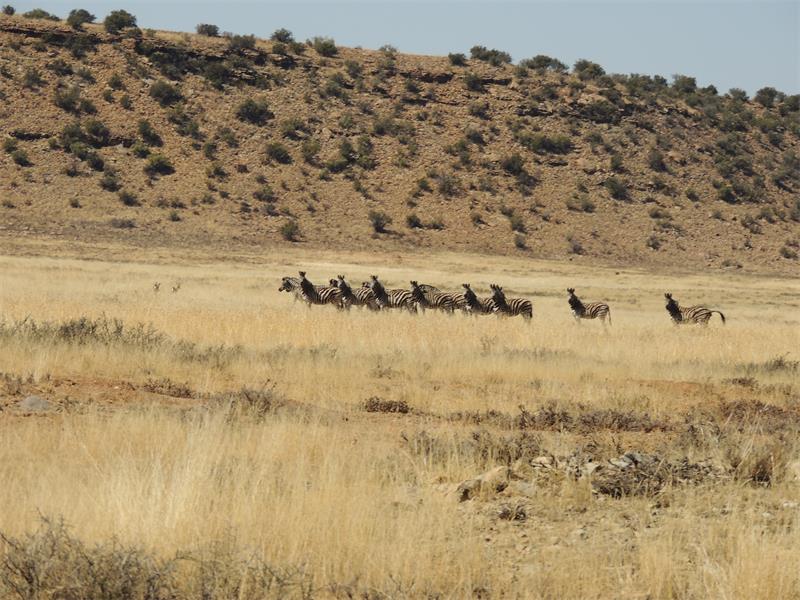
We spent our first day in the reserve trying out the various game-viewing loops and were most impressed. From a scenic point of view the routes were impressive and there was plenty of game to see. We spotted big herds of springbok, blesbok, eland, zebra, ungainly red hartebeest, graceful gemsbok and black wildebeest, strange creatures with long, pale ‘ponytails’.
The small fry were well represented, too, and we enjoyed quality sightings of ground squirrel, yellow mongoose, a single bat-eared fox and some charming meerkats.
The next morning we set off early, leaving the confines of the nature reserve to explore the general Gariep Dam area. There were plenty of viewsites and picnic spots around the impressive dam wall and its scenic surrounds. The elevated Gariep Village, with its neat homes and pretty gardens, overlooked the dam and appeared to be very well equipped as a tourist destination. It was a delightful little town, as was its beautifully maintained resort on the shore of the dam.
The whole area was attractive, well cared for and spotlessly clean. It was all very quiet when we visited but residents said that the area was always busy during the summer months. We could imagine it being very popular as a summer holiday or weekend destination for outdoorsy families. Hopefully, the visiting families take some time off from the boating , water sports and other water-related activities to visit lovely Oviston Nature Reserve. We might have been wrong but we had a feeling that this little natural beauty spot was not as well appreciated as it should be.
After taking a look at the area around the dam wall, we drove on to Norval’s Pont on the Eastern Cape bank of the Orange River. This insignificant but historically interesting hamlet was named after Glaswegian John Norval who started a ferry service there. His family also built the little riverside inn that has dispensed hospitality to travellers and wanderers since the 1840s.
The railways arrived in the 1880s and a rail and road bridge, which is still in use, eventually replaced the ferry. According to a plaque on the bridge it was built in 1889 by Joseph Westwood and Company Limit, a London firm of engineers and contractors. In 1907 this impressive structure was strengthened.
Norval’s Pont hasn’t always been the sleepy little spot it is today. During South Africa’s gold and diamond rushes thousands of hopeful fortune seekers travelled through the area. It was a strategic spot during the Anglo-Boer War and was also the site of a British Concentration Camp.
After taking a look at the bridge Bill and I went to see the nearby memorial for inmates who had died in the camp. It was a rather bleak little memorial and we were saddened to read the long list of names of child internees who had lost their lives there. Somehow this sobering list, carved in stone, summed up the futility, the madness of war. It is interesting delving into history while travelling but suddenly we’d had enough. The memorial had made us sad. It was time to return to our pretty little Oviston Nature Reserve campsite and to immerse ourselves in the present and the natural beauty that abounded in the Gariep Dam area.



