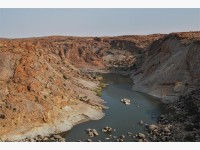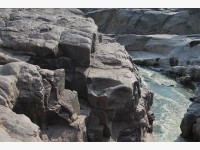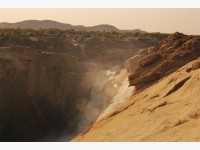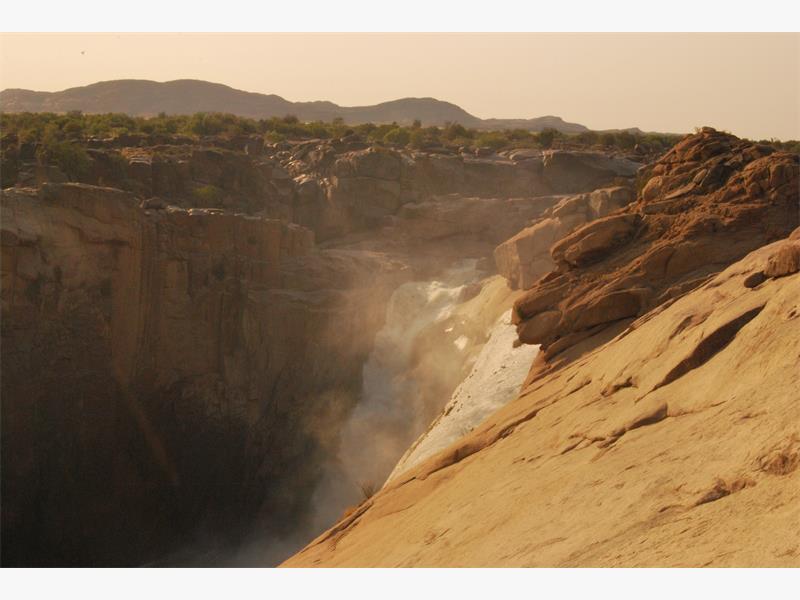
NORMALLY a placid river that meanders peacefully westward without too much drama, the Orange undergoes a change in character soon after it passes the Northern Cape town of Kakamas. At this point it divides itself up into a braided network of waterways that suddenly come together again in a tumultuous flood of water channelled through the narrow passage the Orange has incised into the solid granite surrounds. Then it thunders magnificently over a 90m abyss, dropping into and rushing through a rocky, steep-sided ravine for another 18km.

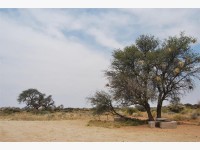
Among the most awe-inspiring of all South Africa’s waterfalls, these are the famous Augrabies Falls, the name a corruption of a Khoi word that means, aptly enough, ‘The Noisy One’. And noisy they are. Even in the Augrabies Falls National Park camp site, quite a distance away from the falls, you are aware of a constant thrumming and a vibration beneath your feet.
The ‘noisy one’ is what initially bring the visitors here and they are the reason why the national park was proclaimed in 1954. However, this well-established and richly endowed national park is far more than just a pretty frame for a famous waterfall.
Bill and I were simply blown away by the harsh beauty of this rocky, arid park when we spent a few days there as part of our ‘Filling in the Gap’ road trip. It was our second visit. We’d spent a couple of days at Augrabies Falls National Park on our way home from the Kgalagadi Transfrontier Park many years ago but I don’t remember being quite as impressed as we were on our second recent trip.

Back then, rest camps at national parks tended to be a bit dull and the rest camp at Augrabies had a rather government institution-inspired atmosphere and look about it. Also our first visit was at the height of the Namaqua flower season and the camping ground was packed.
Our national park rest camps have changed so much since then, all of them acquiring really impressive indigenous gardens that highlight the beauty of the surrounding flora. I wonder if those gifted horticulturalists, garden designers and hard-working gardeners know how much we visitors enjoy their green creations.
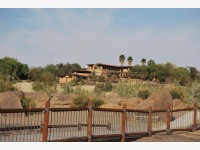
At the newer parks the imaginative architecture and inspired design of structures like administrative buildings, public areas and accommodation reflect each park’s unique ambience and sense of place. Rest camps at the older parks have been thoroughly revamped, too, and have completely lost their institutional dullness. It amazes me how clever use of simple, mostly natural materials and lovely gardens have transformed these older camps, including the now most attractive main camp at Augrabies.

When we booked in we spent quite a bit of time looking at a photographic display near reception then strolling around the gardens and looking at the interesting, labelled arid region plants, native to that area. These striking plants had been skilfully put to artistic use as garden subjects and the gardens were lovely.
We also learnt, when we booked in, that the water falls were illuminated for a couple of hours each night. It was late afternoon when we set up camp in the comfortable, shady green oasis that is the camping ground. We decided not to rush a visit to the falls that evening and to save the walk around the extensive boardwalk network until the next day. All the same we couldn’t resist a short moonlit walk along a section of the boardwalk to see the floodlit falls. If you are visiting Augrabies it is an experience that should not be missed.

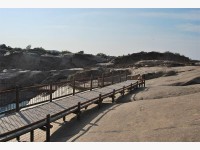
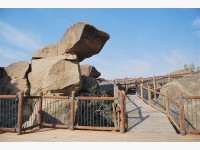
We spent a good few hours the next day exploring the extensive and most attractive boardwalk system of pathways, steps and viewing platforms, offering lovely views of mother nature’s giant, sculptured water feature. The falls weren’t too full but there was still an impressive amount of water cascading over the sheer, sun-baked rocks.
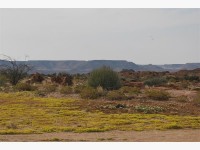
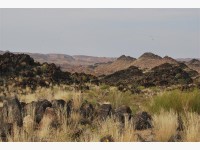
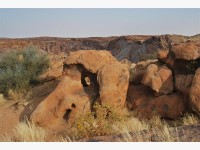
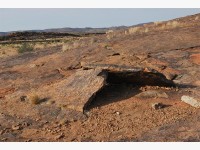
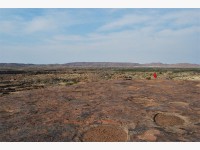
One of the highlights of our Augrabies visit was a lengthy drive along the dramatic Quiver Tree loop, which took us all afternoon to complete. There was plenty of game about and the arid vegetation was striking but it was the ever changing rock formation that impressed us the most.
The scenery in this park is among the most dramatic that South Africa has to offer. We drove straight to the remote picnic site without stopping much along the way then we meandered slowly homeward stopping at the Orangekom view site and the strange Moon Rock. One of the most impressive features of this really fascinating drive was the weird black hills and ridges of the Swartrand.

On our last day in this ruggedly beautiful place, Bill and I put on our hiking boots and did the interpretive Dassie Trail. Not for the fainthearted, this 6km trail took us two hours and involved plenty of rock hopping and scrambling over rough terrain.
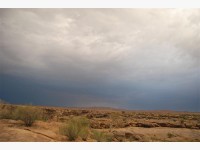
The park provides an interesting route guide that offers information about the flora, fauna and geological features along the way. We had been enjoying hot, sunny weather for the last few days, a nice contrast after the wintry weather at the start of our holiday. On our last evening in the park, dramatic storm clouds gathered and a little rain fell.

Of course the clouds saved a bit of rain for the next morning when we were taking down our tent. Rain tends to do that. It is a subsection of Murphy’s Law. Any way, rain is always a blessing in Africa, particularly in an aridly beautiful place like the magnificent Augrabies National Park.