
TC Talk: Night Critters
LIKE most primates, we’re diurnal. When the sun goes down so does our vision and we creep into our caves behind the protection of our fires against the things – like Eskom – that go bump in the night. There’s a fascinating nocturnal world out there, however, which, thanks to modern technology, we’re beginning to …
LIKE most primates, we’re diurnal. When the sun goes down so does our vision and we creep into our caves behind the protection of our fires against the things – like Eskom – that go bump in the night.
There’s a fascinating nocturnal world out there, however, which, thanks to modern technology, we’re beginning to understand.
Because most predators are nocturnal and due to the enormous number of bat species – 1 100 worldwide and 58 in South Africa – second only to rodents – it’s fair to say, though you’d never know it, there’s more going on by night at the TC Robertson Nature Reserve than by day.
Of nocturnal mammals, we do know TC supports bushbuck, blue duiker and common (grey) duiker. The latter becoming truly nocturnal through being disturbed by day. Bush pigs and porcupines occasionally wander through. Greater cane rats frequent the reed beds along the river, their presence marked by their runways and distinctively grooved little ‘pellets’.
Carnivores fascinate us the most. Our favoured pets come from this family after all: dogs and cats. Perhaps because we humans, too, are hunters at heart?
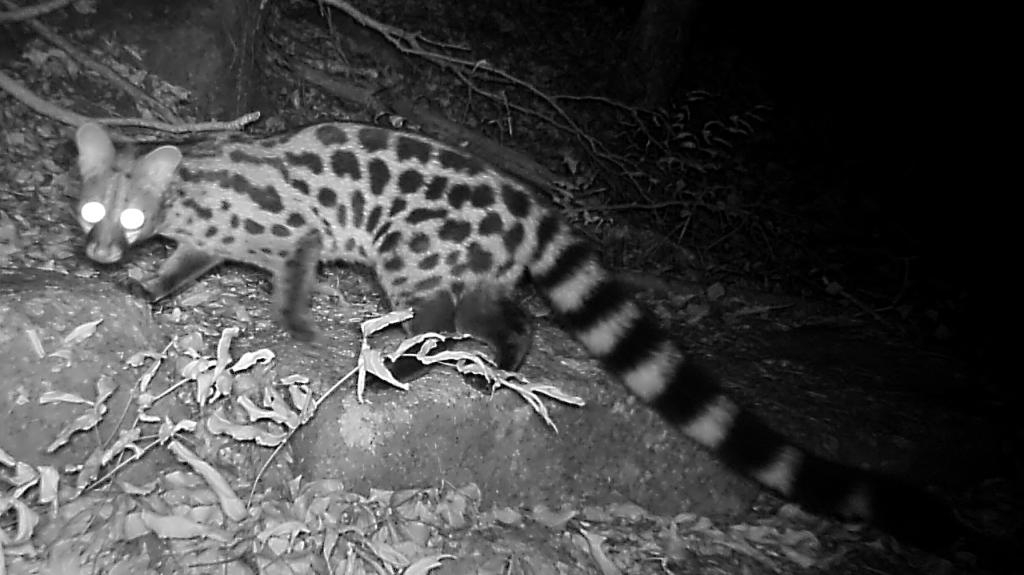
As shown in the picture, taken with an automated camera trap, the large-spotted genet (genetta tigrina) is a gorgeous little hunter. What the picture doesn’t show is the thrillingly brilliant green eye-shine reflected back at you by torchlight when spotting one in the depths of a night forest.
Their superb night-vision is enhanced by a reflective layer of crystalline tissue behind the retina, known as the tapetum lucidum. This reflects incoming light back to the photoreceptors, giving the animal a ‘double dose’ of available light in the centre of the eye.
Genets – 2-3 kg, lithe, low, long-tailed and agile – have sharp retractile claws like a cat, but look like mongooses. They and the much larger civet (which only occurs from Zululand northwards) are classified in their own Family: Viverridae.
Other night-hunting mammals we know of at TC are white-tailed and water mongooses. The former’s long legs and bushy white tail are unmistakable by torchlight, while the latter’s distinctive webbed spoor are often evident along the sandbanks of the Mpambanyoni.
It’s likely that we also host two vividly black and white striped specialist ratters and insectivores, the striped polecat and African striped weasel. These secretive little mustelids both have serious anal glands which they use freely when threatened!
Speculation about black-backed jackal, caracal and serval await proof. Reports of weird howls and shrieks in the night lend some credence to the presence of thick-tailed bushbabies in the reserve. Or perhaps the endangered tree dassie.
These too await proof. And proof might soon be to hand. A PhD candidate student has agreed to add TC to her field study of the mammals of the KZN South Coast and will shortly be rigging a series of camera traps throughout the reserve. Her findings are keenly awaited.
See KZN Wildlife Watch’s facebook page by clicking here.
P.S. Be there! Mardi Gras at TC on Sunday, December 14 from 9am to 4pm.



