IN spite of a chilly little morning shower that dampened our tent but not our spirits, we were up early and ready for our next adventure after spending our last night at Augrabies Falls National Park.
It didn’t take us long to pack up our (now wet) tent and we were soon on our way, heading towards Springbok, our planned destination that night. We didn’t have far to go so we were looking forward to another of those slow, meandering days of leisurely exploration. Road trips are really all about days like these.
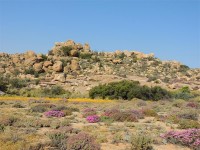
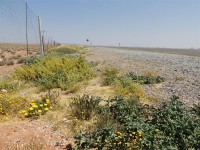
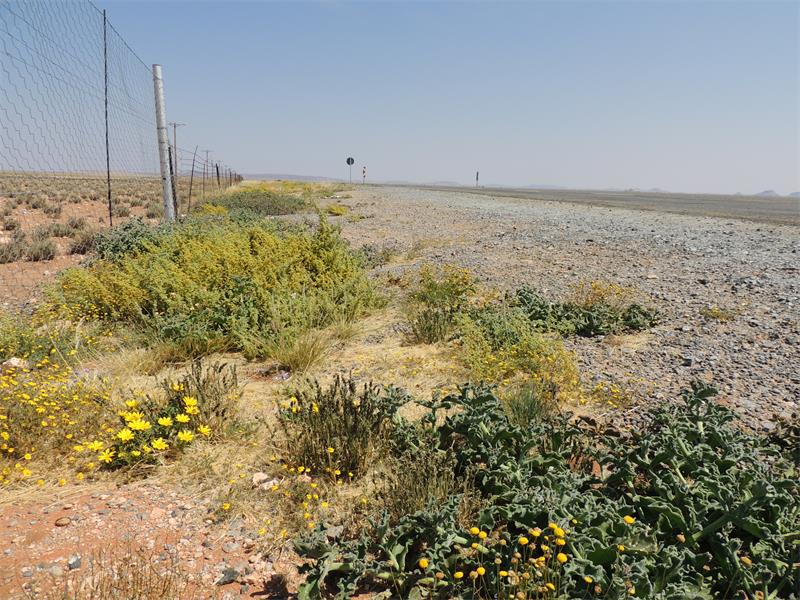
Although the road west from Kakamas stretched straight ahead for kilometre after kilometre it was not a featureless road. Strange little outcrops that looked like huge piles of sometimes black, sometimes orange rocks, rose up from the surrounding scrubby vegetation. It looked like some giant gardener had been busy with his wheelbarrow.
I’m not sure where the green Kalahari ends and Namakwa (or Namaqualand as it is also known) begins but the Namaqua people seem to have claimed little Pofadder as their own. So, when we reached its outskirts, we bade the Kalahari a formal goodbye.
Pofadder is something of a South African Timbuktu, its name short hand for all those back-of-beyond places that litter the less populated regions on the South African map. It is a place you drive through rather than treat as a destination and that is what we usually do when we travel this route; but that day we had plenty of time on our hands, so we decided to pay it a long-overdue visit.
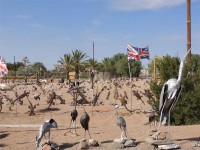
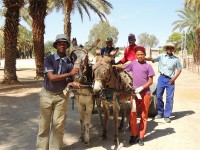
As we drove into Pofadder we came across a large square of bare red earth alongside the N14, the national road westward to Springbok that passes through the town. The square was neatly fenced and filled with the most amazing collection of metal sculpture, art and crafts. This gallery in the veld was, according to the locals, well patronised by N14 travellers and was proving a successful enterprise.
I was most impressed by this entrepreneurship but couldn’t help wondering what had brought these artists and traditional craftsmen, some of them from as far away as Zimbabwe, to this dusty spot in remote Namaqualand.
We took a drive around this iconic little town and found it to be neat, well-maintained and rather attractive. We passed a home for the elderly but decided not to tell our children about it. As much as we liked Pofadder we would hate them to banish us there if were badly behaved as we grew old disgracefully.
It didn’t take us long to do a complete tour of Pofadder and we soon found ourselves back where we started, at the garage alongside the N14. Next to the forecourt was a little craft shop, restaurant and take-away outlet.
There were some nice crafty items on sale and I bought a tiny tin mug decorated with a picture of a Namaqualand daisy for my granddaughter – but it was the take-away counter that attracted Bill’s attention. We left Pofadder with the thoroughly unhealthy but delicious breakfast of a jaffle for me and a giant, super-tasty curried mince vetkoek for Bill. For the food alone Pofadder is worth at least a short stop.
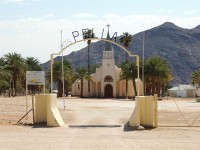
Soon after leaving Pofadder, we turned off the N14 towards the rocky Great Pella Mountains and the dusty little town that has grown up around the mission station of Pella. This really is a fascinating place, not only because of its history but because of its biblical appearance and the rather special atmosphere that still lingers there. Driving into Pella is like driving into a illustration straight out of the Old Testament and even its name has biblical connotations.
A true desert oasis, it boasts a spring that was used by the San for centuries before the London Missionary Society established a mission station there in 1814. A refuge for the local San in what was then a wild and woolly frontier area, it was named after an ancient town that became a refuge for persecuted early Christians.
And so the seed of Christianity was sown, but it took a while for it to take root in that dusty, stony, drought-afflicted ground. The missionary society’s tenure of Pella was at best intermittent and in 1872 it abandoned it permanently.
Six years later a French Roman Catholic Missionary occupied the mission station for a short while but it was only when 23-year-old Father JM Simon arrived there in 1882 that Pella began to flourish. Two years -and a few less stoic missionaries later – Brother Leo Wolf joined him. These two dedicated men gave the rest of their lives to the Pella community, ministering to their people for more than 50 years.
Father Simon became the first bishop of that area and Brother Wolf was eventually ordained as a priest. They both died and are buried in Pella.
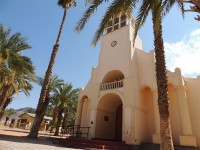
The most eye-catching structure in Pella is the date palm-shaded and rather magnificent cathedral there. The two priests built it from as much local material as possible, using an encyclopedia as a guide. They even forged the iron work for the staircase themselves.
On an earlier visit to Pella, Bill and I had been shown around the mission station by an elderly but sprightly and very welcoming nun, but on this visit we could see everyone there was pretty busy. We had a quick look at the cathedral then took a drive around the neighbouring residential streets.
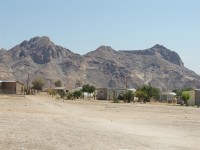
Pella was a far from a wealthy settlement but the neat and modest homes, usually set in pretty little gardens, nestled peacefully beneath the lopsided mountains that looked like badly risen cakes. This little settlement seemed to boast the kind of quiet contentment and simplicity that money can’t buy.
We returned to the N14 and carried on driving west along this incredibly straight road. As we drove we noticed that although the gradient wasn’t steep the route was relentlessly increasing in altitude, a long, straight, gradual uphill that Bill described as a cyclist’s nightmare.
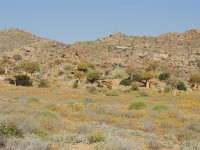
Every now and then a rocky ridge or range of stony hills would intersect the road, providing relief from the monotony of this arrow-straight route. As we neared Springbok the terrain became more mountainous, the surrounding flat terrain broken by great blobs of rock that had seemingly bubbled out of the earth. Often their surfaces were littered with broken slabs and layers, the detritus of onion peal weathering.
The vegetation was growing more and more lush and it was markedly green and flower-bedecked by the time we drove into town. I am fond of Springbok, a neat, pretty and spotlessly clean town that nestles between the smooth granite hills of the Klein Koperberg – the small copper mountains.
The name denotes the origins of the town. It was built on the copper mining industry. Nowadays it is the major centre for the surrounding area. And it supports a dynamic tourism industry largely based on the annual spring Namaqualand flower spectacle.
At the crossroads of the east-to-west N14 artery and the N7, the national road from Cape Town to Namibia, it is also centrally situated, making it a convenient stopover for many travellers and we have often spent a night or two there. It is a good base for the spring flower seekers, too, and can be very busy.
This time round we were a little late for the floral feast and the whole flower circus had moved south with the blooms. A week or two before and the town’s popular caravan park would have been jam-packed with caravanning flower people but we were pleased to see that it was half empty.
It was still early so we were able to spend most of the afternoon joyously exploring the marvellous Goegap Nature Reserve, just outside of town and incorporating the lovely Hester Malan Wildflower Garden. When we entered the reserve the woman at the gate was rather apologetic. “You do know that the flowers are finished?” she asked us.
While most of the riotously blooming annuals had already gone to seed, there were still some colourful swathes of them carpeting some of the slopes and many of the bushes and succulents were in flower adding vivid colour to the scrubby vegetation, the foliage of which sported an amazing range of tones of green.
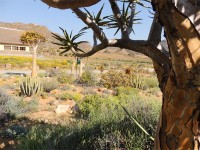
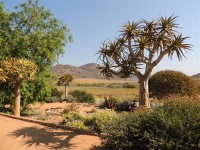
We first took a look at the artfully landscaped Hester Malan garden, a truly exquisite showcase for the wild flowers and succulents of the area, then we drove the scenic tourist road that looped its way over and between the mountains. The main show might have been over but our visit to the reserve was still a floral treat.
I’m sure our fellow tent travellers are like us in that they develop much-loved traditions regarding places they frequently visit. A must-do tradition for us when we visit Springbok, is dinner at the Springbok Lodge and Restaurant, a family-owned business that was established way back in 1947.
Not much has changed since then, I don’t think, except for its name. When we first discovered this retro, fifties-style eatery it was known as the Springbok Cafe. The menu reflects the era from which it grew and meals are wholesome, simple and good – it is one of the few places that still offers a mixed grill – but it is far more than a restaurant.
It is a veritable museum of the area, housing all sorts of photographs, newspaper cuttings and an impressive hoard of treasures from yesteryear. Reflecting the town’s status as the administrative centre of a busy mining area, the restaurant boasts a fine display of semi-precious stones, too. However, for us it is the book section – an incredible collection of books on South Africa and particularly of Namaqualand – that really makes the Springbok Restaurant a winner.
We enjoyed our dinner there. Bill succumbed to temptation and had a mixed grill although he probably should not have done so considering his vetkoek breakfast! We then spent the rest of the evening relaxing round a fire at the attractive caravan park.
From all our wanderings in South Africa’s drylands, we knew Springbok so very well but the next day would see us travelling to an unknown destination. We were due to spend three days in the Namaqua National Park, incorporating the old Skilpad Wildflower Nature reserve and a newly proclaimed coastal section.
It was one of Sanpark’s newest national parks and we wondered what we would find there.