
WE erected our tent at our sandy designated camp site in the lee of a small, crescent-shaped stone wall, our only protection from the elements on this wild, wind-swept, westerly coast.
Except for sandy tracks and the discreetly positioned enviro loos, these little shelters, one at each of the four Kwas se Baai campsites, were the only visible man-made structures in the whole of this amazingly pristine piece of Atlantic seaboard.

From our tent veranda we had a lovely view of Kwas se Baai, a picture perfect little bay, all snowy white sand and tranquil aquamarine sea, set amidst the striking rocky outcrops, jagged, gnarled or water-smoothed, that made up this fierce shoreline.
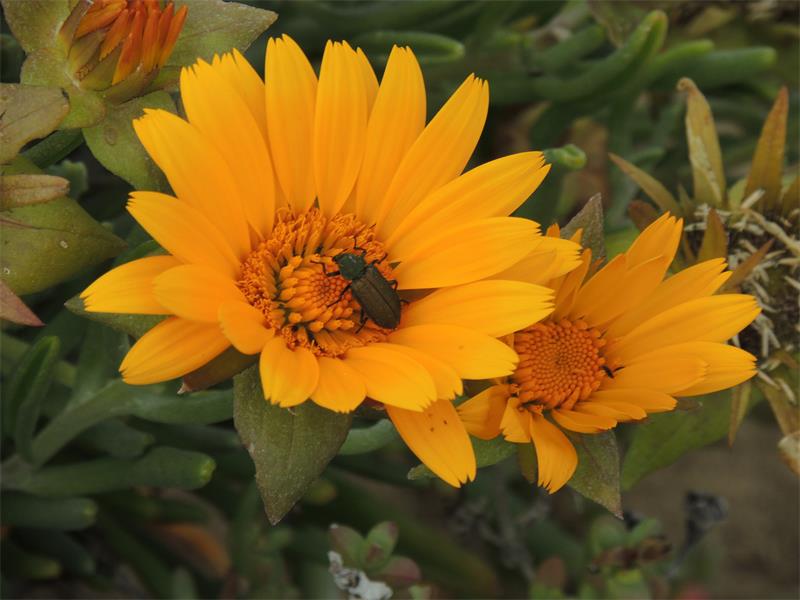
Between our campsite and the rocky shore – and behind our tent, all the way to the horizon – the rough ground was thickly carpeted with succulent vegetation. As it was spring the vygies were in full, riotous bloom, the vivid jewel colours of the flowers perfectly off-set by the bottle green, rust and ochre of the fat, waxy foliage.
It was nature at her most ruggedly beautiful and, on this, the evening of my birthday, we had this extravagance of beauty all to ourselves. The Namaqua National Park offers 31 basic, no-frills camp sites at eight camping areas along the coast.

There were four sites at Kwas se Baai, one fairly close to us and two others quite a distance away. When we arrived there were no other campers in the other sites and we were blissfully alone in this coastal wilderness. Adding to our sense of isolation was the fact that, apart from the aforementioned stone shelter and eco loo there were no other facilities at our campsite – not even cellphone signal. It was heavenly and, as a venue for a birthday, celebrated with a boerewors roll supper and a glass or two of good red, it just couldn’t be beaten.
The sheer magnificence of this new national park would be hard to beat, too. A unique and wonderfully biodiverse national park, it really is a national treasure and it is well worth making a special effort to see it. Its history goes back to 1988 when Skilpad Farm, the northerly section of the park, became a wildflower reserve.

SANparks eventually took it over, incorporated surrounding farms that had been purchased and, in 2002, proclaimed the area the Namaqua National Park. The story of the park didn’t end there, though. In 2008 the almost untouched coastal section, between the Groen and Spoeg Rivers, was added to the park and this preserved piece of land gained a whole new dimension.
The park offers a fascinating mix of fauna, flora and geographical features. It ranges in altitude from sea level to about 1 000m above sea level and has habitats that vary from beaches, rocky shores, estuaries, rivers and wetlands to dunes, grasslands and mountains. It is also part of the Succulent Karoo, one of South Africa’s three internationally recognised biodiversity hotspots. Of the Succulent Karoo’s more than 6 500 plant species about 40 percent are endemic – meaning they occur nowhere else on earth.

We got to experience the park’s amazing variety of scenery, habitat and vegetation on our first day there when we entered at the Skilpad section and took the long, slow road – the Caracal 4X4 Eco Route – to our campsite in the coastal section. We spent most of the day driving this route and it was a magical experience. To anyone who loves nature and enjoys a bit of an adventure, we heartily recommend it.
Our first impressions of the park set the tone for our lovely three-day stay. The Skilpad rest camp was so pretty and the office staff so friendly and enthusiastic. This section of the park is famous for its annual wildflowers and although they were now well past their prime we found quite a good splash of floral colour in some of the surrounding fields. As its name suggests, many tortoises are found here and at certain times of the year it attracts a good selection of game.

There were a couple of inviting walking trails near the office but we only had time for a short one as we had a long, slow drive ahead of us. Soon we were on our way, our printed eco route guide, our Namaqua National Park flower guide and other informative pamphlets in hand. There is no shortage of helpful information and advice when you book into the park.
The first section of the route took us through the lushly vegetated, flower-sprinkled and scenic Kamiesberg and over the stunning Wildeperdhoek Pass. Constructed in the 1860s under the supervision of Duncan Fletcher and using, first, convict then free labour, the fine dry stone masonry still bears witness to the skilful workmanship that went into the project.

It was built, with great difficulty, to transport copper ore from Springbok to Hondeklip Bay but was hardly ever used for this purpose. Soon after it was completed the powers that be decided to develop Port Nolloth rather than Hondeklip Bay as an outlet for the ore.
Today it is part of a beautiful eco route through the pristine mountains – and a little bit of quirky living history.
Down from the mountains the eco route took us over grassy plains then into the glittery Riethuis quartz field, an area that is home to many rare succulents that are associated with quartz. The vygies were in full floral glory there but, as lovers of succulent plants would know, the rich and varied colours of the foliage provided almost as much colour as the flowers.

The last section of the Skilpad part of the route was through a rather strange, rain deprived area. However it receives enough moisture from the fog that rolls in from the Atlantic to support a vegetation type that has a rare fynbos element. Sporting plants like restios and pincushions that one associates with better-watered areas like the Cape Peninsular, it seemed out of place.
Soon after passing through this area we crossed the Hondeklip Bay road, entered the newer coastal section of the park and passed the Swartfontein House, which was being used as a temporary office for park staff. The vegetation in this section of the park is described as Namaqualand Coastal Dunefield and this is one of the few unspoilt places in South Africa that preserves it.

All sorts of intriguing sandy tracks led off from the main route towards the coast but it was getting late and we decided to head straight for our campsite and to leave explorations of the Groen-Spoeg coastal section for another day.
One more interesting geographical feature awaited us that day, though. We soon started seeing notices warning us to deflate our tires as we were approaching a very sandy section, the strange, rather spooky grey world of the Bitter River Dunefield. Described in the guide books as a sand movement corridor, this is a good and a relatively untouched example of a dynamic moving dune system.
These strange shifting dunes of very fine sand cover all sorts of interesting fossils and archeological treasures that are uncovered as the sands move. From a conservation point of view, this dune system is very precious and rare. As visitors we found it eerily fascinating, the gloomy greys relieved by splashes of vivid red flowers.

There was hardly a cloud in the sky when we reached Kwas se Baai and we enjoyed a fine, windless evening there under the stars. Next morning, however, we woke up to a grey world and a cold, moist wind that had us digging out our winter woollies. We erected a wind break around our rather exposed campsite then headed to the beach for a lovely long walk. It was such a beautiful stretch of snowy white beach and the many little paw prints in the sand, including those of jackal and otter, reminded us that we were in a game reserve.
We’d spent most of the previous day in our vehicle and weren’t too anxious to do any driving so, after our walk, we enjoyed a couple of relaxing hours in our camp, reading, looking at the flowers and just enjoying being in such a beautiful spot. Later we went for another long walk, heading south, the opposite direction of our morning walk and along a more rocky piece of coastline.

By the time we got back to the camp it was raining, cold and very windy so we hunkered down and prepared for an early night. Some campers had arrived while we’d been walking. They’d set up their tent a good distance away from ours but they came over and said hello. We’d seen the odd vehicle passing our camp but they were the first people we’d spoken to all day.
They didn’t stay long and soon we were left to ourselves again. The strange misty, rainy weather did not make for comfortable camping but it gave the bay and rocky coastline a whole new haunting beauty.
The wind howled and rocked our tent all night but by morning it had abated a bit. The sun came out, too, but there was still a mean little chill in the air and we kept our winter woollies handy when we hopped into the bakkie to do a bit of exploring.

We spent most of the day doing the little coastal loops and having a good look at the coves, bays and rock formations in the Groen-Spoeg section. This rugged rocky stretch of the Namaqualand shoreline was awesomely beautiful and so amazingly pristine and wild. How privileged we felt to be there.
A couple of the camping areas seemed a little more sheltered than our elevated and rather exposed one at Kwas se Baai but we didn’t find a bay that was quite as pretty as ours.
When we’d left our camp, early in the morning, the vygie flowers had been sulking but as soon as the sun came out they opened up, providing us with another feast of floral glory. They brightened up our drive all the way to the attractive Spoeg River estuary, a good birding spot and our turning point. However, before heading south again, we detoured to the fascinating Spoeg River Cave, an important archeological site with an ancient feel.

Shell middens and detritus show that this cave has been occupied by humans for many centuries. However, of particular interest was the discovery of sheep bones that dated back to an amazing 2 100 years ago. These bone fragments provide the oldest evidence of domesticated sheep in South Africa.
It is amazing to think that, while shepherds watched their flocks by night on that fateful evening near Bethlehem, some 2 000 years ago, the Spoeg River Cave shepherds were doing just that, too. Did they also wonder about that very bright star – and did they perhaps hear the whisper of an angel’s wing?

We had a late breakfast at Boulders Bay, the most northerly of the coastal camping areas, took a look at the seal colony there, then slowly headed back to our camp to enjoy another long beach walk and our last evening, another strange misty one, at pretty Kwas se Baai. In the morning we took a slow drive to the gate at Groen River mouth and had a look at the estuary before taking leave of this very special national park.
It truly is a wonderful place and one we wouldn’t hesitate to recommend to anyone. The absolutely no-frills, back-to-basics camping might not suit everyone and many people declare themselves a little allergic to canvas, anyway. Fortunately, the rustic coastal campsites are not the only option. There are four attractive chalets in the Skilpad section – and during the flower season accommodation is offered in a temporary, luxury tented camp, also on the coast.

Now about 150 000ha in size Namaqua National Park is still expanding and will be of even greater value once its adjoining Namaqua Marine Protected Area is proclaimed. It is still in the development phase. Certain sections are being rehabilitated and unwanted structures are being removed. When all this is completed this new and wonder-filled national park will surely be a reason for all South Africans to feel very, very proud.




