
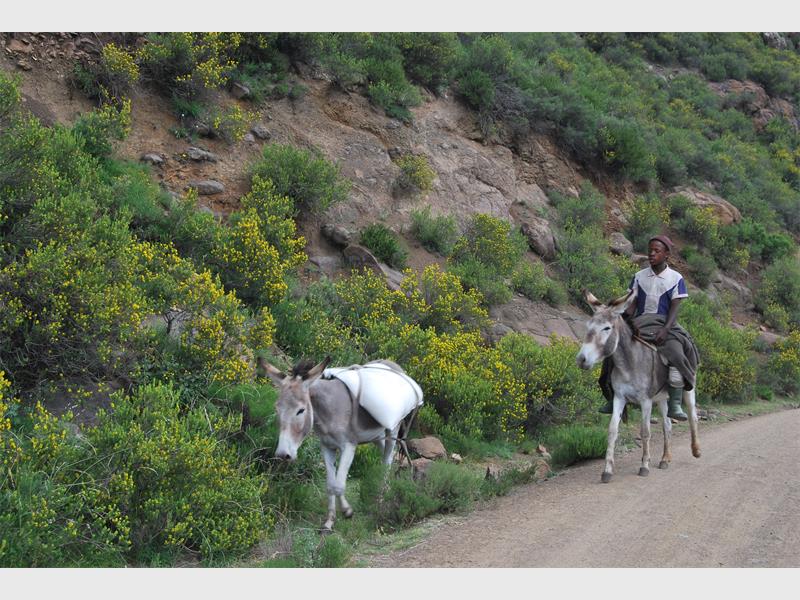
AS we have spent the last few weeks virtually wandering round the Drakensberg let’s linger awhile and try out one of the mountain region’s most exciting routes, the world-famous Sani Pass from KwaZulu-Natal into Lesotho.
And if we are taking the trouble to pay the mountain kingdom a virtual visit lets stop there a while and take a look at Lesotho’s premier national park, Sehlabathebe, next week. So hang on to you hats and let’s begin our virtual expedition up and over the Drakensberg – the dragon mountains – and into the kingdom in the sky.
Sani Pass is always an adventure, no matter how many times you crawl up the dragon’s side or inch your way down again, hugging its ribs, trying to ignore the sheer drop at the edge of the gravel track.

Once the dragon was a fiery beast, born of fire and ice. Now it slumbers, its huge body stretched out along the edge of the sub-continent, a formidable barrier between the east coast and the hinterland. From a distance, on a fine day, you can clearly make out its sleeping form from viewpoints like the one outside Underberg. It is truly a gorgeous creature.
Sani Pass is one of only few passages through the jagged Drakensberg into the interior, and it is the only road link between Lesotho and KwaZulu-Natal.
“Today, Sani is like a freeway,” hardened offroaders might sniff, remembering the battered surface of the road and the reversing and three point turns that once had to be done to round each hairpin bend. For the coils of the pass have relaxed somewhat. Once a simple bridle path, it is now a fairly respectable road, although, as it snakes its way upwards, climbing some 900m, to a height of 2 892m above sea level, in just eight steep kilometres, it is still an awesome one.
The turnoff to Sani is about 3km north of Himeville and the pass itself begins at the South African border post, about 25 bone-jolting kilometres of gravel road after the turnoff. The pass winds up and up, rugged and rocky, turning back on itself in a series of sharp corners, the gradient increasing around each bend. As you crest the top, you reach the Lesotho Border post, an unprepossessing building that always smells of coal fires. It is the smell I associate with Lesotho. Wood is scarce in the mountain kingdom and even in midsummer, it can be bitterly cold.

There is usually a warm fire and hot gluwein at the pub at Sani Mountain Lodge at the top of the pass. This quaint hostelry’s claims to fame are its frontier atmosphere and the fact that it sells itself as the highest pub in Africa. Nearby is Thabana Ntlenyanae – Beautiful Little Mountain – at 3 482m the highest point south of Kilimanjaro. On the balcony in front of the pub, you can admire the view, soak up the thin rays of the sun and watch the ice rats. Basic camping and comfortable rooms are available, if you are planning to stay. Or you can head onwards up Black Mountain pass, less dramatic than Sani but just as scenic. The rough road up this pass continues onward to Mokhotlong, the place of the bald ibis, some 50km from Sani Top. From there you can head across Lesotho to Maseru, or, via Oxbow, to Butha Buthe and the Free State.
When the dragon is in a benign mood, Sani Pass is lovely. In summer, the rain-drenched Umkomazana River valley is all rich green folds. Small streams leap down the mountains in sparkling waterfalls. The sides of the pass are transformed into a garden of wild flowers. Each bend in the road is a reason to stop and take in the spectacular view. In winter, the greens disappear and Sani is all shades of brown. The monochrome scenery dramatises the ruggedness of the pass and has a harsh beauty of its own.
But beware the slumbering dragon, for sometimes it stirs. Storm clouds gather at the top of the pass and the dragon spits fire or lays icy patches on the corners that can trip up the unwary. Snow or mist or driving rain can cloak the dragon almost any time of the year and often extreme weather makes the pass treacherous.
The dragon slumbers as you tickle its ribs, steering your puny little vehicle up its side. But never take sleeping dragons for granted.




