
WE have been presented with something of a dilemma.
I’ve mentioned before that we get the occasional and very welcome visit from Mr Spotty, a large spotted genet who ambles up the steps and into the Hide in the evening, checks out the scene, and then ambles off.
It’s all very civilised, no one interferes with anyone else and we get to share our space with a piece of real wildlife for just a little while. Anyway, the other night we were sitting there quietly debating the meaning of life when Mr Spotty arrived.
He slunk along, and I must point out that genets are very low slung, and we noticed something different about our pal. He/it seemed to have put on weight around the middle, so much, in fact, that it poses the question, is Mr Spotty in fact Mrs Spotty?
Wouldn’t it be wonderful if this were indeed the case and that in some very small way we could be involved in some spotted genet kittens coming into this world?
This is the right time for such an event, and my Smithers* mammal book tells me that large spotted genets have litters of up to five young, but usually one to three. By the way, the genet is not of the cat family as one might suppose, but of the Order of Carnivora and the Family of Viverridae, along with civets and mongooses.
It’s interesting that genets can become quite used to slinking around human habitats and can also quite easily become habituated to humans.
We’ve come across this twice, once on a tiny island in the Okavango Delta in Botswana where the local lodge had a permanent braai set-up, and a permanent genet in attendance, and once in the Malaysia Mara in Kenya, where there was a genet that frequented one of the camps at which we stayed.
Both were quite happy to be seen, never approached, mind you, but certainly quite in evidence. Anyway, if our Mr or Mrs Spotty loses weight suddenly, we’ll let you know.

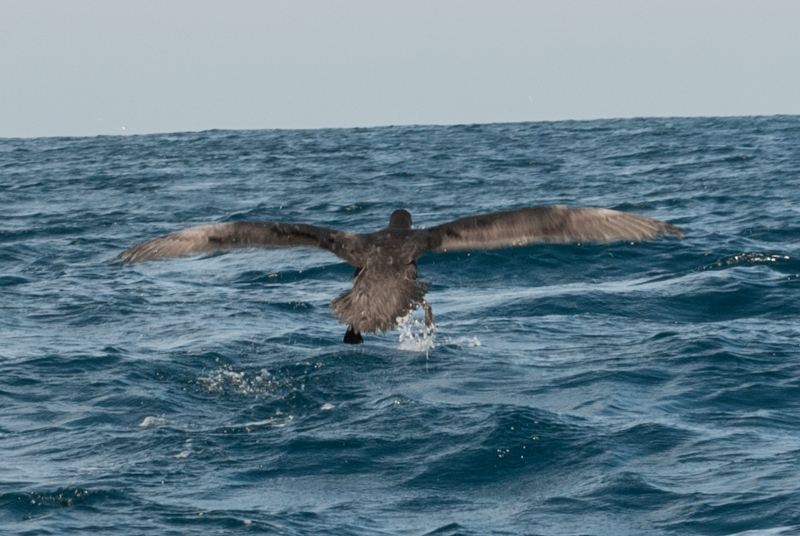
And now it’s out to sea. The Second Chance Avian Rescue facility (SCAR) in Shelly Beach has successfully re-released a pair of giant petrels that have been at the unit for a while.
A Southern giant petrel was brought in a little over two weeks ago and then by pure chance a Northern giant petrel a week later, both of them juveniles on their annual migration path from the Antarctic, according to Michelle Pearson, who owns and runs SCAR.
Michelle told me that she had struggled to keep the exhausted and hungry birds happy as they ate up to 20 sardines a day between them, but she had managed. The birds were taken out to sea last weekend on a C-Freaks boat and happily took to their natural habitat.
If you can help Michelle in any way, and remember she is there to help us and our wild birds, she is at 083 2466765. Cheers, and happy hunting, giant petrels.
*Smither’s Mammals of Southern Africa, Ed: Peter Apps, Southern Books, Halfway House, 1996.
The South Coast Herald is also on Facebook and Twitter – why not join us there?



