Tent Travels: Mist, rain and mountain zebras
Stunning Mountain Zebra National park is one of my favourite wild places.
WITH the sun making a welcome appearance after yet another, misty rainy day in Mountain Zebra National Park, the birds and animals were in high spirits.
We were driving from camp along the ‘main road’ towards the Ubejane Loop in the flatter plains section of the park and all the lively creatures were providing royal entertainment.
Soon after setting out we startled a spotted eagle owl, sitting on the edge of a causeway. It flew up into a branch just above our vehicle and sat motionless, blinking at us, in the wise way of owls. A close encounter with one of these silent creatures of the night is always special.We’d seen buffaloes along this stretch of road before but the herd was out in full force that day. Two high-spirited youngsters were play-fighting, an impressive show of muscle and force. Good thing it was only a game.
A pair of hungry secretary birds came striding towards us across the veld. We stopped and watched them for a while. We’d seen quite a few of these fascinating long-legged raptors since our arrival five days ago. Entertaining birds! After we left them to their hunting we turned off the main road onto the Ubejane Loop, a particularly rewarding route, we’d discovered. Soon we began ticking off the usual plains animals then, as we came round a corner, we encountered our first zebra crossing of the day.

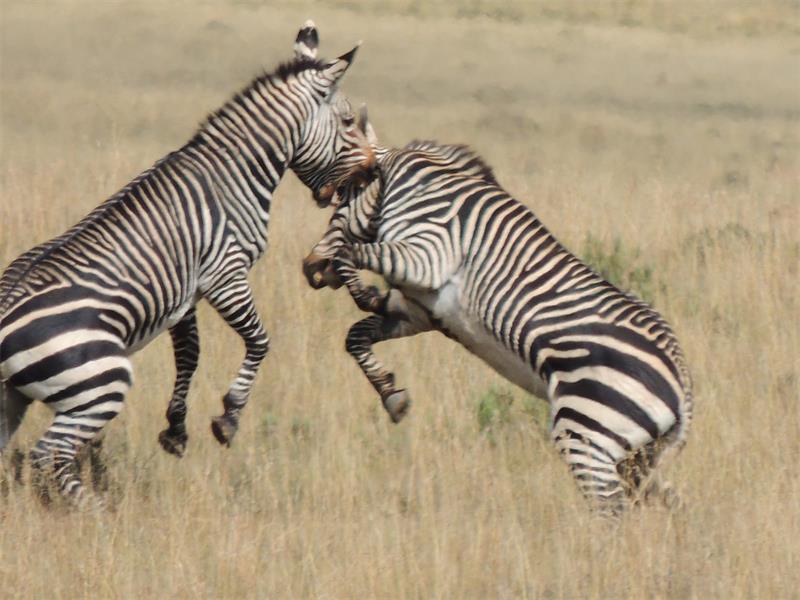
They were Cape mountain zebras, a small family group that included two very young foals. As they were wandering all over the road, we stopped the vehicle and settled down to watch their antics.
Adorable creatures, these zebras are smaller and stockier than their cousins, the plains-dwelling Burchell’s zebras and they always remind me of those toys made of mattress ticking you might remember from your childhood. Lacking the shadow stripes you see in other species, they are rather dapper creatures with crisply-contrasting, clearly-defined black and white stripes that extend right down to their hooves. The stripes are beautifully offset by their pure white bellies.
It is a sobering thought that they could well have followed the quagga into extinction. Without the Mountain Zebra National Park they might not have been around for us to admire today. Back in the 1930s these zebras were considered pests by all but a few farmers. Even in the 1800s they were uncommon. Numbers had dwindled to almost nothing by 1937, when the Mountain Zebra National Park was established, specifically to protect them.
Originally it was a tiny game reserve and the single mare and five stallions it protected did not thrive. Fortunately, as more farms were bought and added to the park to provide better grazing, two farmers who protected the zebras on their farms approved of the new home and were finally persuade to part with their pets.
Since those early days the park and the zebras have flourished. Mountain Zebra National Park has expanded enormously and so has the mountain zebra population. More than 1 000 of the offspring of the farmers’ small herds have been relocated to other reserves in areas where the mountain zebra once roamed free.

The Mountain Zebra National Park is also well stocked with an interesting variety of other game, ranging from gemsbok, springbok, red hartebeest and kudu to the interesting small fry like meerkats, ground squirrels and mongoose. In recent years, cheetah, black rhino and lion have been reintroduced into to the park, adding to the game viewing excitement and there are plenty of interesting specials for the birders to seek as well. However, considering their brave fight back from the brink of extinction, the mountain zebras are the stars of this lovely park.
Mountain Zebra National Park is not just about game viewing and birding though. Physically, it is truly beautiful, offering some of the most dramatic and varied scenery you are likely to find in any of our wonderful national parks. As well as the great variety of topography and vegetation it changes with the seasons and no two visits are ever the same.
On this, our Easter weekend visit, although a little summer greenery remained autumn was advancing rapidly, overlaying the greens with brass and copper tones. Temperatures drop dramatically in the Karoo when the hot summers give way to winter, particularly here in the more mountainous parts, and with the misty, rainy weather we were experiencing, we were soon glad we had brought along plenty of winter clothes. The seriously cold winter was, however, still waiting in the wings and although it was chilly at times it was only very cold on one of the five days we spent there, the Easter Sunday.
As I said last week, we were luckily able to complete two of the three 4X4 route on our first afternoon before the rainy weather set in. By evening, the camp was filling up rapidly, mostly with big family group, all looking forward to an outdoorsy Easter weekend. Bill and I tend to do most our tent travelling during the less popular, out-of-season months, so it was a pleasant change to be part of all the long weekend bustle. It was also good to see so many children of different ages out exploring, making friends, riding bikes, getting dirty, getting physically tired and thoroughly enjoying being outdoors. What a wonderful encounter with real living nature in what I fear is becoming a more and more virtual world for many children.

On our first morning in the park, we woke up to wet, dull weather but we hoped the mist would clear once the sun had warmed up the world. It was not to be. Thick mist obscured much of the view when we tried out the mountainous Kranskop loop, probably the most dramatically scenic section of the park. Even though the magical vistas usually seen from the higher points had vanished in the mist, it was still such a beautiful drive and the misty weather added a Lord of the Rings quality to what is always a rather mystical place. The rock formations along this route are fascinating, with massive, round onion-peeling rocks, huge balancing boulders and great slabs carved up by the elements into geometric shapes, all held together precariously by gravity like some giant jigsaw puzzle.
The end of the morning drive took us home via green and pleasant Wilgeboom River valley, the rocky river bed and surrounds softened by thick green swathes of bushes and shrubs and bright karee trees. We stopped for breakfast at the Weltevrede picnic site, the more remote of the two lovely picnic sites in the park and a good spot for some armchair – or should I say camp chair – birding.
It was still a bit misty the next day so we started out with a pleasant morning drive along the Ubejane loop in the more low lying part of the park. More scrubby than the higher sections of the park, it is a good place to look for the park’s smaller fry and we also spotted plenty of plans animals there. What makes this route even more attractive is the scenic new road leading up the plateau and linking the lowlands with more lofty Rooiplaat Loop. We drove up the link road and did a section of Rooiplaat, a loop that we find the most rewarding both from a game viewing and birding point of view. By the time we reached this section the mist had cleared so we were able to enjoy the typical Karoo vistas of plans, plateaux, bossie studded koppies and blue, flat-topped mountain ranges. The more you see of it the more the Karoo grows on you.

We took a drive out of the park on Saturday to take a look at the nearby town of Cradock – more about that later – and did the Ubejane Loop on the way home, stopping to watch the entertaining ground squirrels for a while. We didn’t really feel like sitting around in camp so we had a productive game-watching afternoon up on Rooiplaat. That night, the clouds disappeared and allowed us some heavenly star gazing, but by morning the mercury had plunged and a mean and icy wind was prowling round our tent.
It probably wasn’t a great idea but we packed a breakfast picnic basket and headed for the hills. Although freezing cold up there, the crisp air ensured amazing views and, with the interplay of weak sunlight and moving clouds, mountains and shadows, we enjoyed an incredibly light show. It was freezing cooking our breakfast, hiding from the icy wind in the lee of the vehicle, but our hot coffee and bacon and eggs rolls were better than a banquet.
In spite of the cold weather the game viewing was excellent that morning and we saw a substantial herd of eland, a breeding herd of buffalo, a few jackal and plenty of shy, tiptoeing kudu. It was a bit warmer that afternoon and the animals were out in full force when we did a section of Rooiplaats. A rewarding birding session included a group of four blue cranes, a couple of secretary birds and some shelduck on one of the dams as we drove down the plateau to the Ubejane Loop. The squirrels were enjoying the sunshine on the scrubby plain and we saw some mongoose as well.
At home, we put up the windbreak we always carry in our car, lit a fire and made a delicious pot roast leg of lamb as an Easter Sunday treat. The Easter bunny had found our campsite so we rounded off a good meal with some chocolate treats. By evening the weak sun had given up the fight and had retired behind the clouds that had come along to drizzle on our camp.

On the Monday, our final day in the camp, we woke to sunshine and decidedly warmer weather. To celebrate the lovely day we were out until after lunchtime driving most of our favourite routes and enjoying some first class game viewing.
Then, that afternoon we took advantage of the dry weather to do a little exploring on foot. With a steep, rocky ascent to the top of a ridge, the Black Eagle Hiking Trail proved fairly challenging and seemed much longer than its purported 2,5km but, wow, it was well worth the effort. The view from the top of the ridge was just amazing.
Up here, far away from the hustle and bustle of a busy camp we were reminded about why we love the Karoo so much. It is all about the Karoo’s great emptiness and its crisp champagne air, its bossies and mountains, lonely windmills and is plains. Mostly though, in this noisy world of ours, it is the Karoo’s silence, its silence that sings, that draw us back time and again to South Africa’s lonely heartland.
So often while visiting a national park we seem to receive a special little farewell gift on our last day or on our way out of the park.
Last time we visited the Mountain Zebra we’d seen two cheetahs on a kill just a short distance from the gate, on our way out. This time round the farewell gift was less dramatic but just as special. On our way to the gate we caught sight of two of the Karoo’s very special birds, its striking, rather rare and near threatened blue korhaan, a South African endemic and, for many, a mega- birding tick.
Not at all shabby, as farewell gifts go.

To receive news links via BBM, add us using the pin 2BABF7D1.
The South Coast Herald is also on Facebook and Twitter – why not join us there?