Tent Travels: Addo elephants – a story of survival
This pachyderm paradise is a very user-friendly national park.
LATE summer rains had left Addo Elephant National Park looking quite magnificent, the grassy sections and the spekboom-dominated thicket all vivid emerald green against the red soil.
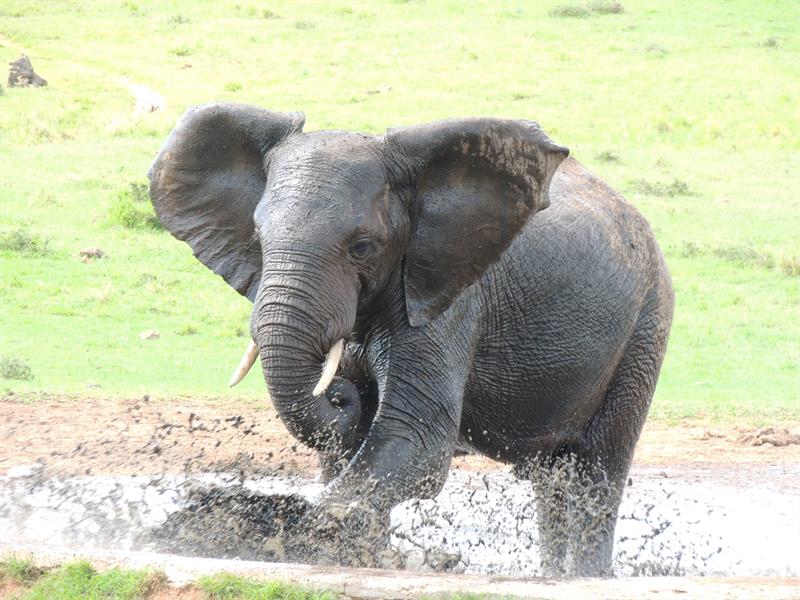
The Addo ellies were making the most of this seasonal bounty. We’d quickly tracked them down, two big breeding herds, on the natural ‘lawn’ near Carol’s Rest Waterhole on the Gorah Loop. There were many babies, including some very tiny ones, and plenty of rambunctious teenagers adding to the fun.
The Addo elephants are fairly well habituated to motor vehicles although visitors should always remember they are wild animals. We must always keep our distance. On this lovely sunny day, though, they were totally unconcerned about the row of cars that had stopped to watch them. As they grazed and played and communicated in the touchy-feely, rumbly way of ellies, They were totally at peace with the world – and so were all their human companions.

Watching the relaxed, often playful, interaction between the different ellie individuals and groups I could not help rejoicing at the thought of their change of fortunes. At one stage the elephants in the Addo area were ruthlessly hunted and were in fact nearly completely exterminated. A public outcry against the killings eventually halted the slaughter but by then only 16 elephant remained. By the time Addo Elephant National Park was proclaimed in 1931, as a haven for the Addo elephants, only 11 had survived. As an elephant refuge the park has been a huge success and is now home to about 400 of them. To introduce new bloodlines, park authorities have also relocated some Kruger elephants to Addo and from all account these immigrants have integrated and settled in well.
The elephants weren’t the only animals we encountered on our first Addo game drive . We’d headed into the main game viewing section of the park around midday, soon after setting up our tent in the camping section at the main Addo rest camp. On our way to Gorah Loop we’d encountered plenty of zebra, a lovely herd of eland and a sprinkling of red hartebeest but it was the kudus that had impressed us the most.

They were everywhere – hundreds of them. In fact we couldn’t remember ever seeing so many in any other national park. It was a reminder of how Addo had grown over the years. From its humble beginnings as a small haven for the Eastern Cape elephants it has grown into one of South Africa’s largest, most popular national parks, conserving the big seven – the conventional five plus great white sharks and whales. Its endemic flightless dung beetles are well-photographed celebrities, too.
For us, returning to Addo is always like a reunion with an old friend – with a very dear old friend, as this pachyderm paradise is so close to our hearts. Over the last few years many other people have discovered its delights and it has become hugely popular with overseas visitors and locals, including many tent travellers.
In fact, as this visit to Addo had been a bit of an impulsive decision and we’d only booked three months previously, we’d only managed to obtain a booking for one of the smaller tent-only sites on the periphery of the main camping area. Fortunately the slightly more roomy end one in the row had been vacant and we’d set up camp there. It really was a lovely site, too, overlooking a hill within the game viewing area. Throughout our stay there were usually a few elephants to see from our camp and one evening we had a lovely sighting of a lion.

Perhaps partly because we know it so well, we find it a welcoming, undemanding, user-friendly sort of park – and we are not alone. Many of our fellow tent travellers agree.
On our first visit to Addo, many years ago, facilities were limited, the park was much smaller than it is today and the main rest camp was pleasant but a little tired. Back then, national park rest camps had a certain old-fashioned charm but were generally no-frills, rather rough and ready tourist facilities and Addo was no exception. It was a busy camp, too, and catering for the sheer numbers of people who came to visit the ellies had given it a slightly down-at-heels air.
By our next visit, a few years later, all that had changed. The rest camp had benefited from a major overhaul and the park itself had begun the amazing expansion we have watched with great joy and interest over the years. In short it was then already well on its way to becoming one of our premier national parks and the world-class tourist destination that it is today.
It now offers excellent tourist facilities, a much-expanded network of game-viewing roads and a wide assortment of accommodation options to suit all budgets and tastes. This coupled with its proximity to various popular tourist routes and destinations has really put it firmly on South Africa’s tourist map. We’d booked four nights at Addo and were looking forward to reacquainting ourselves with our old friend.

We were also looking forward to seeing our niece, Kim, and her husband, Matt, who were joining us at Addo on our second night there. They were both doing post-grad environmental degrees at nearby Rhodes University. We’d gone to their wedding in the Western Cape last year as part of our ‘filling in the gaps’ road tour. Both keen birders and knowledgeable about all things natural, they were the ideal companions for a visit to a game reserve. It was almost like having personal guides.
They arrived soon after 7am and we caught up with all their news over toast and tea. Soon we all set off to explore the gaem viewing area with plans to meet up at Jack’s Picnic Site for lunch. This really lovely, bird-filled picnic site was another of the many top-class tourist facilities that had been introduced in recent years.
Kim and Matt went off to see if the ellies were still at Carol’s Rest and we did a few of the loops around Hapoor Dam. Amazingly, after our wonderful elephant sightings the previous day, we hardly saw an elephant that morning even at Hapoor Dam, where ellie sightings are almost always guaranteed.
In fact, most unusually, throughout out stay we did not see any elephants or buffalo at Hapoor, at the rest camp waterhole or at Domkrag Dam where we usually rounded off a day in the game viewing area with sundowners. With so many puddles left over from the rain the big mammals were avoiding the popular water points. During previous visits Donkrag had almost always offered us good buffalo and elephant sightings but this time, the view site was for the birds – and birders. Even if the big guys stayed away there were always a good few avians hanging around.
We found the game viewing was generally poor in the Hapoor area but the scenery was lovely and we enjoyed our morning drive. When we met up with Kim and Matt for lunch, they were ecstatic about their exciting morning with the elephants and all the other game in the Gorah Loop area. Later, after another Gorah Loop meander to see the ellies, we enjoyed a sunny sundowner with Matt and Kim at the Domkrag Dam lookout, which is conveniently situated near the rest camp.

After Kim and Matt left the next day, we spent a morning in camp, looking at the smart new interpretive Centre – really impressive – and doing some bird watching at the waterhole and the small in-camp bird hide. In the afternoon, we drove up to the popular Zuurkop Lookout from where we watch plenty of ellie activity. Again, we were amazed at the huge numbers of kudu that we saw.
We were up and away early on our last day at Addo, our picnic basket packed with breakfast and lunch. After breakfast at the picnic site, we crossed over into the Colchester section of the park where we were pleased to find a well-established network of tourist roads and plenty of elephants and other game. If you are staying at Addo it is well worth spending time and effort exploring this scenic and interesting, newly developed section of the park.
Every time we go to Addo we are amazed at how more tourist-friendly it has become and the now well developed Colchester side is a huge bonus. There is also something rather lovely about being able to see the sea from a big-five game reserve, which you can do from the southerly section of Colchester. The larger Addo also now includes two coastal sections, which we have yet to explore, plus a substantial chunk of land inland from the main section of the park to the Zuurberg Mountains. On a previous trip we’d spent a couple of nights at the rustic Mvubu camping site in the Kabouga Section and had seen a bit of the more mountainous sections of the park. A stay at Mvubu is also well worth while, if you don’t mind back-to-basics camping..
On our way back to camp, much later that day, we enjoyed a final sundowner at Domkrag, one of our very favourite spots in the park and a place that holds many fond memories for us. Later that evening, packing up and preparing for an early start the next day, we were thrilled to spot a lion from our campsite. Thinking it might have been heading to the camp waterhole for a drink we hurried over there. The lion didn’t make an appearance so we went back to camp and spent a final peaceful night in our cosy camping site in one of the most interesting and user-friendly of all Sanpark’s national parks.
To receive news links via BBM, add us using the pin 2BABF7D1.
The South Coast Herald is also on Facebook and Twitter – why not join us there?