Tent Travels: Mngazana’s magical mangroves
Life is pretty tough for the specially adapted creatures of the mangroves.
BILL and I can happily spend weeks by ourselves in splendid isolation, communing with nature in some remote wild spot, but we are sociable people and also enjoy heading off on an adventure with a bunch of lovely friends.
Somehow, the Transkei, with its gregarious and slightly offbeat nature, is a really great place to share with special people. It is also fairly close to home so it is not surprising I have many happy memories of busy, sociable long weekends with some of my favourite people in this laid back and beautiful part of South Africa. One particularly special weekend with friends was spent in a typically rustic Transkei cottage on a promontory overlooking a simply gorgeous beach at Mngazana. A beauty spot alongside a particularly scenic stretch of Transkei coastline, it is not far south of Port St Johns. We spent a long weekend there as part of a big, happy, noisy three-generational group.
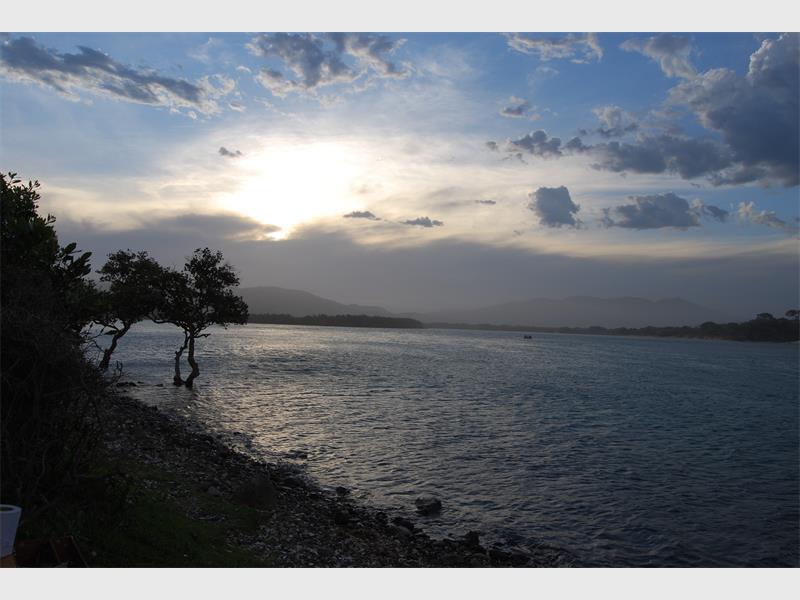
What fun we all had and there was just never a dull moment. From the time we rose with the sun until the end of our action-packed day there was always something happening. However, my favourite time was towards the end of the day when the sun was starting to sink. That’s when would all congregate alongside the river near the Mngazana estuary for a spot of fishing and a sundowner or two. After a hot, busy day the cool rather reflective evenings were sheer bliss.

Bill and I usually started out with a walk along the stoney, shell-strewn sand beside the estuary, surely one of the prettiest beaches I have yet to see. Then we’d join our friends on the pebbly banks of the sparkling river. It was a really special little spot alongside a waterway that had a very special feature. Not far upstream from our evening sundowner meeting place is an extensive mangrove stand. It is about 140ha in extent, making it the third largest mangrove swamp in South Africa. In Southern Africa mangroves are found only in our estuarine systems alongside our warm Indian ocean. According to Richard Boon’s eastern tree guide `Pooley’s Trees’, published by the Flora and Fauna Publications Trust, mangrove communities reach their southern most limit in Africa at Kobonqaba, in the Eastern Cape, just north of Kei Mouth and not that far from the gorgeous mangrove stand at Mngazana.

The mangroves on their gooey intertidal mud flats have a strange beauty although, like other swampy places, they are a little spooky, not least because of the strange leggy trees with their weird aerial roots that enable them to breath. Conditions are tough for the specialised plants and creatures that call the mangroves home and it is not surprising that the number of species found there is limited. Flooded at hightide, left high and dry at low tide, the mangrove swamps are very salty, inhospitable places where organisms must adapt quite dramatically or die.
Among the unusual creatures that have adapted to their salty home is the fiddler crab, a creature that scuttles around the mud flats hunting for the decaying organic matter that makes up their diet. The male crab has one huge brightly coloured claw that he waves around to impress the females. I was interested to read in a Jacana publication entitled `KwaZulu-Natal, a Celebration of Biodiversity’ that the Pemba mosquito, which occurs in mangrove swamps lays its eggs on another crab species, the red-clawed mangrove crab.
This charming publication also talks about the mudhopper, another mangrove dweller. A small mottled brown fish with bulging eyes, it spends much of its time out of the water, skipping across the mud or clinging to mangrove stems. There are also some eye-catching avian mangrove visitors and dwellers, including the mangrove kingfisher, a beautiful creature and a tick to brag about among the birding fraternity.

Mangrove seeds are unusual in that they germinate on the parent plant, often rooting where they fall. Three of the most common species of mangrove trees that occur in South Africa are the red mangrove (Rhizophora mucronata), the black mangrove, (Bruguiera gymnorrhiza ) and the white mangrove (Avicennia marina). While these three trees are commonly spotted in our mangrove swamps, according to Richard Boon you would have to go to Kosi Bay to see all of the different mangrove species that are found in southern Africa. Kosi where the three mangrove common trees can be found, is also the southernmost limit for two others, the Indian mangrove (Ceriops tagal) and the Tonga mangrove (Lumnitzera racemosa).

Like the extensive mangroves stand, the Mngazana River itself and its wide estuary are lovely – and form quite a substantial waterway. Enterprising young locals have acquired boats and run a ferry service backwards and forwards across the river. On the one evening there, a number of locals who lived on our side of the river were attending some big function on the other side. The ferrymen were pretty busy that evening, ferrying their passengers, who were all dressed up in their Sunday best. In spite of the sometimes overloaded boats and a brisk little wind, the ferrymen were skilled operators and everyone arrived at the destination safe and sound and, amazingly, dry.
Our last evening alongside the Mngazana River was special. We watched in awe as huge purple clouds amassed, brewing up a quite spectacular storm. The first drops fell as we packed up and headed for our vehicles and we drove back to the cottage in the pouring rain. As storms are wont to do in this part of the world, it soon moved on, in search of someone else to drench. The clouds disappeared and the stars came out and the local insect orchestra began to celebrate the rain. Suddenly it seemed as if some of the stars had made landfall as hundreds of fireflies came out to play.
To receive news links via BBM, add us using the pin 2BABF7D1.
The South Coast Herald is also on Facebook and Twitter – why not join us there?