
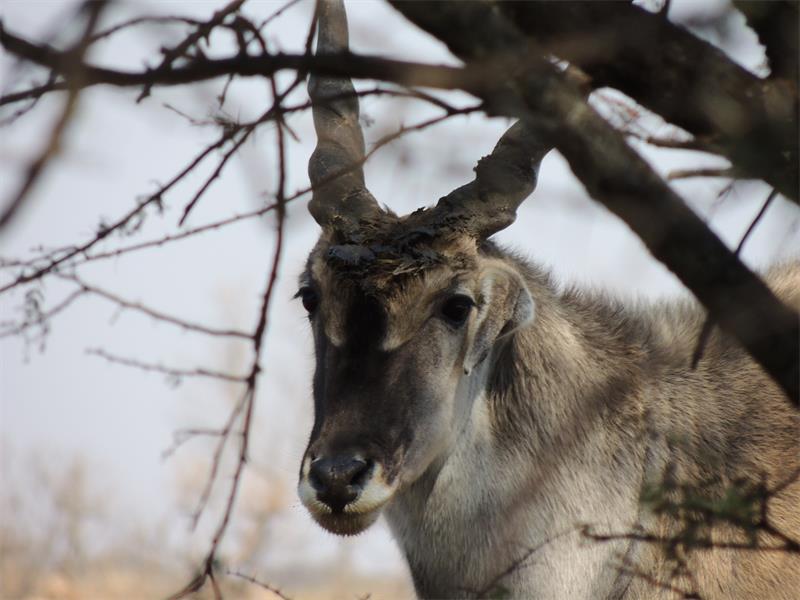
BLEACHED grass, bare thorn trees, low winter sunshine and a line of eland making its way to the dam – gazing at the classic out-of-Africa view from our tent I felt myself falling in love with Weenen Game Reserve all over again.
You tend to forget what a special little place it is. Situated in the KwaZulu-Natal Midlands this Ezemvelo KZN Wildlife park is a conserved area of about 5 000ha of rolling grasslands and undulating thornveld, craggy hills, soggy waterways and spongy vleis where tall thatching grass grows.
In the south of the reserve the scenery is more dramatic. Here the Bushman’s River has carved itself a steep, thickly-vegetated valley, at the bottom of a magnificent escarpment. A viewsite perched on a craggy rise near the Umtunzini picnic site overlooks the river valley.

Weenen was the starting point of our three-week KwaZulu-Natal camping trip reacquainting ourselves with Ezemvelo KZN Wildlife’s wild and wonderfully varied game reserves. We were just into August when we set off so officially it was still winter. The veld was all wintry tones of khaki and bronze and that drab shade of olive green that is a useful neutral in any wardrobe.
The first camp of our walkabout set a high standard. Weenen has a lovely camping area, set in a grassy saucer surrounded by thorn-tree dotted hills. As we’d got to Weenen fairly late in the afternoon we didn’t really have time for a game drive that day but we were quite content, sitting on our tent `verandah’ watching the passing parade.

The camping area is a bit of a maze, with the ample and private sites like linked fairy circles in the long grass. There are plenty of shady trees in the camping area, many of them shapely paper bark acacias. It overlooks a dam wall, beneath which there is a marshy area that in summer is green and squelchy. Even though it was winter and the swampy vegetation had been reduced to brittle browns, it attracted plenty of game, as did an adjoining grassland that was greening up after a fire. It had attracted quite a bit of general game including big herds of red hartebeest and zebra, about a dozen eland and a whole lot of noisy ostriches that did their lion’s roar imitation all night. With the ostrich booms harmonising with the song of the jackal and a selection of munching sounds from assorted grazers, we were lulled to sleep by quite an impressive night symphony.

Our destination for our first full day in the park was the Umtunzini Picnic Site but we took a roundabout route and we met up with a herd of zebra when we explored a nearby cul de sac. The winding road took us up a rocky slope through brittle, leafless trees. It was amazing to see how well the zebra stripes blended into the rugged, monochrome surrounds.
After a picnic brunch we wandered over to the viewsite and gazed down on the fertile valley through which the Bushman’s River meanders after dropping down through the surrounding rocky hills. A furrow leading from the river to the nearby town of Weenen was a reminder that this was Voortrekker country, an area redolent of those creaking wagons.
The nearby town was laid out by trekker settles in 1838 and the name is an echo of one of the violent episodes in their history. Weenen means weeping and the name chosen for the fledgling town was a grim reminder of the recent massacre of a Voortrekker party by Dingaan’s warriors. The town founders built the channel in 1841, no mean feat considering they had no surveying instruments.
Travelling back to camp slowly, via the Mfomfeni viewsite and the Umthombe Hide, we enjoyed good game viewing and the dramatic wintry savannah scenery. In places, coppery grass added ruddy tones to the predominantly khaki landscape and a few fig trees and cabbage trees offered a little green relief.

When we arrived back at the camping area a chilly, dust-laden wind came sweeping through, tugging at our tent and covering our camping table with a layer of gritty sand. We put up our windbreak and spent the rest of the afternoon reading our books and hiding away from the weather. By evening the wind was dropping and we took a drive along one of our favourite routes, to the lovely Sanctuary picnic area. The fence around it has been removed but the attractive stone and wrought-iron entrance has been left standing to remind visitors that Weenen people had set the area aside as a bird sanctuary as part of the 1938 Voortrekker centenary celebrations.
Well-treed and offering panoramic views and good birding, what was once known as Centenary Park is now a delightful picnic site but what always makes it special for us is the knowledge that it is at the heart of what is today a well-established game reserve.
A further treat awaited us. We drove home via the Tierskloof Road, which hugs the edges of the densely wooded Tierkloof Gorge named for the many leopards that once called it home. The rock formations are striking along this road and, with all sorts of interesting trees, like huge boer-beans, cabbage trees, figs and naboom euphorbias, it was a really good tree-hugging route. Tierskloof is my favourite and perhaps the most scenic of all the park’s many interesting tourist roads.

The wind subsided as it grew dark and the still air seemed to accentuate the brilliance of the millions of stars, twinkling brightly in the velvet night skies. Starry starry nights are among the many reasons why Bill and I so love heading out of town with our tent.
The next day’s drive was another reminder of Weenen’s interesting past. After breakfasting in camp with the zebras who had come to call, we tackled the Mona Drive 4×4 track to a little dam where we planned to stop for some birding – Weenen is a great little birding spot.
This scenic route follows the meandering route of the now-defunct narrow gauge railway line between Estcourt and Weenen. It was surveyed in 1902 and as in commission by 1907. In contrast to those creaking wagons, still probably in use at that time, how modern must have seemed the small Garret-type steam locomotive that plied the route.
Another road within the reserve follows a section of the old wagon trail between Weenen and Estcourt, built by the trekkers when they were first developing the territory.

After completing our planned route we still had plenty of time so we did a big detour back home via the Mtombe Picnic site, another great area for birding and tree-hugging – or just sitting with a book and enjoying some peace and quiet. We stopped at the nearby hide and enjoyed a close encounter with two magnificent male kudu. Throughout out stay, on all the routes, we’d found the game viewing excellent. Weenen might not be a big five reserve, but there is still plenty to see, including a good selection of antelope, giraffe, jackal and hyena, and it has the added advantage of being malaria free.
When we got back to camp, which had been almost empty up until then, we found the population of the camping area had grown considerably. Most of our fellow campers were honorary rangers who were preparing for a weekend of road running and mountain bike races. We would miss all the fun as we were leaving in the morning but it was good to see people involved in conservation coming up with bright ideas to help fund it.
We did a final drive along the Tierskloof route then settled down to cook a potjie for supper. Next morning, a strange mist had moved in during the night and had transformed the camping area into an other-worldly, strangely beautiful place. By the time we’d packed up out tent and were ready to hit the road, the rising sun had chased away the mist and the animals below the camp were happily soaking up its rays.



