Tent Travels: A green tunnel and a sapphire blue lake
Lake Sibaya is South Africa's largest fresh water lake.
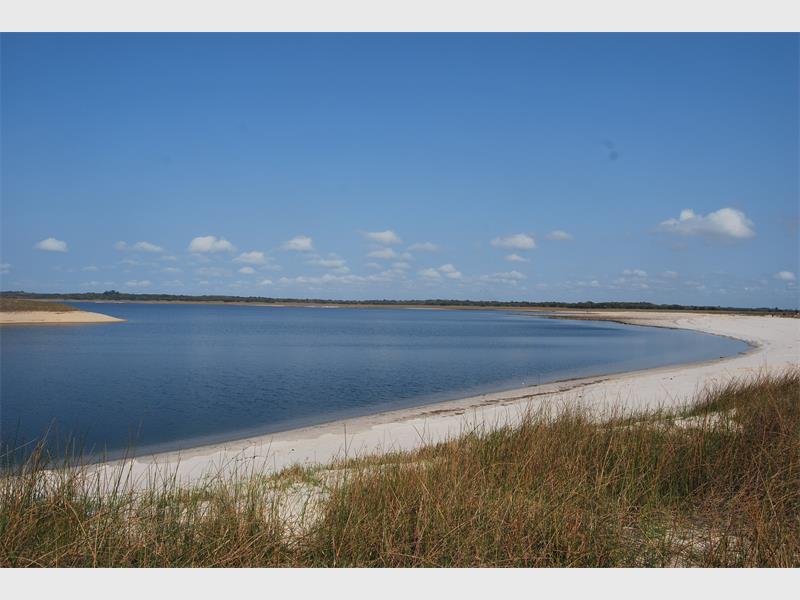
IT was a sunny windless morning and when we reached the picnic spot, crystal-clear Lake Sibaya lay before us like a big blue shiny sapphire, set out on a cushion of perfectly white sand.
We drove down to the lake, along a sandy white track across a sort of flood plain covered in hardy grasses, sedges and restios and we stopped to have our picnic breakfast at the edge of a little inlet. Across the way was a stand of dead-looking trees covered in white-breasted cormorants and their untidy nests. It was just such an exquisite spot, but it wasn’t the only exceptional natural beauty we had encountered that morning. The road – well a sandy 4X4 track – between Mabibi camp through the Coastal Forest Section of iSimangaliso Wetland Park to the busy little rural town of Mbazwana, is one of the most gorgeous drives that KwaZulu-Natal has to offer.

We had thoroughly enjoyed our two wonderful days under canvas at Mabibi but we were looking forward to seeing Lake Sibaya again. It was still early by the time we’d packed up our tent and said goodbye to the four-footed and winged residents with whom we’d shared our pretty campsite.
In Africa, things can get a bit confusing when you leave the beaten track to travel through our more rural areas. After backtracking to the turn-off to Mabibi and heading south we found ourselves negotiating a network of informal sandy tracks weaving their way past rustic homesteads. In Africa when faced with this sort of network dilemma, the trick is simply to keep on trucking. As usually happens, some of the bumpy, sandy tracks simply petered out and the ones that remained eventually coalesced into a single mainish sort of road. We thought we were on the right track and a friendly elderly woman was delighted to be able to assure us we were indeed travelling the great Mbazwana road.

We soon left behind the little populated section and found ourselves driving through untouched coastal forest. Most of the time the track ran along a sort of natural bridge, a narrow level section wedged between tall, vegetated dunes and the bushy Lake Sibaya shore. From time to time gaps in the trees afforded us tantalising views of Lake Sibaya but it was not until we reached the picnic spot that we were able to see it properly. The Maputaland coastline is a dynamic system that has seen some dramatic changes in its shape and form over the millennia and old dunes, left behind by the receding sea have formed the fresh water lakes that are one of its attractive features.

As well as the massive estuary known as Lake St Lucia, iSimangaliso Wetland Park boasts two extensive fresh water systems, Kosi Bay and Lake Sibaya. Kosi, on our most northern stretch of East Coast shore, comprises four linked lakes, like a bright string of beads. The final one is the estuary that opens the system to the sea.
Lake Sibaya is different in that the old dunes have permanently isolated it from the ocean. Because it is fed by small streams and fresh water seeping into it through the filtering sandy shores, the water remains sparkling clean. Formed about 7 000 years ago, it is South Africa’s largest fresh water lake and it really is a stunning body of water. It is also interesting from a biological point of view in that it is home to a number of endemic fish species, many water birds and large populations of hippos and crocs.

After our leisurely, lakeside breakfast stop we continued on our way. The forest seemed to grown more dense and the trees, even taller and it was like travelling through a cool, silent, green tunnel. We hadn’t seen a single vehicle after leaving the populated section at the start. Occasionally the scenery changed dramatically as we left the forest and drove through swampy coastal grassland areas, liberally decorated with stocky, water-loving umdoni trees.
Soon after leaving the coastal forest section of the wetland park we were reminded that we were moving out of a pristine piece of unspoilt nature and back into the real world. We had to stop and wait for a large herd of handsome Nguni cattle to pass.

They seemed to feel they cattle had right of way and we didn’t argue. We were not in a hurry. We stopped our vehicle and enjoyed watching the multi-coloured passing parade. From there it didn’t take us long to drive through a fairly populated rural area to the major junction of bustling Mbazwana then on to our next destination, magical uMkhuze Game Reserve.
DID YOU KNOW?
Click on the words highlighted in red to read more on this and related topics.
If you are reading this on your cellphone and there are telephone numbers provided in the text, you can call these simply by clicking on them.
To receive news links via BBM, add us using the pins 58F3D7A7 OR 58F25573. The South Coast Herald is also on Facebook, Twitter, WhatsApp and Instagram – why not join us there?