Tent Travels: This seaside town has a wild spirit
St Lucia is almost completely surrounded by wilderness.
BEWARE of hippos and crocs if you go out walking around the pleasant seaside town of St Lucia at night.
When you spend some time in this resort at the southern end of Lake St Lucia in KwaZulu-Natal, you soon discover that it has a really wild side.
We’d often passed through or stopped to shop at St Lucia en route to Cape Vidal or other wild places but we’d never actually stayed there. On our recent KZN camping trip we decided to remedy this. After a wonderful slow drive from Mkhuze to St Lucia via the gorgeous new Western Shores route, we drove to the Ezemvelo KZN Wildlife offices and booked into the popular Sugarloaf Camp.
On one level St Lucia is an attractive, affordable, family-friendly seaside town, boasting the excellent tourist infrastructure that makes it a great favourite with beach-loving families and the fishing fraternity. Sugarloaf was fairly empty when we were there but I can imagine it is a really bustling busy place during the holiday seasons.

St Lucia is, however, so much more than a seaside resort for it is here that Africa’s largest estuarine lake empties itself into the Indian Ocean. Measuring about 80km in length, Lake St Lucia is a vibrant, life-sustaining and dynamic system. It is home to more than 800 hippos and 1 200 crocodiles, a wide variety of fish species and a huge assortment of waders and water birds including flamingos and pelicans.
The lake had its origins some two million years ago when sea levels started to drop. Since then this ever-changing body of water has been played upon by rising and dropping sea levels, wind and river erosion and drought and other meteorological events like Cyclone Demoina. In 1984, Demoina caused massive damage and flooding and is still talked about today.
And, of course, man has influenced the lake, too, and not always to its advantage. Good news for the estuary is that many thirsty timber plantations in the area have been cut down and the cleared land is now being rehabilitated, thus rejuvenating this amazingly complex estuarine system.

The Beware of Hippo and Crocodile signs also remind visitors that the town of St Lucia is the gateway to a world-class eco-destination, the fabulous 332 000 ha iSimangaliso Wetland Park of which the lake is the focal point. Declared South Africa’s first World Heritage site because of its natural attributes in 1999, its name means marvel in Zulu. This is a fitting name, indeed, for a marvellous slice of conserved wilderness.
This extensive park stretches all the way from the southern end of the St Lucia Estuary northward to Mozambique. In the near future it will be part of an even greater conservation initiative, a peace or transfrontier park that will be shared between South Africa, Mozambique and Swaziland.
What makes iSimangeliso so fascinating is the fact that it is a mosaic of wonderful different habitats and eco-systems – the estuarine lake itself, its lush eastern and drier, fossil-rich western shores, 280km of pristine, dune-lined coastline and adjoining marine reserve and the vast Mkuze Swamps. Here can also be found inland lakes, rivers, grassy planes, mangroves, soggy wetlands, dune, coastal and riverine forests, savannah, thornveld and even mountains.

Its different components – described by park authorities as its ten jewels – include Lake St Lucia, Kosi Bay, the untrammelled Coastal Forest section, Lake Sibaya, Sodwana Bay, Mkhuze Game Reserve, False Bay, Charters Creek and the Western Shores, Cape Vidal and the Eastern Shores and Maphelane.
The wide variety of habitats within the park boundaries sustains a rich, diverse mix of fauna and flora. A number of mammal species have been reintroduced and the list now includes the big five, hippopotamus, cheetah, wild dog, many different antelope species and a host of smaller creatures.
Whales and dolphins complete the mammal line-up as the conserved area extends out to sea as a marine protected area, offering visitors contact with a pristine shoreline. One of the wonders of this particular habitat is the arrival of some 500 loggerhead and 150 leatherback turtles that come ashore to lay their eggs on the beaches within the park every year. Offshore, the coral reefs and diverse marine life make the coastal resorts magnets for anglers and divers.
Birders, too, have plenty to chirp about. As can be imagined, iSimangeliso’s environmental kaleidoscope makes it a twitcher’s heaven – and a paradise for flower people and anyone inclined to hug trees.
As befits a world Heritage Site there are plenty of excellent amenities for the thousands of visitors who seek out iSimangaliso Wetland Park every year. Although there are a number of comfortable rest camps in the various sections of the park, St Lucia, with its ample accommodation options and tourist amenities is a good choice as a base for anyone with limited time who wants to see the great iSimangeliso.
In fact, with the lovely wild feel to St Lucia’s extensive, comfortable and well-equipped Sugarloaf camping area I found myself thinking of the town as the iSimangeliso equivalent of Kruger National Park main Skukuza Rest Camp.

We were amazed by the wildlife in and around Sugarloaf. Although right next to a fairly substantial residential area, the camp was home to a wonderful assortment of little creatures, including cute but noisy bushbabies and a large and gregarious troop of banded mongoose that were highly entertaining to watch. The in-camp birding was amazing, too. Living in St Lucia would be like living in a game reserve.
We also found ourselves enjoying a bit of so-called civilisation after all the time we had spent camping in the KZN game reserves. After setting up camp we did some much-needed shopping then enjoyed a short but pleasant stroll along the boardwalk to the estuary beach, looking out for crocodiles and hippos as advised by many signs.
We rounded off another excellent day in KZN paradise with sundowners at the popular ski-boat club, within walking distance of the camping area. We did keep a wary look out for hippos when we walked back to camp.walk, though.
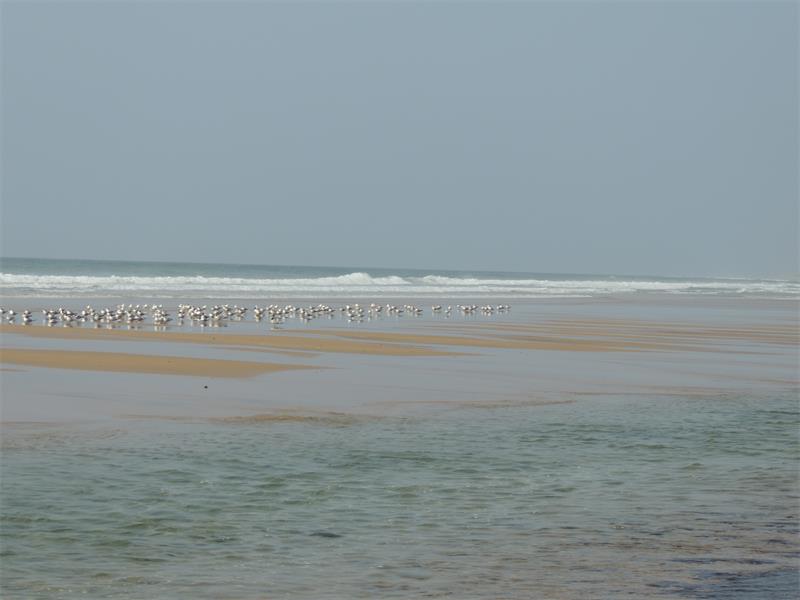
Up early the next morning, we set off for a lovely long beach walk to the estuary mouth, via the boardwalk. The birding was amazing and included a good assortment of herons and waders in the estuary and a huge flock of terns on the beach.
It was a long walk so we felt we deserved to treat ourselves to Sunday lunch with our fellow travellers, Fiona and Ian, at the incredibly busy ski-boat club. After weeks of camp cooking having some-one cook us lunch was one of those little luxuries that you really appreciate when you are on a road trip.

Bill and I then rounded off our visit to St Lucia with a leisurely drive around town. St Lucia really is such a pretty little village. Even with all its modern buildings and attractive residential areas it is understated and unpretentious and still feels like a bit like an old fashioned seaside village.
It is also such a green town and we got the impression that residents appreciated the privileged of living in a little enclave completely surrounded by a massive conserved wilderness.
As we left St Lucia the next morning, looking forward to driving iSimagenliso’s Eastern Shores road to Cape Vidal, we were mindful of what the late Nelson Mandela had to say about the wetland park:
“iSimangaliso must be the only place on the globe where the oldest land mammal, the rhinoceros, and the world’s biggest terrestrial mammal, the elephant, share an ecosystem with the world’s oldest fish, the coelacanth , and the world’s biggest marine mammal, the whale.”
DID YOU KNOW?
Click on the words highlighted in red to read more on this and related topics.
If you are reading this on your cellphone and there are telephone numbers provided in the text, you can call these simply by clicking on them.
To receive news links via BBM, add us using the pins 58F3D7A7 OR 58F25573. The South Coast Herald is also on Facebook, Twitter, WhatsApp and Instagram – why not join us there?