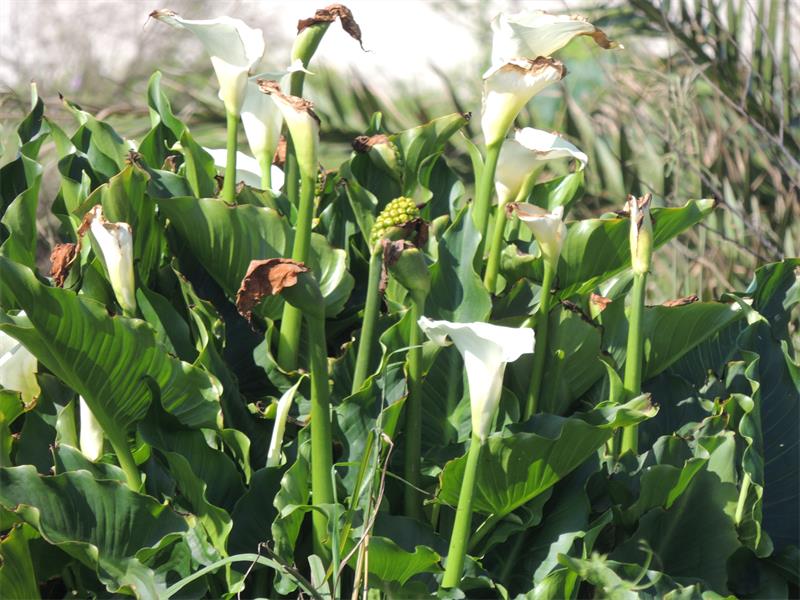
A WELL-established colony of one of South Africa’s most elegant flowering plants is providing a fine show in a swampy grassland near St Michaels beach.
This spectacular plant goes by the Latin name of Zantedeschia aethiopica but most people around the world would know it by its common name, the white arum lily – although these flowers are actually not lilies.
YOU MIGHT ALSO BE INTERESTED IN : Invasives and natives: Welcome these wild flowers
They aer members of the Araceae family and, like to rest of the family, including the Anthurium species, its large, showy ‘flowers’ are not really flowers. According to ‘Bring Nature Back into your Garden’ by Charles and Julia Botha, these are actually sheaths or sheathing bracts formed by modified leaves, enclosing a finger-like spine – the yellow column in the middle of the sheath, made up of hundreds of tiny flowers. In some of my other books the sheaths are referred to as spathes.
In her guide to the Wild flowers of KwaZulu-Natal, Elsa Pooley tells us that the Zantedeschia genus is endemic to South Africa and consists of eight species.
Zantedeschia aethiopica is the most commonly cultivated but another species, Zantedeschia albomaculata, the spotted-leafed arum, is also a popular garden subject.
These arum spathes are creamy white to pinkish and the leaves have small white spots. Zantedeschia valida is similar but without the spotted leaves and, like the other two species, grows in KwaZulu-Natal.
Less common and coming from the northern reaches of our province, is Zantedeschia rahmannii, an arum with pink to red or even deep maroon spathes.
Arum lilies were first cultivated in Europe in the 17th century and are now popular around in world as cut flowers or garden subject – well maybe not in Australia where they have escaped into the wild and become invasive aliens.
We too have a problem lily that has also been brought into South Africa and has now become invasive. The beautiful white flowers of the Lilium formosanum or Formosa lily are often seen decorating our verges. This plant hails from Asia from where it was brought into South Africa as an ornamental plant. Sadly, like our arums in Australia, this beautiful Asian flower has become a pest in our wild areas and is a declared invader.
It just goes to show – it pays to choose indigenous, wherever you are in the world. We are so lucky to have such a wonderful choice of plants in our country so we should appreciate and make more use of our proudly South African beauties, like our endemic arums.
HAVE YOUR SAY
Like our Facebook page, follow us on Twitter and Instagram
For news straight to your phone, add us on BBM 58F3D7A7 or WhatsApp 082 421 6033