IF I were compiling a list of southern Africa’s most beautiful places, the Kruger’s Punda Maria rest camp and surrounding areas would have to be very close to the top.
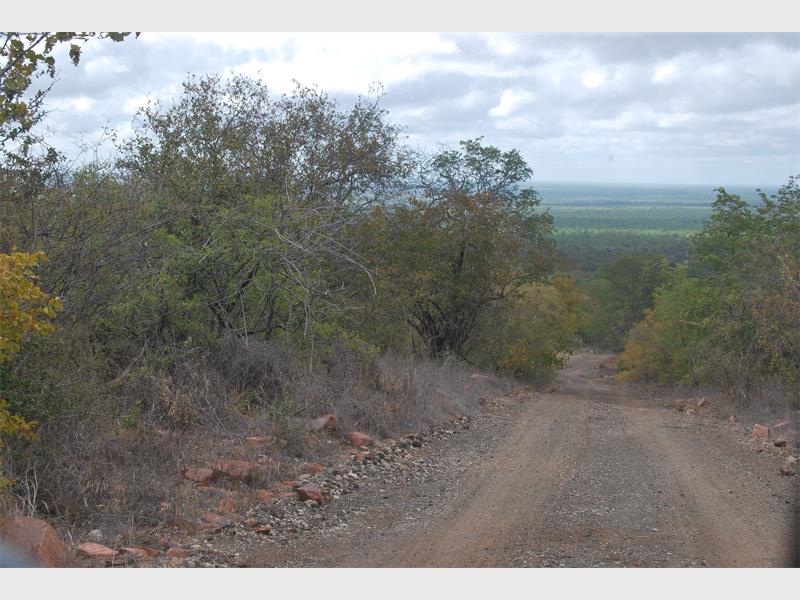
This, the most northerly corner of our premier national park, is a place of great rivers and fever tree forests; of multi-coloured mopanes, ancient baobabs, extensive flood plains, majestic riverine giants, rocky hills and green-fringed streams.
YOU MIGHT ALSO BE INTERESTED IN : Tent Travels: Big cats and buffaloes
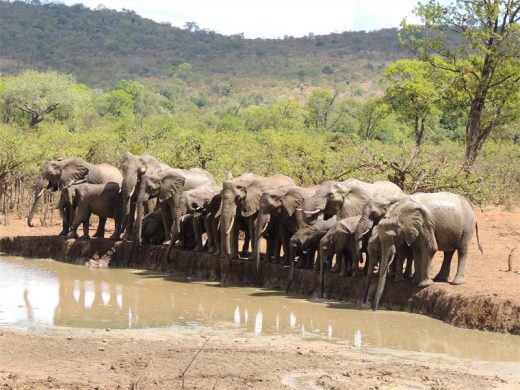
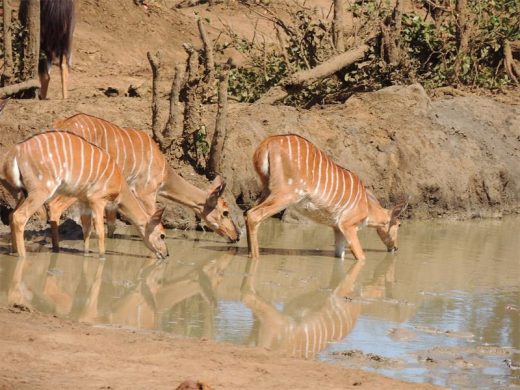
Boasting this floral diversity, it is not surprising that it is the beautiful home of a wide assortment of creatures great and small including the rare nyala and some massive herds of elephants and buffaloes.
Although it has a reputation of being a little short on game viewing opportunities, I believe this is unfair. We’ve enjoyed some great game viewing in the north and have even had fairly regular encounters with big cats there. If there is any lack of interesting game, however, the north more than makes up for it with its stunning physical attributes and its remote, untamed character.
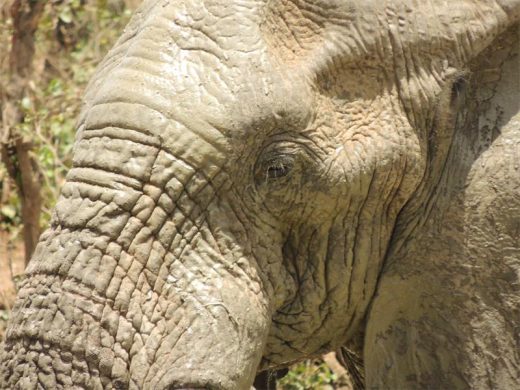
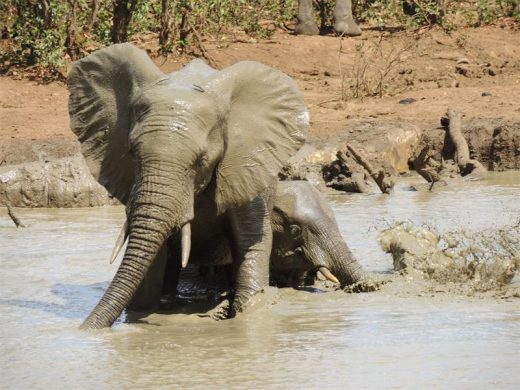
mud pack.
This hilly, well-watered corner of Kruger is also the perfect setting for Punda Maria which I consider the prettiest of all the lovely Kruger rest camps. It is one of he park’s oldest camps. According to South African author TV Bulpin, it started its life as a ranger post to counter ivory poaching in 1919 and was named by its first ranger, Captain ‘Ou Kat’ Coetser. Punda Maria derives from the Swahili name for zebra, ‘punda miliya’ or striped donkey, and it also honours the first ranger’s wife, Maria.
This tranquil camp offers thatched, whitewashed accommodation, adorned with deeply-shaded verandas supported by rustic wooden poles, that harks back to rest camps from yesterday.
These lovely old wattle and mud buildings help to give Punda Maria its unique character and its old fashioned charm.
The huts are set out on terraces overlooking an attractive, communal braai area, a natural-looking swimming pool and the shady, tree-filled bowl that is the camping area.
The rest camp’s most popular feature, though, is its roomy in-camp hide overlooking a well-used waterhole. Because of this, you don’t even need to leave the comforts of the camp to enjoy quality game viewing and birding. However, you would be unwise to spend all your time in the hide. There is so much to see around Punda Maria.
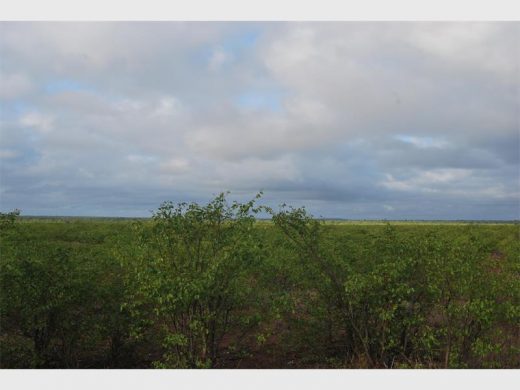
To reach Punda Maria from our previous camp, Shingwedzi, we travelled through sometimes vast expanses of mopane scrub and trees, interspersed with mixed woodland and lush riverine areas. Driving through kilometre after kilometre of mopane can seem a little monotonous but there is something rather thrilling about the wide open space as you travel across the great expanse of undulating mopane country you find in Kruger’s north.
YOU MIGHT ALSO BE INTERESTED IN : Tent Travels: Charmed by Letaba and the river of sand
Game-wise, the drive was a little quiet but we just missed seeing a cheetah and her cubs at the Lamont waterhole outside Shingwedzi and we encountered another group of five ground hornbills. I wonder if we are just lucky regarding seeing these adorable birds or if the population is growing. On our two most recent Kruger trips we’ve encountered so many of them. As expected, we did spot quite a few elephants making their way through the mopane trees.
Before booking into Punda Maria, we did a quick detour to drive the short but scenic Dzundzwini Loop, stopping at the lookout point to admire the surrounding scenery. This loop is one of quite a few short drives close to the camp that are great for a quick evening excursion to round off a busy day.
As we approached the camp gates we met two vehicles reversing rather rapidly away from a lone buffalo who’d decided to set up a road block there. We waited patiently for Mr Buff to get bored with this game then drove into Punda Maria.
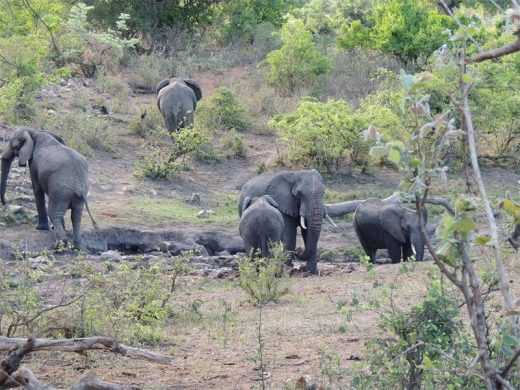
It is normally less busy than many of the southern camps but this time we were amazed to find it almost empty. Only five other campsites were taken. We were thrilled to be able to set up camp right next to the fence, overlooking the waterhole –and wow, was there plenty of action there! Wave after wave of buffalo, nyala, impala, all sorts of interesting birds, zebra, kudu and massive breeding herds of elephant arrived to quench their thirst, keeping us royally entertained all afternoon.
As the shadows grew longer we set out to do one of our very favourite Kruger drives – along the S99, a well-watered, scenic mountain route, crisscrossed with streams and little water courses and known as Mahoney’s Loop.
The gravel road wends its way through exquisite mixed woodland and tall mopane trees, past rugged hills, cliffs and rocky outcrops.
It takes about two hours to do this lovely route and almost always offers sightings of elephant and various antelope. Mostly though, we enjoy it for its stunning scenery and lush vegetation.
We finished off our first Punda day with a spell in the hide, watching a giant eagle owl hunt for its supper at the flood-lit water hole, then it was early to bed as we had a big day ahead of us. We would be spending it in the incredible Pafuri area, the most spectacular part of our wonderful Kruger National Park.
HAVE YOUR SAY
Like our Facebook page, follow us on Twitter and Instagram
For news straight to your phone, add us on WhatsApp 082 421 6033