
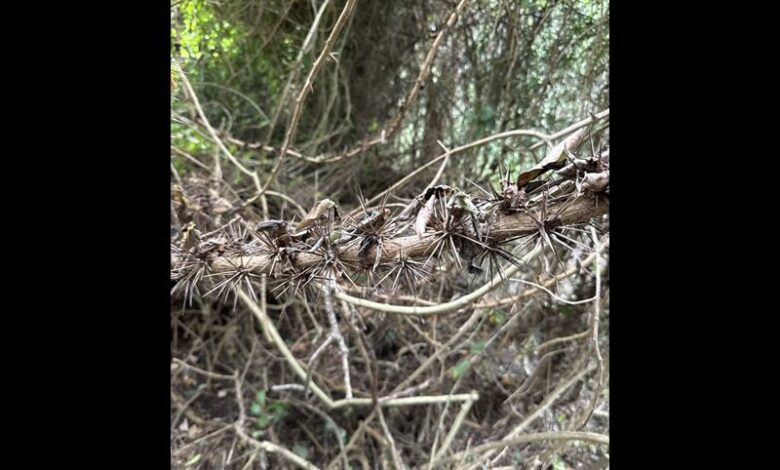
The invasive Barbados gooseberry (pereskia aculeata) is once again highlighting the enormous challenge facing volunteers in the Bendigo Nature Reserve near Southport, where years of efforts have failed to bring the destructive plant under control.
The Bendigo Conservancy has been aware of the problem since at least 2011, when botanist Geoff Nichols described the species as ‘the most pernicious of the invasive plants’.
“It will take at least five growing seasons to bring under control. It may never be eradicated depending on how successful the band of volunteers is in their efforts,” he warned.
Pereskia is a small genus of cacti that resembles a sprawling shrub, with shiny evergreen leaves that intertwine with indigenous vegetation and can grow up to 5m high.
The invasive plant smothers the vegetation on which it grows, and its sheer weight can cause even large indigenous trees to collapse.
It is commonly known as Barbados gooseberry, Barbados stekelbessie, blade apple, leafy cactus, lemon vine, pereskia creeper, primitive cactus, Spanish gooseberry and ufenisi.
Hope of controlling the invasion emerged in 2010 when Rhodes University lead researcher Dr Iain Paterson, from the Department of Zoology and Entomology, announced that sufficient numbers of the pereskia stem-wilter (catorhintha schaffneri) had been reared for release.
About 300 of the insects were introduced at selected sites from Port St Johns to Kosi Bay, including the Bendigo Nature Reserve.
The biological control programme appeared promising because the pereskia stem-wilter feeds exclusively on pereskia aculeata. Unable to survive on any other plant species, it poses no threat to indigenous vegetation or agricultural crops.
Unfortunately, the programme has not been successful at Bendigo. The insects require exposure to sunlight to thrive, but the dense forest canopy prevents them from establishing viable populations.
As a result, the invasion has continued largely unnoticed because most of the plants were growing away from the reserve’s walking trails.
An eight-member volunteer team has now begun the painstaking task of removing the plants using chainsaws and other cutting equipment. The cut material is left to dry before being burned on site, as even the smallest fragments can take root and produce new plants if left on the ground.
For the past several Wednesdays, conservancy volunteers have been carrying out controlled burns to destroy the dried material.
The work is labour-intensive, costly and time-consuming. Volunteer Mbekezile Ngcobo estimates that only about 25% of the infestation has been cleared.
Adding to the challenge, the plant’s seeds are spread by birds, and further infestations have already been identified in the Sea Park and Southport areas.
Residents are urged not to handle the plant without protective gloves because of its long, sharp thorns.
HAVE YOUR SAY
Like the South Coast Herald’s Facebook page, follow us on Twitter and Instagram



